
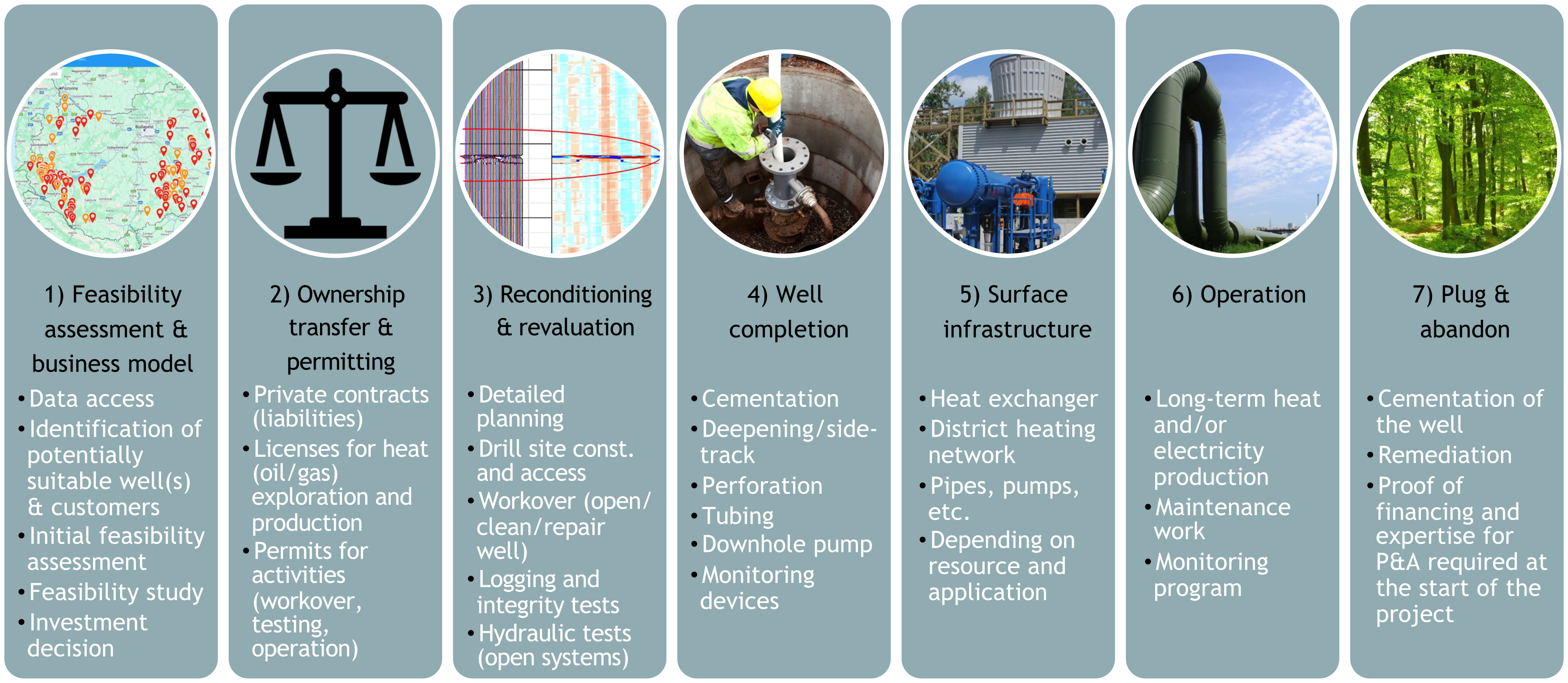
TRANSGEO (2023–2026), funded by the Interreg CENTRAL EUROPE Programme, investigated whether abandoned oil and gas wells can be repurposed for geothermal energy production and energy storage. The project covered major hydrocarbon basins in Germany, Austria, Hungary, Croatia, and Slovenia, where thousands of existing wells and extensive geological data offer opportunities to reduce the costs and risks of geothermal development.
Rather than promoting a single technology, TRANSGEO developed a comprehensive assessment framework to evaluate different geothermal reuse options—including Borehole Heat Exchangers (BHE), Borehole Thermal Energy Storage (BTES), Hydrothermal Energy (HE), Aquifer Thermal Energy Storage (ATES), and Enhanced Geothermal Systems (EGS). The project combined geological, technical, economic, regulatory, and socio-economic analyses to determine the most suitable reuse option for each site.
Key project results include a transnational well database, a web-based Well Assessment Tool, pilot feasibility studies across five countries, and a Transnational Strategy and Action Plan that provide practical guidance for integrating geothermal reuse into future regional energy planning.
Who can use the Well Assessment Tool?
The Well Assessment Tool is intended for organisations involved in geothermal planning and the management of existing hydrocarbon infrastructure, including:
- geological surveys;
- public authorities and regional energy agencies;
- oil and gas companies managing abandoned or inactive wells;
- geothermal developers and engineering consultants;
- researchers and universities;
- investors and project developers.
The tool provides a first-stage screening of existing wells by evaluating geological conditions, well characteristics, infrastructure availability, and potential geothermal applications. It helps users identify promising wells and determine which reuse concepts may be technically suitable before investing in detailed engineering studies.
How do the feasibility studies support geothermal development?
The pilot feasibility studies (Ampfing, Lausitz, Gross Schoenebeck, Mihovljan, Savica, Pomurje, Hungarian Great Plain, Weinviertel) demonstrate how the assessment methodology can be applied under real geological and operational conditions.
They support geothermal development by:
- validating the assessment methodology through practical case studies;
- evaluating the technical and economic feasibility of different geothermal reuse concepts;
- identifying geological, engineering, and regulatory challenges;
- providing examples that reduce uncertainty for future projects;
- generating knowledge that improves confidence among investors, authorities, and developers.
These studies serve as practical references that can be adapted for similar wells and regions across Central Europe.
How does the Transnational Strategy support geothermal development?
The Transnational Strategy and Action Plan translate the project’s technical findings into practical recommendations for policymakers, regional authorities, and industry.
They support geothermal development by:
- providing a common framework for evaluating abandoned wells;
- recommending approaches for integrating geothermal reuse into regional energy planning;
- identifying legal and administrative barriers and opportunities for harmonisation;
- supporting informed investment and policy decisions;
- encouraging cross-border cooperation and knowledge exchange;
- promoting the reuse of existing infrastructure as a cost-effective pathway towards renewable heating and energy storage.
Together, the Strategy helps regions move from individual feasibility assessments towards wider implementation of geothermal reuse projects.
Overall impact
TRANSGEO demonstrates that abandoned hydrocarbon wells can become valuable assets for the energy transition. By combining the Well Assessment Tool, pilot feasibility studies, and the Transnational Strategy, the project provides a complete decision-support framework that enables stakeholders to identify suitable wells, evaluate their technical and economic potential, and plan future geothermal projects with greater confidence while reducing development risks and costs.