
Project overview
Circular Frozen-Food Value Chains for Reducing Cross-Border Barriers in Central Europe
Before reaching consumers, frozen and chilled food often crosses borders with different packaging rules, paperwork and hygiene procedures that create extra costs and waste. COOL-BORDER adapts tools from earlier Interreg projects into one support programme for SMEs. The support programme tested in six countries will help companies choose reusable or lower-waste packaging, align documentation practices, optimize cold-chain processes and logistics, and develop circular business models. Six cross-border hubs will bring companies and support organisations together to identify barriers and develop shared solutions. The project will help food businesses reduce waste, use resources more efficiently and cooperate more smoothly across central Europe.
-
1,19m €
-
Project Budget
-
80%
-
of the Budget is funded by ERDF
-
6
-
Countries
-
7
-
Regions
-
7
-
Partners
-
1
-
Pilots
Duration
Start date
End date
Project progress
Project partnership
Project partners

Lead partner
South-Transdanubian Regional Innovation Agency
Project partner
Packaging Research Group COBRO / Circular Economy Centre
Center for Education, European and Institutional Cooperation
Business & Tourism
Roadmap
Cold chains, warm borders
Frozen and chilled food often crosses several borders before it reaches our plates. Every crossing brings different packaging rules, documentation, hygiene records and temperature logs. For small and medium-sized food businesses this means extra paperwork, higher costs and delays. It also makes reusable packaging and other circular solutions hard to introduce, because what works on one side of the border may not be recognised on the other.
Circularity as a bridge
COOL-BORDER uses circular economy solutions to make cross-border food flows smoother. When businesses, support organisations and authorities on both sides of a border work together on reusable packaging, efficient cold chains and less food waste, they also align their procedures. Shared circular solutions become a practical way to reduce the effects of borders.
Six hubs, one goal
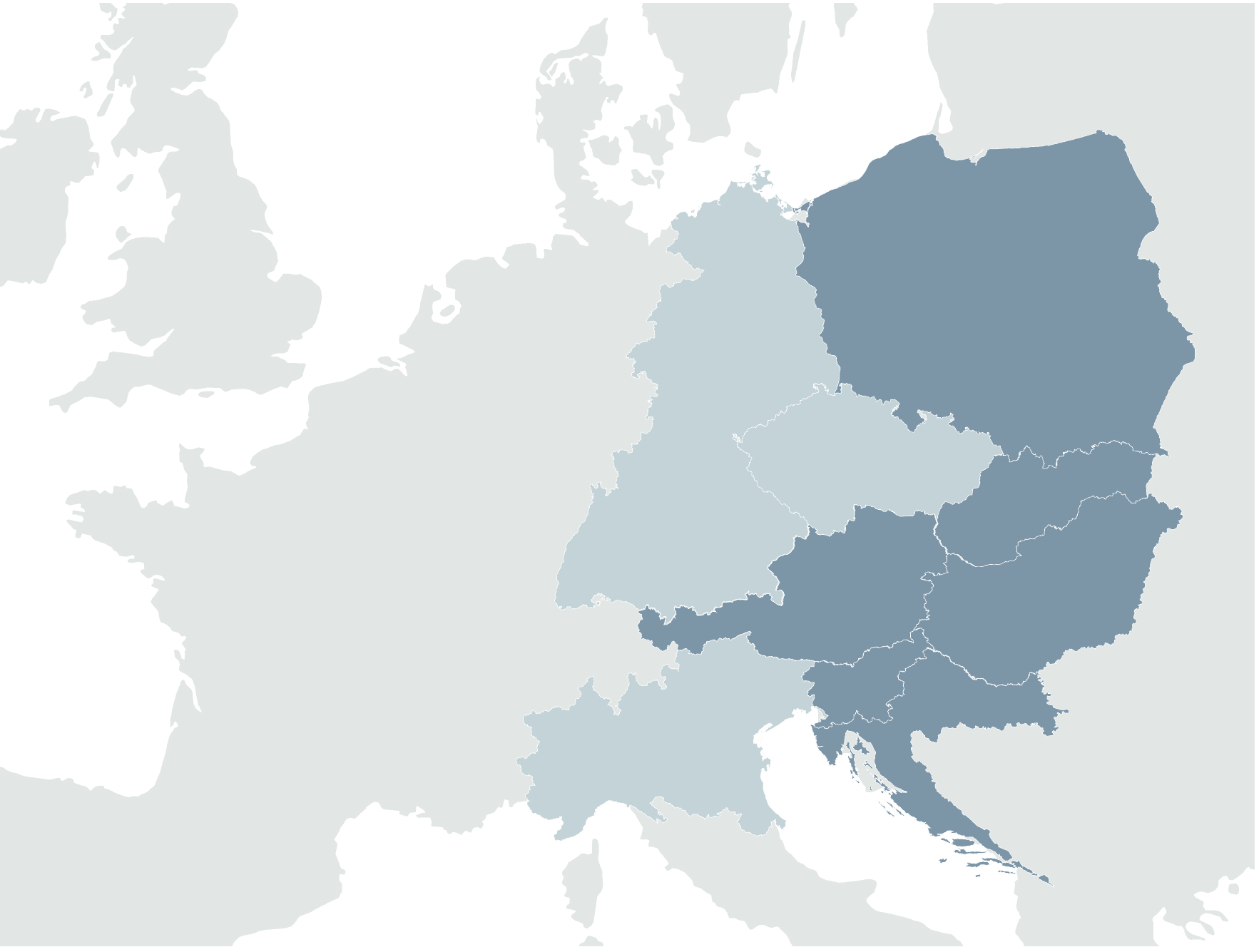
We set up six bilateral cross-border hubs: Hungary–Slovakia, Hungary–Slovenia, Hungary–Croatia, Slovakia–Poland, Slovenia–Croatia and Austria–Slovakia. They bring together food businesses, clusters, logistics and packaging providers, NGOs, training bodies and public authorities. Together they map where cross-border processes create unnecessary burdens and co-create shared templates, training and practical improvements.
Building on what works
We do not start from scratch. COOL-BORDER adapts proven tools from earlier Interreg projects to frozen and chilled food: the CIREVALC circular business accelerator model, the D4Pack packaging guidance tool, the FoodCycle.ai platform for food waste revalorisation, a cross-border training approach from TESTEAT and the cross-border monitoring and co-creation methods from BEE-DIVERSITY.
Combined, they form the COOL-BORDER Transnational Accelerator: support services on circular packaging, business models, technology, logistics, cold-chain optimisation and cross-border documentation. In 2027, partners test it with real businesses in each partner country and improve it based on the results.
Fewer barriers, less waste
By the end of the project in 2028, the refined COOL-BORDER Transnational Accelerator will be ready for use by business support organisations and clusters across Central Europe. We expect less administrative friction for food businesses, more reusable and circular packaging, more efficient cold-chain logistics and less food waste. The hubs and proposals for aligned documentation will keep neighbouring regions working together beyond the project.
News

Pilot actions
Outputs
COOL-BORDER Transnational Accelerator
Project documents
COOL-BORDER Project poster
COOL-BORDER Project Factsheet
COOL-BORDER Project Roll-Ups
Project images
COOL-BORDER
Priority 2: Cooperating for a greener central Europe
SO 2.3: Taking circular economy forward in central Europe
The project lead partner is solely responsible for all content published on this project website, including, where applicable, content created with the support of AI tools and the appropriate labelling of such content. The views expressed do not necessarily reflect those of the Interreg CENTRAL EUROPE Programme, its programme bodies or the European Union.