Hand with hydrogen nozzle
Scharfsinn86

HyEfRe

Project overview

Hydrogen integration for efficient renewable energy systems

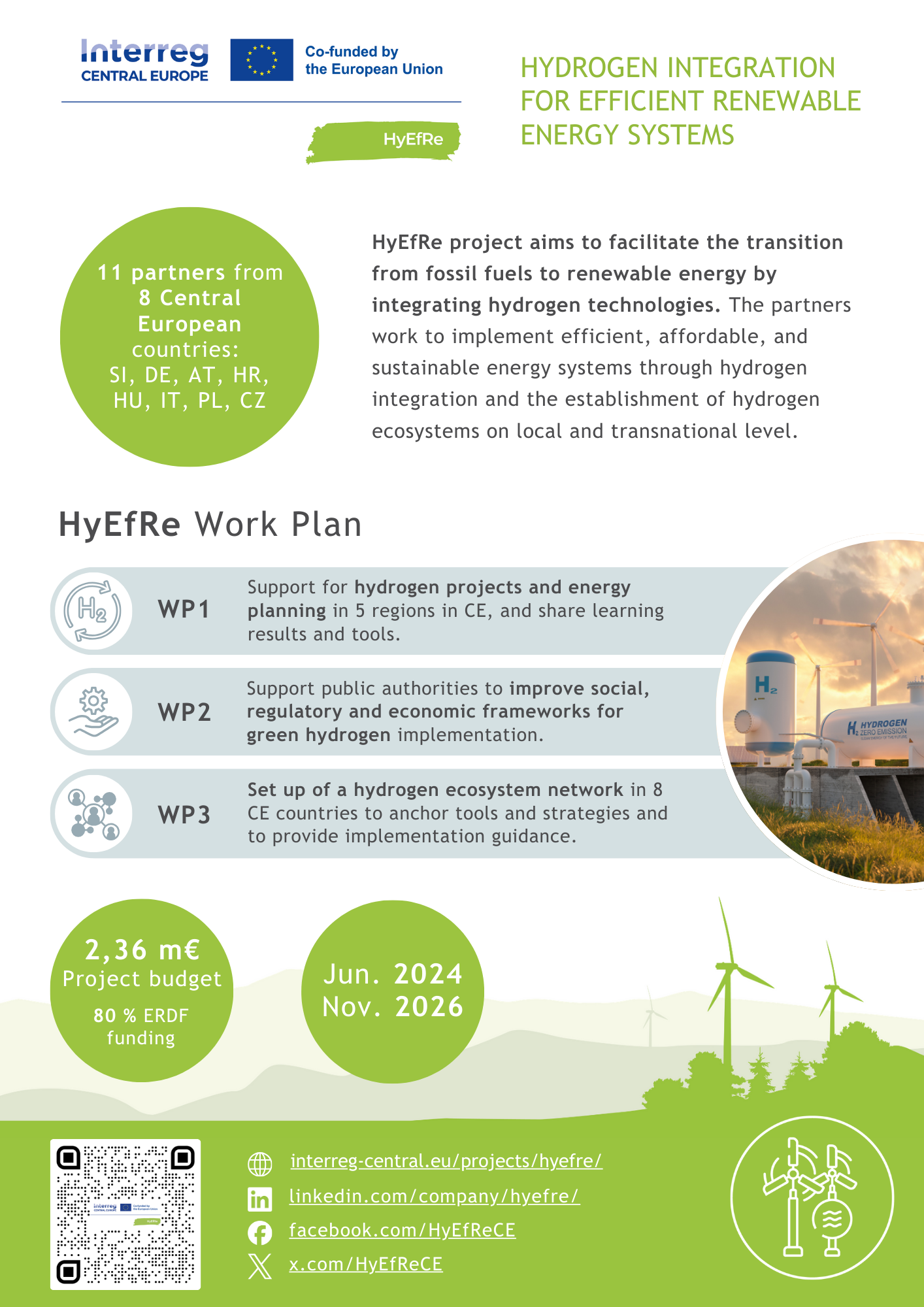
Sector-coupling is a promising approach to replace fossil fuels with renewables. However, this idea of “electrifying” the entire economy requires the rollout of new technologies and rules. The HyEfRe project helps with this by establishing green hydrogen ecosystems in eight regions. The partners foster an investment-friendly environment for renewable energy and green hydrogen technologies. They evaluate hydrogen potentials with a new model and develop and test a new tool to calculate ideal parameters for technical plants. Their action plan for policy actors will reduce regulatory barriers impeding a timely expansion of renewables and green hydrogen.

2,36m €

Project Budget

80%

of the Budget is funded by ERDF

Layer 1

8

Countries

8

Regions

11

Partners

3

Pilots

Duration

Start date

End date

Project progress

79%

About the project

HyEfRe will counteract challenges related to low integration and balancing of fluctuating renewable energy sources (wind and photovoltaic), suboptimal energy efficiency and lack of carbon-neutrality in CE energy systems, resulting in high energy prices and climate change. The project will lead to the establishment of hydrogen ecosystems in the participating regions, supporting uptake of solutions and strategies, considering all stakeholders. Our consortium consists of research institutes, energy/regional development agencies and SMEs experienced in renewable energy and hydrogen integration, modelling, optimization & IT, legal/economic assessment and stakeholder engagement. HyEfRe will advance the timely energy transition towards carbon-neutrality and result in decentralized new jobs, increasing prosperity and ensuring Europe's leading role in the renewable energy sector.

Project partnership

Project partners

Deutschland (DE)

Lead partner

Landshut University of Applied Sciences

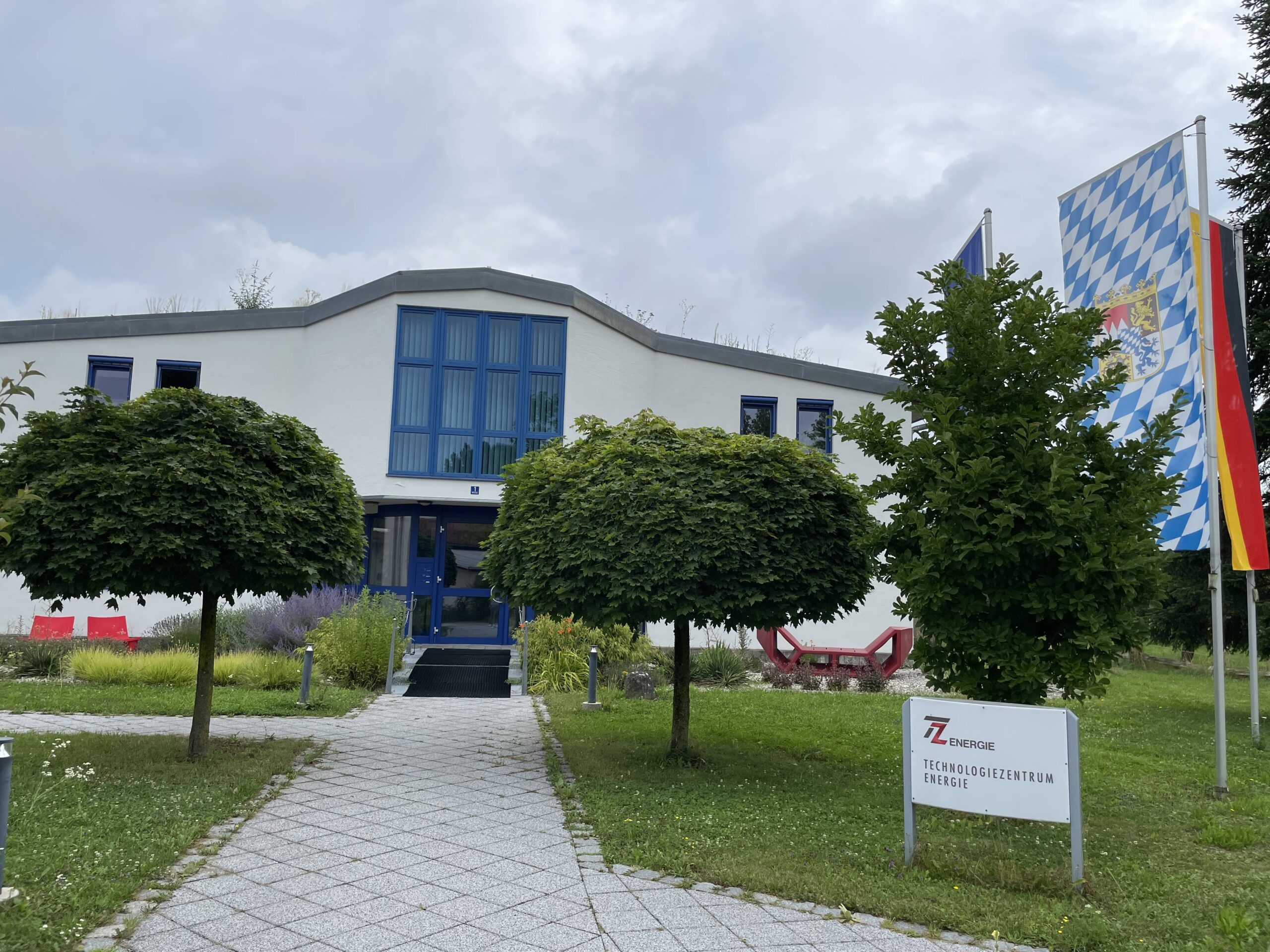
Technology Centre for Energy
Address
Wiesenweg 1
94099 Ruhstorf an der Rott
Country
Germany (DE)
Web
www.tz-energie.de

Project partner

Address
Nowogrodzka 31/300
00-511 Warsaw
Country
Poland (PL)
Web
www.mae.com.pl
Total partner budget
182,000 €
Address
B. Němcové 49/3
37001 České Budějovice
Country
Czechia (CZ)
Web
www.rera.cz
Total partner budget
193,200 €
Address
Altenbergerstr. 69
4040 Linz
Country
Austria (AT)
Web
www.energieinstitut-linz.at
Total partner budget
175,000 €
Department of Control and Computer Engineering
Address
Unska 3
10000 Zagreb
Country
Croatia (HR)
Web
https://www.fer.unizg.hr
Total partner budget
242,060 €
Department for Renewable Energy Sources, Climate and Environmental Protection
Address
Savska cesta 163
10000 Zagreb
Country
Croatia (HR)
Web
http://www.eihp.hr/?lang=en
Total partner budget
242,200 €
Address
Am Mitterfeld 20
84028 Landshut
Country
Germany (DE)
Web
www.hyfuture.de
Total partner budget
211,120 €
Address
Koroška cesta 37a
3320 Velenje
Country
Slovenia (SI)
Web
www.kssena.si
Total partner budget
185,815 €
Address
Mária u. 3
7621 Pécs
Country
Hungary (HU)
Web
https://ddriu.hu/en/home/
Total partner budget
201,921 €
Institute for Applied Informatics
Address
Grafenauer Str. 22
94078 Freyung
Country
Germany (DE)
Web
www.th-deg.de
Total partner budget
240,800 €
Address
Viale dell'Industria 21
35129 Padova
Country
Italy (IT)
Web
https://www.resolve-consulenza.it/servizi/future/
Total partner budget
127,746 €

Roadmap

1

Challenges

Central European regions are facing increasing pressure to decarbonise their energy systems while ensuring energy security, grid stability, and affordable energy supply. Although renewable energy production is growing rapidly, its integration into existing energy systems remains a major challenge due to fluctuating generation patterns, insufficient storage capacities, and limited sector coupling solutions. At the same time, green hydrogen is emerging as a key technology for balancing renewable energy systems, reducing greenhouse gas emissions, and supporting the transition toward climate-neutral economies. However, many regions still face significant technical, economic, regulatory, and social barriers that slow down the deployment of hydrogen solutions. The lack of coordinated planning approaches, investment-ready tools, and stakeholder cooperation further limits the integration of hydrogen into regional energy systems across Central Europe.

2

Ideas

HyEfRe will bring together tecnical, policy and social solutions to create more investment-friendly environment for renewable energy and green hydrogen solutions into regional energy systems. The project will use cross-border cooperation to help municipalities, regions, energy planners and SMEs turn local renewable energy potential into practical hydrogen projects. By connecting regional needs with innovative planning tools and real-life pilot actions, HyEfRe will help regions better understand how hydrogen can contribute to more flexible, resilient, and climate-neutral energy systems.

3

Solutions

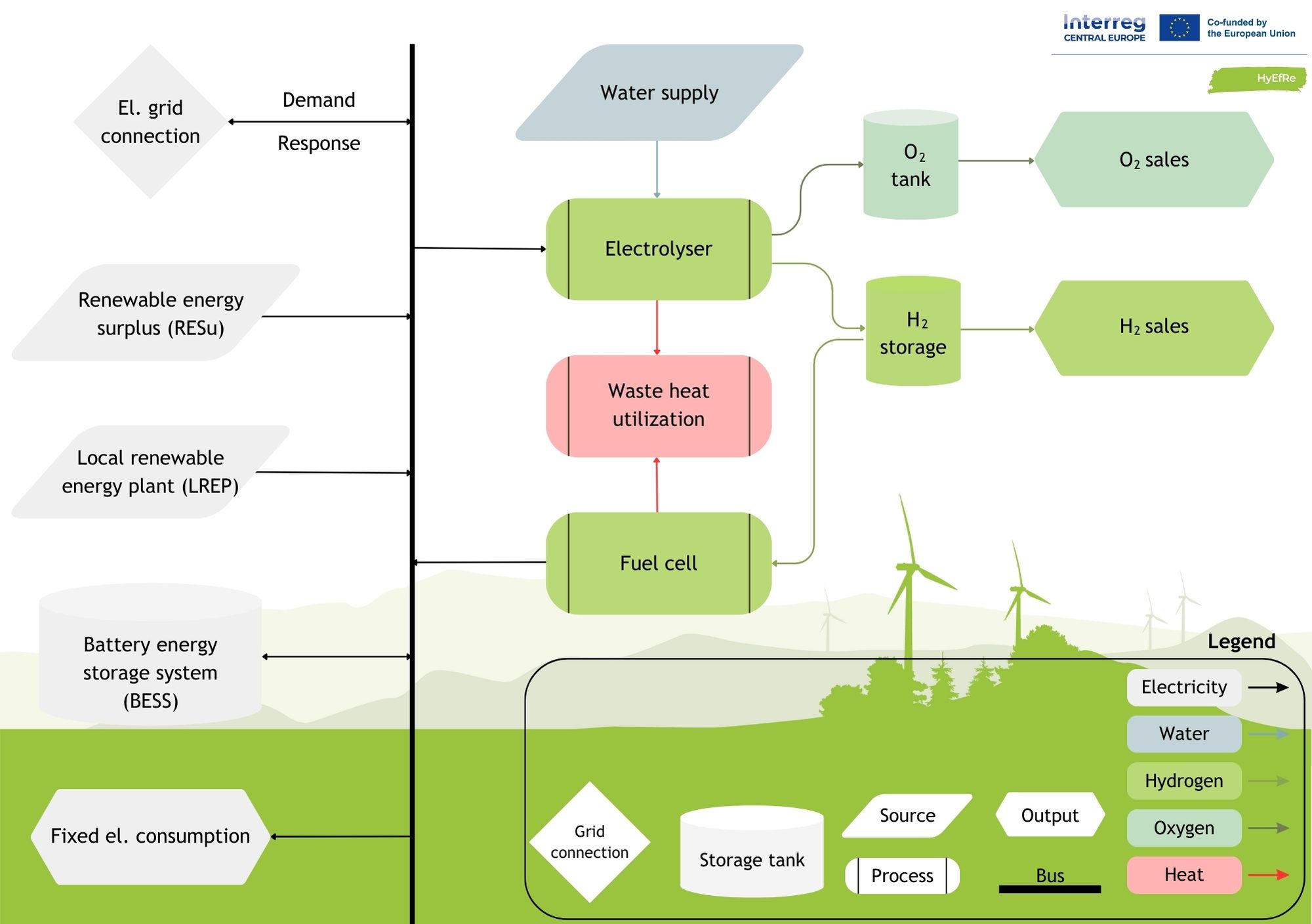
HyEfRe will develop practical tools and strategies that support the integration of renewable energy and green hydrogen into regional energy systems. The project is developing Hydrogen Potential Model that will use real energy data and simulation software to assess hydrogen production capacities and consumption needs within regional energy cells. Complementary to this, the Decision Support Tool (DST) will help municipalities, energy planners, and investors design and optimise hydrogen hubs and related energy infrastructure. In parallel, HyEfRe will prepare policy recommendations and action plans aimed at reducing regulatory and legal barriers that currently slow down the expansion of renewable energy and hydrogen solutions, while also improving the economic framework conditions for future investments. Recognising that the energy transition also depends on public understanding and acceptance, the project will additionally develop stakeholder engagement and social acceptance strategies tailored to regional and national contexts.

4

Follow our journey

Discover more about our initiatives and updates by visiting our webpage and social networks regularly.

News

Events
Pilot actions

Outputs

Hand design the identity branding business trademark

Action plan for framework improvements in the hydrogen economy

The Action Plan provides CONCRETE POLICY AND REGULATORY RECOMMENDATIONS to improve the investment framework for green hydrogen and waste heat utilisation across Central Europe. Developed in co-creation with policy stakeholders and based on national analyses, it proposes concrete actions with timelines, responsible actors and expected impacts, tailored to both national and transnational governance levels. Public authorities and business support organisations can use the Action Plan as a roadmap to remove barriers and improve policy and economic frameworks for sustainable energy systems supported by green hydrogen.
Type of output: Strategies and action plans
Strategy technique tactic word concept

Strategy for social acceptance increase for hydrogen applications

The Strategy for social acceptance increase analyses PUBLIC PERCEPTIONS OF HYDROGEN TECHNOLOGIES in participating countries and identifies key factors that shape acceptance across different social groups and genders. Building on stakeholder analysis, expert input and communication research, it proposes targeted awareness raising and engagement approaches tailored to local contexts and population segments. Policy makers, project developers and civil society organisations can use the strategy to design more inclusive communication and participation processes, building trust around hydrogen projects in their territories.
Type of output: Strategies and action plans

Strategy for establishing hydrogen ecosystems

The Strategy for establishing hydrogen ecosystems provides actions to be taken for TRANSFORMATION OF THE REGIONS INTO HYDROGEN ECOSYSTEMS. It applies a systems thinking model to show how technological, economic, policy and social dimensions interact in regional hydrogen value chains. Based on stakeholder analysis, expert interviews and pilot experiences, it provides step by step guidance for municipalities, regions and sectoral agencies on how to set up and govern local hydrogen ecosystems and connect them into a transnational network. Stakeholders benefit from a practical roadmap that clarifies roles, cooperation formats and governance models, helping them coordinate investments, align policies and build durable hydrogen ecosystems across Central Europe.
Type of output: Strategies and action plans
In development

Hydrogen Potential Model

The Hydrogen Potential Model is a data based planning tool that ESTIMATES REGIONAL GREEN HYDROGEN PRODUCTION POTENTIAL based on real data, producing maps and indicators that show where hydrogen production and renewable expansion are most promising. Energy planners and local public authorities can use it as a pre feasibility and screening instrument, helping them justify investments, prioritise project locations and prepare inputs for more detailed design with the Decision Support Tool.
Type of output: Solutions
In development

Decision Support Tool

The Decision Support Tool PROVIDES CONCRETE RECOMMENDATIONS FOR THE DESIGN AND OPERATION OF HYDROGEN HUBS. Using inputs from the Hydrogen Potential Model, it proposes optimal sizing, technology options, operating schedules and CAPEX/OPEX estimates for hydrogen projects, including options for waste heat utilisation and grid flexibility. Municipalities, regions, development agencies and planners benefit from a practical, user orienteddigital tool that turns complex technical and economic analyses into practical project concepts, reducing planning risks and accelerating implementation of viable hydrogen investments.
Type of output: Solutions
In development
Dementia and parkinson's disease, ADHD, composition for head disease theme

Systems thinking model for hydrogen ecosystems and ecosystem network

The systems thinking model for hydrogen ecosystems SUPPORTS REGIONS IN ESTABLISHING HYDROGEN ECOSYSTEMS. It maps the key stakeholders in local hydrogen value chains, their roles, interactions, benefits and concerns, and how these shape the development of regional hydrogen ecosystems and a transnational network. It is built using socio‑technical methods and integrates insights from best practices, framework assessments, stakeholder analysis and expert interviews across all partner regions. Stakeholders can use the model to understand where they fit in the hydrogen system, which partnerships are crucial, and how to address doubts or leverage synergies when planning or expanding hydrogen ecosystems.
Type of output: Solutions
In development

HyEfRe

The project lead partner is responsible for the content of this project website.

Project on social media

Project Contacts

Project Manager

Sebastian Arjona
Phone: +49 853191404426

Finance Manager

Astrid Heindel
Phone: +49 8531 914 044-68

Communication Manager

Živa Vovk
Phone: +386 5 909 9181