
With the start of the 2026 summer season, high-frequency water quality monitoring at the Vienna Danube Canal is now online and publicly accessible.
The use of urban water bodies for swimming and cooling is becoming increasingly popular internationally. As part of the UrbanBlueHealth – Joint Central European Actions for Improving Quality of Urban Bathing Waters (CE200763) project, partners from Croatia, Poland, Czechia, Hungary and Austria are working together to evaluate innovative methods for water quality monitoring and the potential use of early-warning systems.
As part of the Austrian contribution to the project, the Vienna Danube Canal serves as a case study for applying both standard methods for assessing water quality and high-frequency measurements of enzyme activity, which can specifically indicate faecal contamination.
The online monitoring provides current measurements of β-D-Glucuronidase activity, an indicator of faecal contamination and microbiological water quality. By providing measurements at a higher frequency, this approach can offer more detailed insights into changes in water quality over time and contribute to a better understanding of conditions in urban bathing waters.
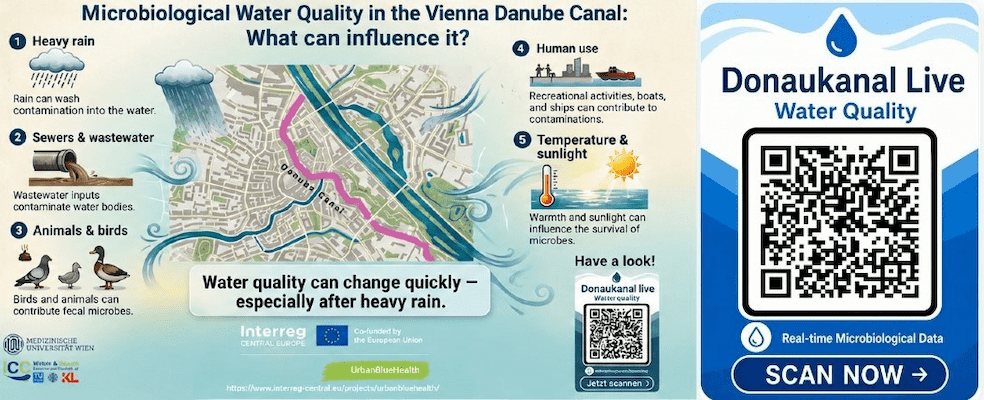
To make information about water quality easier to understand and access, the UrbanBlueHealth team has developed an infographic explaining the main factors that can influence water quality in the Vienna Danube Canal.
A QR code included in the infographic provides direct access to the online monitoring platform, allowing members of the public to explore the latest available measurements.
The latest high-frequency measurements from the Vienna Danube Canal are publicly available online:
Vienna Danube Canal – Live Water Quality Monitoring
By making current water quality information publicly accessible, the initiative aims to raise awareness of the factors influencing urban bathing waters and encourage a better understanding of water quality among the general public.
The activity contributes to the wider objectives of UrbanBlueHealth by supporting innovative approaches to water quality monitoring and helping to make urban bathing waters safer, more transparent and better understood.