
In this context, the Renewable Energy Community (REC) can serve as a practical tool to address one of the key needs expressed by the local economy and stakeholders: to reduce energy management costs and promote access to more stable, sustainable and collaborative solutions.
The initiative stems from the European HERCULES-CE project, funded by the Interreg Central Europe programme, of which ECIPA is a partner. Alongside ECIPA, CNA Veneto and the Veneto Region are also participating as associate partners, strengthening the link between the European project and the Veneto regional system.
Why a REC in Marghera
The Marghera Renewable Energy Community was conceived with the aim of supporting the region’s energy transition and generating environmental, economic and social benefits for businesses and the local community.
The area in question is an industrial hub home to craftspeople, SMEs and businesses that have had to contend with rising energy costs in recent years. In this context, the REC can offer a practical solution: a model based on the local production of renewable energy, self-consumption and the sharing of energy amongst participants.
This is not merely an energy project, but a collaborative initiative involving various stakeholders. The Marghera REC is designed as a local model capable of combining environmental sustainability, economic benefits and social value, whilst promoting greater awareness of the benefits of renewable energy.
The steps already taken
The process of establishing the Renewable Energy Community (REC) began with the direct involvement of organisations based in the area where ECIPA and CNA Veneto have their headquarters. The core of the future REC will, in fact, be based on a photovoltaic system installed on the roofs of the buildings in Via della Pila and connected to the electricity grid, in accordance with the model set out in Italian legislation for Renewable Energy Communities
In recent months, preliminary meetings have been held with companies located in the Via della Pila complex in Marghera, with the aim of presenting the opportunities offered by a Renewable Energy Community. During these meetings, the basic requirements for launching the REC, the potential costs, the economic and environmental benefits, and the participation model were outlined.
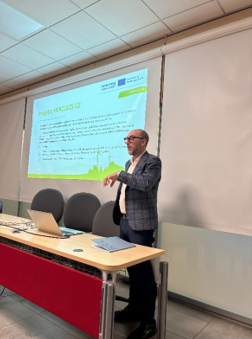
An initial structured discussion took place at the event ‘Towards the Marghera Energy Community’, organised on 26 March 2026 at CNA Veneto, at Via della Pila 3b in Marghera. The meeting represented an important step in presenting the initiative, explaining how RECs operate and gauging the interest of potential participants.
A community designed to grow
The Marghera Energy Community is designed to initially involve four founding organisations, including ECIPA and CNA Veneto, before gradually expanding to include other local stakeholders – primarily small and medium-sized enterprises in the surrounding area, followed by residents, households, local organisations, associations and other bodies interested in supporting or participating in the Energy Community.
This gradual approach is a key element of the process. The REC is not conceived as a closed model, but as a community capable of evolving over time, broadening participation and strengthening the balance between energy production and consumption, in order to maximise the potential for savings and profit associated with the REC.
Technical support and the feasibility phase
The technical partner for the project is Regalgrid, a company specialized in renewable energy management in Italy, operating in both the private sector – in the residential and industrial segments – and within the public sector. Regalgrid is involved as a technical partner supporting the initiative, with the task of guiding the process from the feasibility study phase through to the future management of the community.
The company’s activities include assessing the energy configuration, analysing potential benefits, defining the operational model and supporting the installation of photovoltaic systems – all fundamental stages for verifying the community’s start-up conditions in practical terms, evaluating the ratio of energy produced to energy consumed, and defining the steps required for the formal establishment of the REC.