
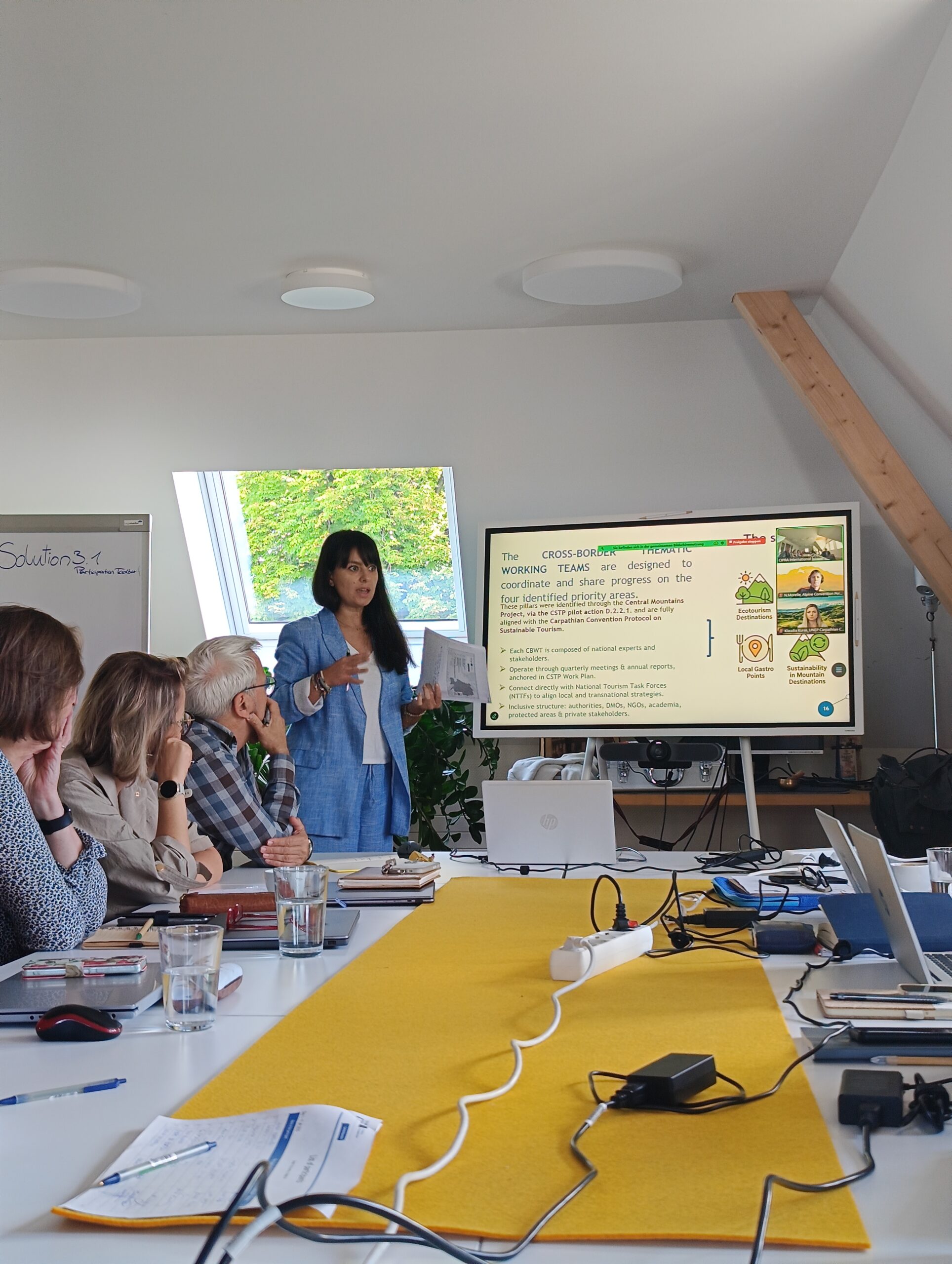
From 16 to 18 September 2025, partners of the CENTRAL MOUNTAINS project met in Feldkirch (Austria) and Schaan (Liechtenstein) to review the project’s governance solutions and exchange experience with organisations actively shaping cooperation in the Alpine region. The meeting combined technical discussions on the project’s final outputs with the exploration of successful governance models that can inspire sustainable mountain development across Central Europe.
A key element of the programme was the joint workshop with representatives of the Alpine Convention and the Carpathian Convention, who reviewed and discussed the three governance solutions developed within the project. Their feedback helped refine the final versions of the Toolboxes and ensured that the proposed approaches reflect the needs of both Alpine and Carpathian mountain regions. Discussions confirmed the practical value, adaptability and transferability of the project’s governance solutions while highlighting the importance of stakeholder participation and stronger integration of the Carpathian perspective.
The meeting also provided valuable insights into the governance role of CIPRA International, demonstrating how long-term cooperation between international organisations, governments and regional stakeholders has become a cornerstone of sustainable development in the Alps. The experience illustrated how continuous dialogue, institutional cooperation and knowledge exchange contribute to effective mountain governance beyond individual projects.
Participants explored two outstanding examples of cross-border governance operating in the Rhine Valley. Representatives of the International Lake Constance Tourism GmbH presented a unique four-country cooperation model bringing together destinations from Austria, Germany, Switzerland and Liechtenstein. The organisation demonstrated how joint governance structures, coordinated destination management and common financing mechanisms support sustainable tourism development across national borders.
Another example was the Agglomeration Rhine Valley Programme, which coordinates spatial planning and mobility management across 23 municipalities in Austria and Switzerland. The initiative illustrated how neighbouring regions can jointly address shared challenges such as commuter traffic, infrastructure planning and quality of life through integrated governance structures.
The study visit concluded in the UNESCO Biosphere Park Großes Walsertal, where partners explored an innovative model combining regional branding, sustainable production and participatory governance. Local stakeholders presented the successful Walserstolz regional brand and demonstrated how strong local identity, cooperation between producers and community participation contribute to the long-term resilience of mountain regions. The Biosphere Park also showcased how protected areas can become drivers of sustainable economic development while strengthening the connection between local communities and their natural environment.
How did this contribute to CENTRAL MOUNTAINS?
The knowledge and experience gained during the visit directly supported the finalisation of the CENTRAL MOUNTAINS Joint Strategy, Toolboxes and policy recommendations. The examples from the Alpine region reinforced one of the project’s key conclusions: effective mountain governance relies on strong cooperation across administrative borders, active stakeholder participation and practical governance models that connect environmental protection, regional development and local communities.
As the project entered its final implementation phase, the Feldkirch meeting confirmed that many of the governance approaches tested in the Alps have strong potential to inspire future cooperation and sustainable development in mountain regions across Central Europe, particularly in the Carpathians.