
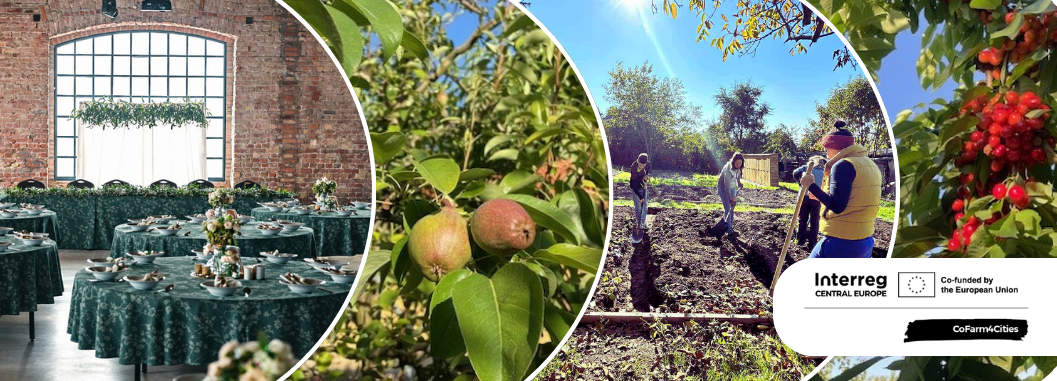
After three years of cooperation across Central Europe, CoFarm4Cities has reached its formal conclusion. Between April 2023 and March 2026, nine partners from five countries developed five urban farming pilots, tested new approaches to land, water, bio-waste and community management, and transformed their experience into a common Urban Farming-based Sustainable Land Use Model and five city Action Plans. The project may have ended, but the farms, gardens, orchards, educational programmes and communities created through CoFarm4Cities continue to grow. CoFarm4Cities was implemented under the Interreg CENTRAL EUROPE Programme with a budget of approximately EUR 2.24 million, 80% co-financed by the European Regional Development Fund. The partnership brought together organisations from Hungary, Poland, Slovenia, Italy and Croatia and tested different approaches to urban farming in Óbuda-Békásmegyer, Kraków, Ljubljana, Turin and Zagreb. More information about the partnership and its results is available on the official CoFarm4Cities website. The five pilots were intentionally different. One of the most important conclusions of CoFarm4Cities is that there is no single urban farm that can simply be copied from one city to another. Every place has different land, regulations, communities, environmental conditions and institutional capacities. What can be transferred is the process: how to select a site, involve future users, choose the right model, build the necessary infrastructure, organise management and create a place capable of continuing after project funding ends.
Why urban farming?
Central European cities face growing pressure on land. Agricultural and green areas on the urban fringe compete with housing, commercial development and infrastructure. At the same time, climate change is increasing pressure on water resources, biodiversity and local food systems, while residents are showing growing interest in community gardening and producing food close to home. CoFarm4Cities approached urban farming as much more than food production. It tested urban farms as tools for regenerating underused land, protecting biodiversity, supporting local food systems, environmental education and creating new forms of community life. As project manager András Guti explained during the final conference, the practical experiences of the partners became the basis for a model intended to help other cities establish and operate urban farms without having to start from zero. Watch András Guti present the Urban Farming-based Sustainable Land Use Model on YouTube. CoFarm4Cities was also built around cooperation. Viera Slavikova from the Interreg CENTRAL EUROPE Programme highlighted the value of bringing different cities together to share not only successful practices, but also problems and mistakes that others can avoid repeating. Watch: Why cooperation is central for a greener Central Europe.
The Urban Farming-based Sustainable Land Use Model
The main methodological legacy of CoFarm4Cities is the Urban Farming-based Sustainable Land Use Model, or UFSLU. The model was developed from three years of practical experience in the five pilot cities. It combines successful approaches with barriers encountered during implementation and translates them into guidance for municipalities, organisations and communities interested in developing urban farming initiatives. UFSLU is based on four main principles: sustainability, responsible land use, circular economy and a community-based approach. It considers environmental, economic and social sustainability together. The model covers the whole process from initial analysis and site selection through planning, construction and cultivation to community involvement, monitoring and long-term management. It addresses practical issues such as soil conditions, water availability, regulations, procurement, financing, biodiversity and the choice of an operator. One of its central conclusions is simple: infrastructure alone does not create a successful urban farm. Land, people, governance, knowledge and a clear long-term purpose have to work together. Download the final Urban Farming-based Sustainable Land Use Model
Five cities, five urban farming solutions
Óbuda-Békásmegyer: Csúcshegy Urban Farm
In Budapest’s third district, CoFarm4Cities addressed the pressure of development on peri-urban green areas. A previously underused municipally owned site at Csúcshegy was transformed into a productive community urban farm. The pilot created cultivation areas based on permaculture principles together with shared infrastructure, water facilities, storage and community spaces. Residents became directly involved and a local organisation emerged around the future operation of the farm. The farm opened in September 2025. Its cultivation spaces were quickly occupied, demonstrating the demand for this kind of activity and showing how public land can gain a productive and community function while remaining green. Watch Dániel Horváth present the Óbuda pilot on YouTube.
- Visit the Csúcshegy Urban Farm website
- Read the Action Plan for Óbuda-Békásmegyer
- Contact: info@obvf.hu
Kraków: Community Plot Garden “Under the Stars”
Kraków tested a hybrid between an allotment garden and a community garden. The Community Plot Garden “Under the Stars” at Orla Street combines 47 individual 5 × 5 metre plots with shared infrastructure, communal cultivation areas, composting facilities, a gazebo and a tool shed. The municipality selected the NGO Grupa Robocza as the garden operator, combining municipal investment with community-based management. Interest significantly exceeded capacity: 277 applications were submitted for 47 plots. The garden opened in June 2025. Its most important result is not only the infrastructure but the community that developed around it. Around 50 people started producing food there, while children, families and gardeners turned the site into an active meeting place. Watch Tomasz Kuźma present the Kraków pilot on YouTube.
- Visit the Community Plot Garden “Under the Stars” website
- Read the Action Plan for Kraków
- Contact: podgwiazdami@agro.diy
Turin: Cascina Falchera
Turin developed its pilot at Cascina Falchera, an existing municipal educational farm managed by Consorzio Kairòs. CoFarm4Cities expanded the site with new community gardens and strengthened its role as a place combining cultivation, environmental education, circularity and social inclusion. The new gardens officially opened in November 2024 and include 83 plots for citizens, associations, schools and educational activities. The wider farm also works with people with disabilities, migrants and other groups through social and agricultural programmes. The Turin experience highlighted two essential ingredients for successful urban farming: a strong local community and professional technical support. Agricultural experts, social organisations, the municipality and the University of Turin all contributed different skills. Watch Giorgio Prette present the Turin pilot on YouTube.
Zagreb: Brestje Urban Orchard
Zagreb chose a different model: an urban orchard designed as both an edible landscape and a public neighbourhood space. The orchard was created on City-owned land next to a school in Brestje, in the eastern district of Sesvete. Children, parents and residents participated in workshops that informed the final landscape design. The site includes fruit trees and shrubs, raised garden beds, seating, shaded areas and planting designed to support biodiversity. A second part of the pilot introduced an electrical composting device at the neighbouring school, which has more than 900 pupils. Food residues can be processed and returned to the local cultivation cycle as compost, while pupils, teachers and kitchen staff were involved in learning how to use the system. The orchard opened in March 2026. Its implementation also provided valuable lessons about procurement, construction schedules and the need for realistic project planning. Watch Iva Bedenko present the Zagreb pilot on YouTube.
Ljubljana: Mini Urban Educational Farm Rakova Jelša
Ljubljana focused on education. Together with DOVES – FEE Slovenia, the City established the Mini Urban Educational Farm at Rakova Jelša and connected it with eight primary schools. The pilot created 16 raised beds, an accessible high bed and shared facilities. Eight participating schools also established their own gardens, creating a network rather than a single isolated intervention. The physical infrastructure was accompanied by an extensive educational programme. DOVES developed the Urban School Garden: A Teacher’s Guide and materials covering food self-sufficiency, biodiversity, circular economy, social skills, sustainable mobility and energy. The goal was to make the garden an outdoor classroom rather than simply another cultivation area. Activities continued after the formal end of CoFarm4Cities and Ljubljana plans to extend the approach to additional schools. Watch Maruška Markovčič present the Ljubljana pilot on YouTube.
- Read more about CoFarm4Cities in Ljubljana
- Read the Action Plan for Ljubljana
- Contact: maruska.markovcic@ljubljana.si
From pilots to transferable solutions
The five physical pilots were also transformed into five tested CoFarm4Cities solutions. A pilot describes what happened in one particular place. A solution extracts the part of that experience that can be useful elsewhere: what problem it addressed, what conditions were necessary and what future implementers should consider.
- Óbuda-Békásmegyer tested community-based urban farming on municipally owned peri-urban land.
- Kraków tested a mixed-use model combining individual plots with common infrastructure and community activities.
- Turin connected urban farming with circularity, education and social cohesion.
- Zagreb developed a public orchard connected with education and bio-waste reuse.
- Ljubljana developed school-programme-based urban farming connecting an educational farm with a network of school gardens.
These experiences became part of the UFSLU model and helped turn five local experiments into knowledge that can be adapted by other cities.
Five Action Plans: what happens next?
The UFSLU model provides the common framework. The five Action Plans translate the experience of CoFarm4Cities into future activities in each partner city. Kraków connects urban farming with a broader urban food policy, education, spatial planning, local food systems and further development of community gardening. Óbuda-Békásmegyer plans to continue developing Csúcshegy Urban Farm and strengthen a wider local network of urban farming and community gardening activities. Ljubljana intends to expand school gardens, continue training teachers and make urban farming education available to more pupils and schools. Zagreb uses the experience of Brestje to define a process for developing further public urban orchards, including site analysis, water planning and co-design with local communities. Turin builds on Cascina Falchera as a model for multifunctional urban agriculture combining cultivation with circularity, environmental education and social inclusion. Together, the Action Plans move CoFarm4Cities from five pilot interventions towards longer-term local policies, programmes and investments.
What did we learn?
- Choose the site carefully. Land ownership, soil quality, water, regulations and accessibility can determine the success of an urban farm before construction begins.
- Plan water infrastructure from the beginning. Water availability and irrigation were recurring challenges across the pilots.
- Allow enough time for public procedures. Procurement, permits and construction can take considerably longer than expected.
- Invest in people, not only infrastructure. Every pilot confirmed the importance of an active operator, community or institutional network.
- Co-design matters. Future users should be involved while the project can still change, not only after the infrastructure has already been designed.
- Urban farms are strongest when they are multifunctional. Food production can be combined with education, biodiversity, recreation, social inclusion and circular solutions.
- Problems are also useful results. Sharing delays, unsuccessful approaches and implementation barriers allows other cities to avoid repeating the same mistakes.
Seeds of Change: the final CoFarm4Cities conference
The project formally came together for the last time during the Seeds of Change conference in Budapest on 19 March 2026. The conference brought together project partners, municipalities, researchers and urban farming practitioners. Partners presented the five pilots and the final UFSLU model alongside urban farming experiences from outside the project. Discussions focused not only on achievements, but also on practical barriers, community management and the question of how urban farming can become a permanent part of city development. The presentations showed why the differences between the pilots are one of the project’s strengths. Óbuda demonstrated the reuse of peri-urban municipal land. Kraków combined individual cultivation with a community model. Turin connected farming with education and social inclusion. Zagreb created a public edible landscape. Ljubljana integrated gardening into education. Watch the Seeds of Change – CoFarm4Cities closing conference on YouTube.
The project ended. The farms did not.
Formal project closure in March 2026 did not mean the closure of the pilot sites. In Óbuda, the urban farm continues to operate and develop. In Kraków, gardeners continue to cultivate their plots and build the community around the garden. Cascina Falchera remains an active educational and social centre in Turin. Ljubljana continues activities with schools and plans to extend the model. Zagreb’s new orchard has entered its operational phase and provides experience that can be used at future locations. This may be the most important long-term result of CoFarm4Cities: the project did not leave five demonstration sites waiting for another project to begin. It left five places with their own users, communities, operators and reasons to continue. Measured physically, CoFarm4Cities created gardens, cultivation beds, fruit trees, irrigation systems, composting infrastructure and community spaces. Its wider legacy is knowledge: how to select land, organise cooperation, involve communities, manage risks and connect urban farming with climate adaptation, education, circularity and local food systems. CoFarm4Cities has formally finished, but the land it changed, the people it connected and the ideas it tested are already entering their next season.
Project documents
- CoFarm4Cities project website, outputs and media
- Urban Farming-based Sustainable Land Use Model
- Action Plan for Óbuda-Békásmegyer
- Action Plan for Kraków
- Action Plan for Ljubljana
- Action Plan for Turin
- Action Plan for Zagreb
Project contact
For questions about CoFarm4Cities and its results after project closure, please contact: András Guti Project Manager, CoFarm4Cities guti.andras@obvf.hu