
Four Policy Briefs to Help Cities Plan Smarter Responses to Heat Waves
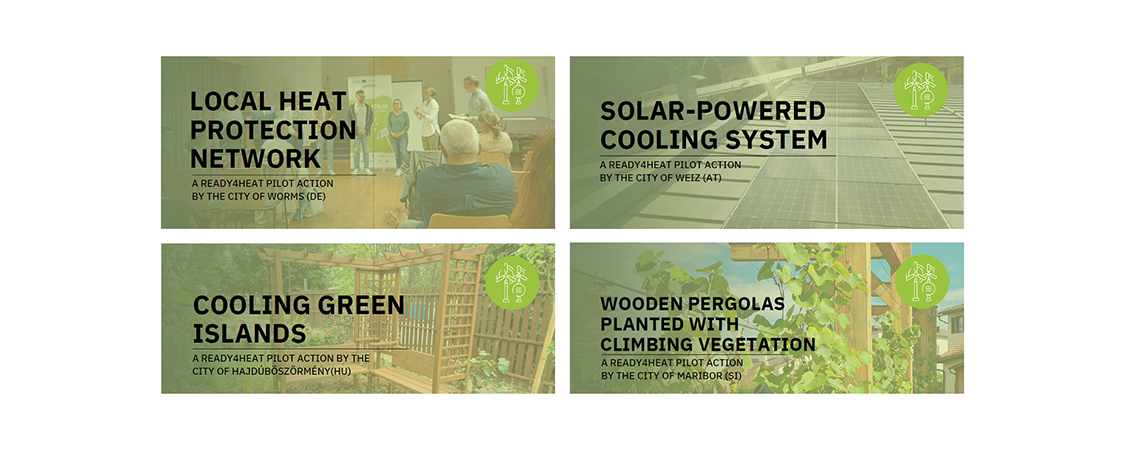
As heat waves become more frequent, intense and prolonged across Europe, local governments are under growing pressure to protect public health and ensure safe, liveable environments—especially for the most vulnerable. In response to this challenge, four policy briefs present concrete, tested solutions from Austria, Slovenia, Hungary and Germany. Developed within the Ready4Heat project, the briefs translate local pilot experiences into practical recommendations that other municipalities can adapt and scale. They show how municipalities can integrate heat adaptation into everyday decision-making while keeping costs, energy use and emissions under control.
Austria: Renewable Cooling for Safe Indoor Environments
The Austrian policy brief draws on experience from the City of Weiz, where extreme summer heat posed serious risks in a senior care facility. Indoor temperatures regularly exceeded safe thresholds, directly affecting elderly residents and staff. To address this, the city implemented a renewable-powered cooling solution that combined a high-efficiency cooling system with on-site photovoltaic energy generation. The pilot proved that cooling can be an essential part of climate adaptation without increasing dependency on the electricity grid. Stable indoor temperatures were achieved while keeping energy consumption, operating costs and emissions low. Beyond the technical success, the project highlighted the importance of early political commitment, clear governance structures and close cooperation between the municipality, care facility operator, building owner and technical experts. The policy brief distils these lessons into recommendations for cities seeking sustainable, resilient cooling solutions.
Slovenia: Nature-Based Shading in Everyday Public Spaces
In Slovenia, the City of Maribor tested nature-based shading measures in outdoor areas of kindergartens that were highly exposed to direct sunlight during heat waves. Simple interventions—such as vegetated shading structures—significantly improved thermal comfort and protected children during extreme heat periods. The Slovenian policy brief translates this experience into transferable guidance on how municipalities can plan, implement and scale nature-based shading solutions. Trees, green pergolas, shaded playgrounds and green roofs are presented as low-cost, socially accepted measures that can be integrated into broader urban heat mitigation strategies. The policy brief suggests that success depends less on the specific structure installed and more on good governance, early stakeholder involvement, clear responsibilities and secured long-term maintenance.
Hungary: Small-Scale Green Islands with Big Impact
The Hungarian policy brief is based on a pilot in Hajdúböszörmény, where the city introduced small, distributed “green islands” in heat-exposed public and institutional spaces. Combining vegetation, pergolas and seating, these shaded areas were strategically placed using heat-stress analysis and local knowledge. The results showed that relatively simple, nature-based measures can significantly improve thermal comfort and the usability of public spaces. The policy brief highlights nature-based shading as a cost-effective and feasible adaptation measure that can be integrated into existing urban environments. It also underlines the importance of early stakeholder involvement, clear maintenance responsibilities and treating heat mitigation as a standard municipal service rather than a one-off project.
Germany: Heat Protection as a Public Health and Governance Issue
In Germany, the City of Worms focused on improving local preparedness for heat events by building a structured cooperation model rather than implementing isolated actions. The pilot introduced clear roles, a cooperation charter, thematic working groups and practical tools such as a map of cool places, a heat hotline and targeted training for staff working with vulnerable groups. The German policy brief emphasises that even with limited financial resources, significant impact is possible when responsibilities are clear and actors are well connected. Its recommendations stress the need to treat heat protection as a public health and organisational issue, formalise cooperation through simple governance tools and tailor communication to specific target groups.
Download and read all Policy Briefs in detail: Ready4Heat Outputs
Further Reading
⬇ Download our brochure with key lessons learned on each pilot solution
- This brochure explains a standalone pilot solution also presented at the webinar: context and challenge, solution overview, explanations covering the effectiveness of the solution and the steps municipalities take to decide, step‑by‑step implementation logic, and key messages for decision‑makers. Solutions in Ready4Heat include: renewable energy-powered cooling solutions for vulnerable buildings, a kindergarten pergola with nature-based cooling, nature-based shading in public spaces across the city, and an actor-centered heat protection network.
- The brochure is intended for municipalities and cities, public authorities and planners, health and social care organisations, and practitioners responsible for buildings, public space, and services.