
After more than two years of research, modelling and real-world testing across Central Europe, OPTI-UP is bringing its accumulated knowledge together in one practical tool.
Small and medium-sized cities face complex decisions when planning public transport. Should an existing network be reorganised? Would demand-responsive transport be more suitable for low-density areas? Is it time to consider fleet electrification? Or does an area first need to establish a basic public transport service?
Through the OPTI-UP project, partners from across Central Europe have been exploring these questions in six project areas – Osijek, Modena, Paks, Pécs, Český Krumlov and Grosuplje. The project combined data collection, transport modelling, local planning and real-world pilot actions to investigate how public transport can become more efficient, accessible and sustainable.
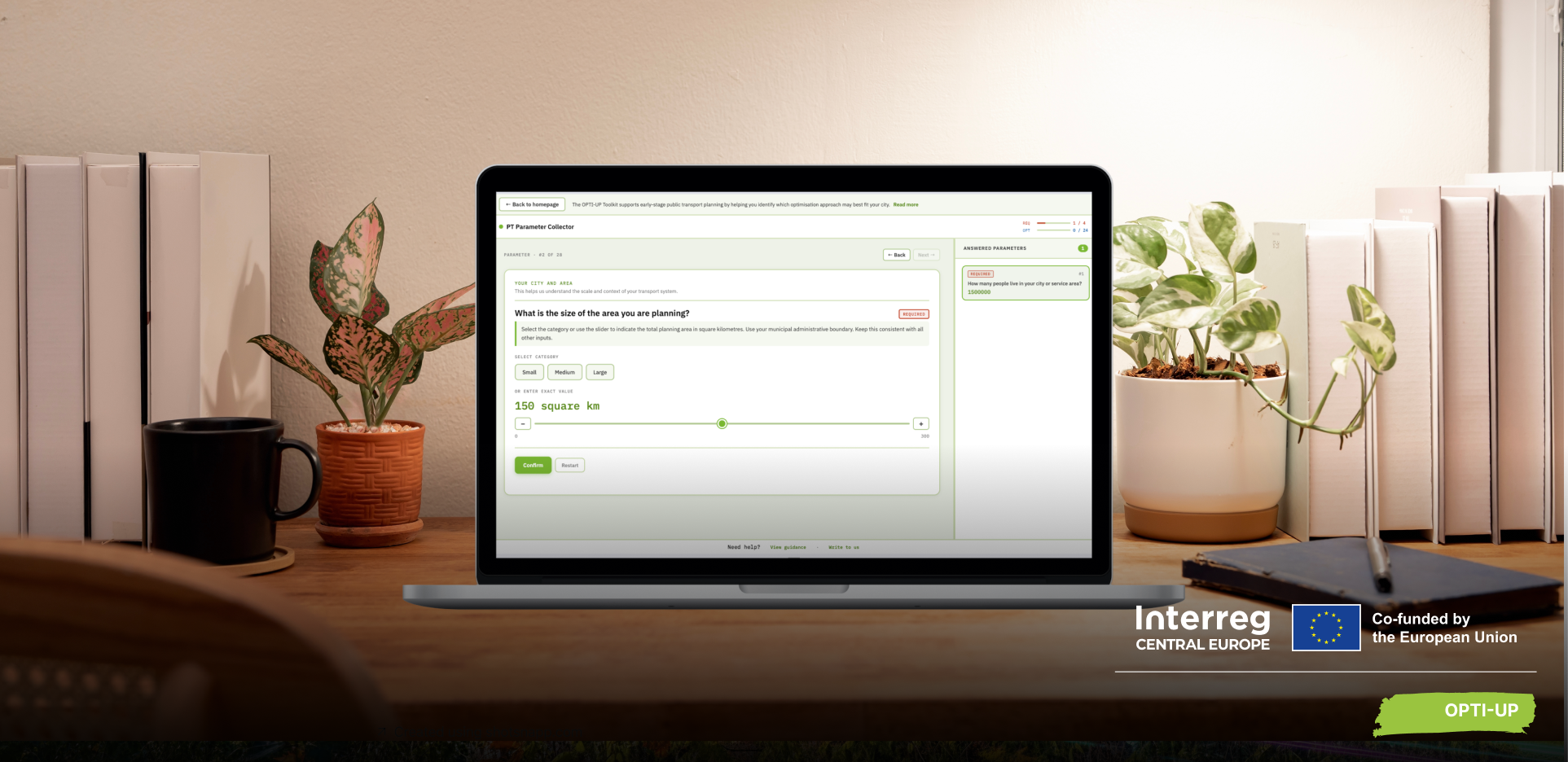
Now, that experience has been translated into the OPTI-UP Toolkit – a web-based decision-support tool designed to help other cities take the first step towards better public transport planning.
A starting point for better planning
The Toolkit has a straightforward purpose: a city provides information about its local context and priorities, and the Toolkit uses that information to identify public transport improvement approaches that may be worth investigating further.
The Toolkit considers several strategic directions, including:
· demand-responsive transport (DRT);
· public transport network optimisation;
· bus fleet electrification.
It can also indicate when the available information or existing options do not support a sufficiently confident recommendation.
This distinction matters. The Toolkit is not designed to make the final decision for a municipality. Instead, it helps narrow down the field.
Curious which approach could fit your city? Explore the OPTI-UP Toolkit and get a recommended planning direction based on your local context and priorities.
Try the OPTI-UP Toolkit
Why is that useful?
Detailed public transport planning can require substantial resources.
Transport models can assess how proposed interventions may affect passenger demand, network performance or long-term urban development. OPTI-UP itself used established approaches including four-step transport models and Land-Use Transport Interaction models during the project.
But project experience also showed that modelling capacity varies considerably between smaller cities. High implementation costs, limited awareness, data availability and shortages of local expertise can all create barriers to integrating modelling into everyday planning.
The Toolkit therefore sits before that detailed stage. It allows a municipality to conduct an initial structured assessment, understand which strategic direction appears relevant and identify what should be explored next.
Built for cities that may not have perfect data
One of the important design principles was accessibility. The Toolkit uses a set of city characteristics covering areas such as socio-demographics, existing public transport supply and demand, fleet characteristics and policy priorities.
But users do not need to know every number. Only four inputs are mandatory: population, area, population density and availability of a local bus service. Other inputs can improve the quality and confidence of the recommendation, but the system is designed to work with incomplete information. Where exact numerical data are unavailable, users can in many cases provide qualitative assessments instead.
That makes the Toolkit particularly relevant for municipalities that want to begin exploring their options before commissioning extensive data collection or modelling.
Turning OPTI-UP experience into something other cities can use
The Toolkit did not start from a theoretical blank page. OPTI-UP first analysed existing public transport systems, collected data, developed transport models and prepared local plans. Project partners then implemented and evaluated pilot actions in six areas across Central Europe.
The Toolkit translates this accumulated knowledge into a transferable digital tool.
Its recommendation logic combines city inputs with expert-defined benchmark cases, while the next stage connects recommended strategies with relevant examples from the OPTI-UP pilot cities. Users can therefore move from a broad strategic recommendation towards a concrete reference case with similar characteristics.
An integrated AI assistant then allows users to explore the recommendation further using information retrieved from OPTI-UP project documentation.
Supporting decisions, not replacing expertise
The most important way to understand the OPTI-UP Toolkit is as an orientation tool. Its recommendations are indicative. They reflect similarities between the user’s situation, expert knowledge and project cases. A high score does not guarantee that the same intervention will produce the same outcome in another city.
Before implementation, municipalities still need appropriate local analysis, financial and regulatory assessment, stakeholder consultation and, where relevant, detailed transport and land-use modelling.
But those processes need a starting point. For cities asking “Where should we look first?”, the OPTI-UP Toolkit is designed to provide one.
Learn more about OPTI-UP and follow the project: Visit the OPTI-UP website | Follow OPTI-UP on LinkedIn