
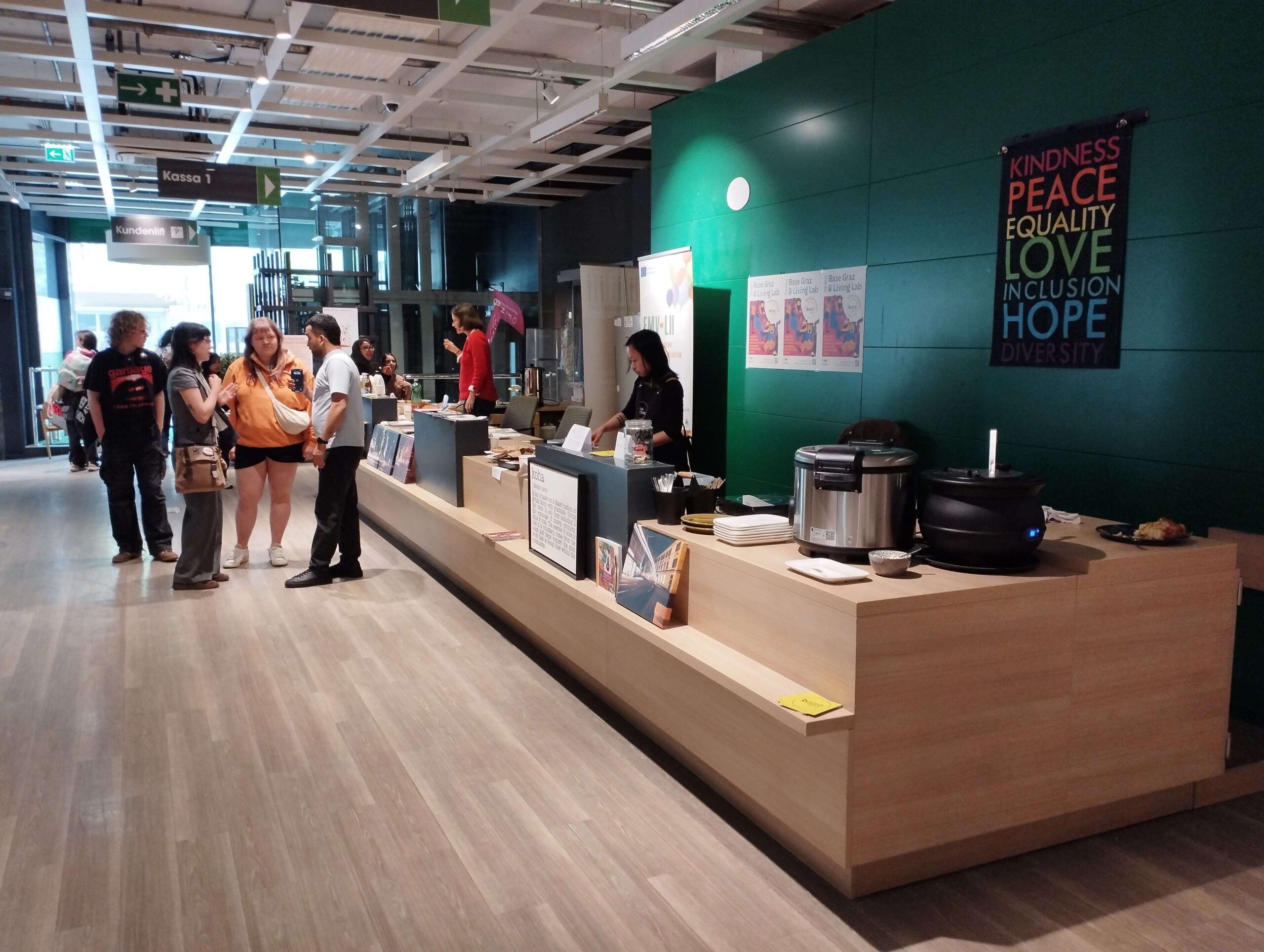
Three events, one common goal: further developing the “House of the Future” in Graz.
How can a “House of Future” be created in Graz? Over the past few months, StadtLABOR has placed this question at the center of three events: the Stadt.Mahlzeit and the 1st & 2nd Leiner Living Lab. These events highlighted that the future cannot be planned by just a few, but must above all be developed, tested and negotiated collectively by many.
The series kicked off with the Stadt.Mahlzeit at the Leiner-Haus on April 2026 – a collaboration between StadtLABOR and Sustain X dedicated to the Inner Development Goals. The focus was on the inner capabilities and attitudes that are important for change – such as self-reflection, empathy, the ability to cooperate and collective action. This made it clear: Anyone who wants to shape the circular and sustainable city of tomorrow needs not only new ideas but also new forms of cooperation.
At the 1st Leiner Living Lab, the former Leiner House on Annenstraße was transformed into an open, vibrant space for learning, dialogue and experimentation. Together with partners from academia, business, public administration and the wider community, participants reflected on the future of Annenstraße, the use of the Leiner House and new forms of participation.
Read here the “Methodology Kit on stakeholders’ engagement in circular lifestyles”.
As StadtLABOR, we organised a co-design workshop on the “House of Future” for young people aged between 16 and 25. Together, we explored what a space would need to look like to enable young people to truly get involved and remain active in the long term. The results were clear and inspiring: the “House of the Future” should not be a ready-made concept, but an open space of possibilities where young people can try out their own ideas and projects for a city fit for the future. Young people want not only to contribute their ideas there, but also to have a say in decisions and help shape the future.
The Leiner Living Lab entered its next phase and continued the process it had begun. Here, too, the focus was on the Leiner House as a real-world laboratory and a potential venue for new business models, collaborations and future-proof urban development. This made it clear that the “House of Future” is both a place and a process, taking shape step by step through collective action.
All three events impressively demonstrated the potential that lies in temporary use as an incubator for innovative ideas and collaborative action.