
The year 2025 marked another turning point for the MECOG-CE project, moving from testing and learning to developing new solutions and strategic framework for strengthening metropolitan cooperation in Central Europe, and ensuring that metropolitan areas are recognised as key drivers of sustainable development in the European Union.
From testing best practices to new metropolitan solutions
At the heart of MECOG-CE in 2025 was the development of five new solutions for strengthening metropolitan cooperation and governance. Building on the experience gained in earlier project phases, partners transformed tested approaches into practical, ready-to-use tools addressing current metropolitan challenges. The new solutions focus on key areas such as coordinated public transport, local food cooperation, participatory strategic planning, prototyping tools for metropolitan challenges, and stronger stakeholder engagement. Together, they translate joint learning into concrete tools that metropolitan areas can directly apply, adapt and further develop, supporting more effective governance and long-term territorial development.
Sharing knowledge: new brochures
To support wide dissemination of project results, MECOG-CE published three brochures presenting
1) pilot actions,
2) new solutions,
3) comprehensive overview combining both.
These publications make project outcomes easily accessible to policymakers, practitioners and stakeholders, helping extend MECOG-CE experience beyond the project partnership.
Strengthening metropolitan cooperation through international meetings
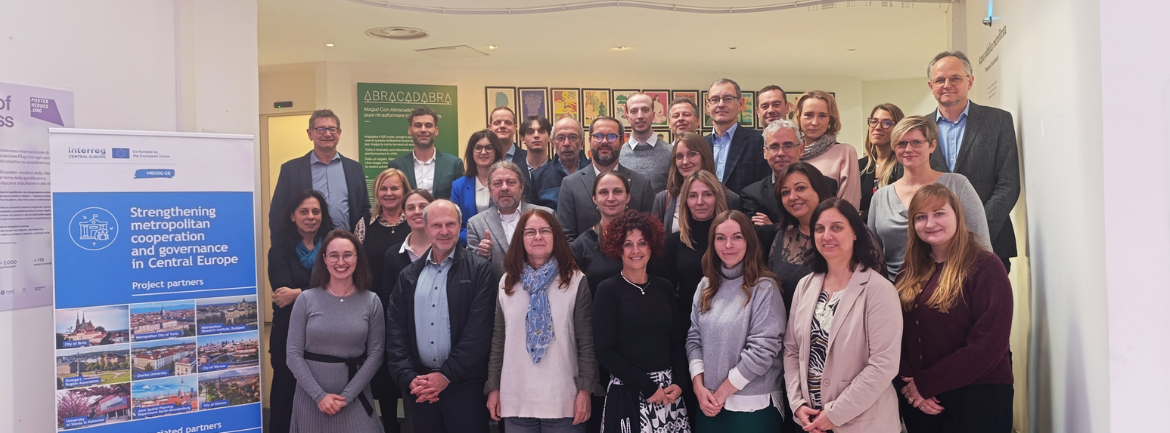
International exchange remained a key pillar of MECOG-CE in 2025. At the partner meeting in Berlin (February 2025), hosted by the Joint Spatial Planning Department Berlin-Brandenburg, partners jointly shaped the new solutions and advanced work on the metropolitan cooperation strategy. This strategic process culminated at the meeting in Turin (November 2025), hosted by the Metropolitan City of Turin, where partners finalized the Strategy for strengthening metropolitan cooperation and governance in Central Europe and discussed Action Plans tailored to each partner metropolitan area.
From strategy to action
The Strategy and Action Plans represent a major achievement of 2025. The Strategy provides a common framework for metropolitan areas across Central Europe, defining priorities, instruments and steps to enhance metropolitan cooperation and governance. The Action Plans ensure practical implementation of strategic principles into concrete measures responding to local priorities of each metropolitan area – from integrated transport and food systems to spatial planning tools, public space revitalisation and technical solutions for improvement of metropolitan governance.
Metropolitan areas on the European stage
A key highlight of 2025 was the seminar at the European Parliament in Brussels (19 November), which brought together policymakers, experts and metropolitan representatives to discuss the role of metropolitan areas in strengthening EU competitiveness. The event underlined the need for stronger recognition of metropolitan areas in EU policies and funding frameworks.
As the project enters its final phase, the achievements of 2025 ensure that metropolitan areas across Central Europe are better equipped to cooperate, innovate and contribute to Europe´s sustainable and competitive future and provide a strong foundation for lasting impact well beyond the project’s duration.