
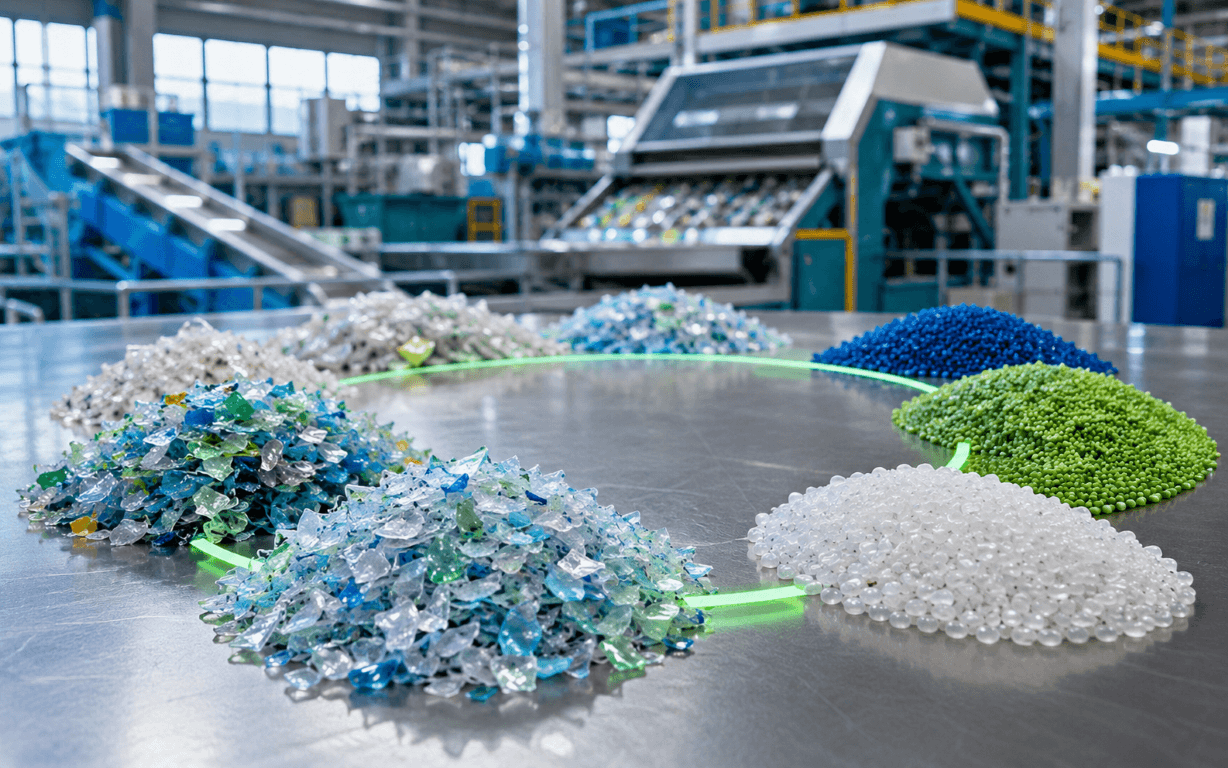
A new open-access article, “A guide on making circular plastics a reality,” by Dr Damjan Krajnc from the Chamber of Commerce and Industry of Štajerska and Dr Lukáš Rýček from Charles University explores this question from the perspective of the GreenChemForCE project. The article was published in the July 2026 edition of Open Access Government.
The publication builds on the GreenChemForCE strategy “Strategies for Sustainable Plastic Management in Central Europe” and translates its findings into an accessible framework for policymakers, industry, researchers and other stakeholders.
Recycling alone is not enough
Plastics provide essential functions in healthcare, food protection, construction, transport and numerous industrial applications. However, their value chains remain largely dependent on virgin fossil resources, short product lifetimes and insufficient recovery of materials after use.
The article argues that plastics must be addressed as a systemic resource and industrial transformation challenge, rather than solely as an end-of-life waste issue. Achieving this transition requires coordinated action across the entire value chain – from material and product design to production, use, collection, sorting, recycling and the reintroduction of secondary materials into the economy.
Four interconnected levers for circular plastics
The publication identifies four mutually reinforcing conditions for accelerating the transition:
- Regulation and governance: clear rules, extended producer responsibility and green public procurement;
- Regional collaboration: cross-border partnerships, industrial symbiosis and shared quality standards;
- Education and skills: eco-design, life-cycle assessment and circular business model competences;
- Technology and infrastructure: advanced sorting, high-quality recycling and digital traceability tools.
None of these elements can deliver circularity on its own. New technologies require supportive policies and market demand, while regulation must be accompanied by adequate infrastructure, skills and implementation capacity.
From strategy to implementation
In the short term, the GreenChemForCE strategy calls for improved governance, better material-flow data, targeted training, pilot activities and stronger collection and sorting systems. By 2030, these measures should support mature markets for secondary materials, wider implementation of eco-design and stronger circular value chains across Central Europe.
The transition also represents an economic opportunity. It can reduce dependence on virgin fossil feedstocks, strengthen industrial resilience, support innovation and create skilled jobs.
Read the full open-access article:
https://www.openaccessgovernment.org/article/a-guide-on-making-circular-plastics-a-reality/210994/
Permanent DOI:
https://doi.org/10.56367/OAG-051-12507