
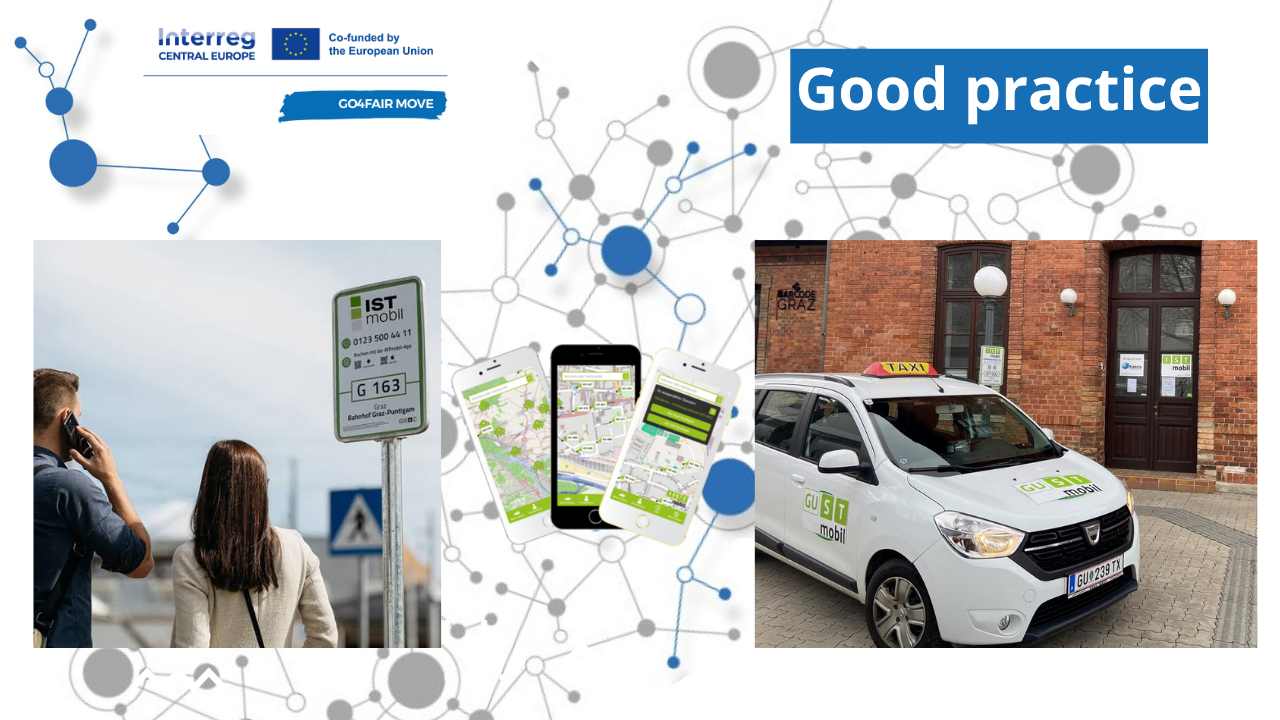
ISTmobil operates through cooperation between municipalities, regional authorities, the technology operator and existing local taxi and transport companies. The model has been implemented in several Austrian regions under different local names, including GUSTmobil, Marchfeld mobil and Bezirk Korneuburg ISTmobil. Its main purpose is to complement existing bus and rail services and make everyday mobility possible without relying on a private car.
Passengers can book journeys by telephone, online or via an app. A common system manages requests, pools passengers travelling in similar directions and assigns journeys to available local carriers. A dense network of designated stopping points provides local accessibility, while connections to railway stations and bus stops allow the service to function as a first- and last-mile solution.
An important strength of ISTmobil is its inter-municipal approach. Several municipalities can participate in one regional system, sharing the technological and organisational framework while relying on existing transport providers. The Marchfeld mobil experience illustrates the importance of connections with conventional public transport: in 2019, more than half of bookings started or ended at a railway station or another important public transport point.
The experience also provides valuable lessons about potential risks. Demand-responsive services remain dependent on stable public funding and sufficient passenger demand, while coordination between municipalities and carriers requires an effective IT and management system. The Marchfeld mobil experience also showed that high costs, vehicle availability and insufficient use by intended target groups can challenge the long-term sustainability of such services.
For GO4FAIR MOVE, ISTmobil is particularly relevant as an example of cross-municipal cooperation combined with local service delivery. A shared booking and dispatch platform, use of existing local carriers, integration with buses and rail, and continuous monitoring of costs and passenger demand could all provide inspiration for the project’s pilot territories. Just as importantly, the experience demonstrates why testing a model through a pilot and adapting it based on actual demand is essential before moving towards longer-term implementation.
With ISTmobil, our good-practice series comes to an end – but the lessons collected from across Europe will now feed into the next stages of GO4FAIR MOVE, supporting the development and testing of solutions tailored to our pilot territories.