
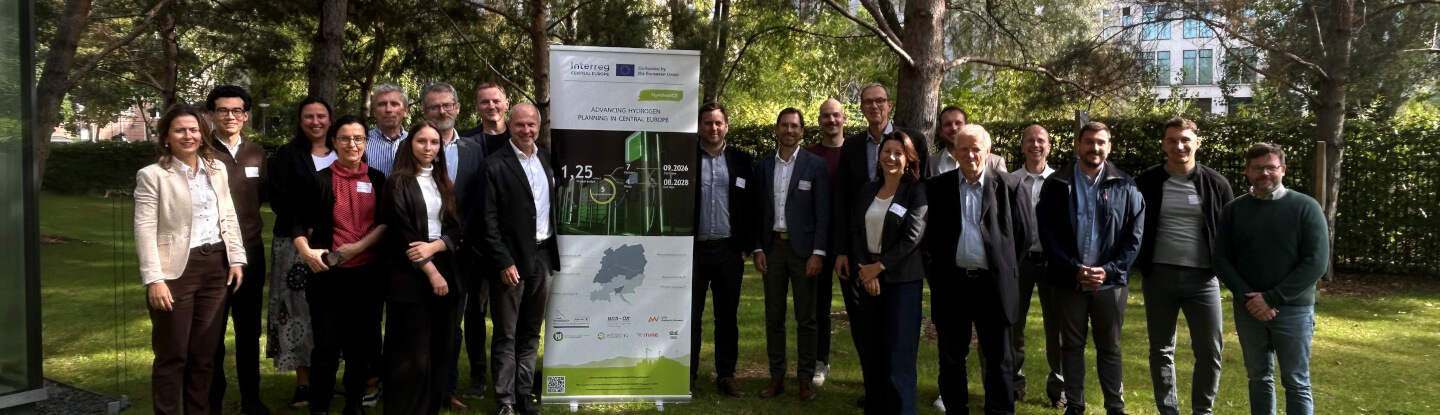
Berlin, 7–8 September 2026 – How can European border regions better coordinate hydrogen development and turn existing knowledge into practical solutions? This is the central challenge addressed by HyAdvanCE – Advancing Hydrogen Planning in Central Europe, a new European cooperation project officially launched at its kick-off meeting in Berlin.
Hosted by the Joint Spatial Planning Department Berlin-Brandenburg (JSPD), the two-day meeting brought together project partners and associated organisations, alongside a representative of the Interreg CENTRAL EUROPE Joint Secretariat. The event marked the start of a two-year collaboration involving seven partners from Germany, Poland, Czechia, Slovakia and Slovenia.
Building on existing knowledge, focusing on practical results
Hydrogen infrastructure, production potential and future demand increasingly connect regions across national borders. However, planning frameworks and stakeholder cooperation often remain fragmented.
HyAdvanCE aims to bridge these gaps by adapting and applying existing European hydrogen planning tools and methodologies in new territorial contexts.
Rather than starting from scratch, the project builds on results from five previous European projects: H2CE, HyEfRe, H2GreenFUTURE, HyBaBo and H2MA.
A central outcome will be the Hydrogen Planning Guidance, providing practical methodologies to support public authorities and regional stakeholders in cross-border hydrogen planning.
Four pilots putting hydrogen planning into practice
A major focus of the kick-off was the introduction of four pilot actions, each addressing a different challenge:
- Germany–Poland: Cross-border spatial planning, hydrogen infrastructure and ecosystem coordination in East Brandenburg and Western Pomerania.
- Slovenia–Austria: Planning and governance approaches for a cross-border hydrogen mobility corridor.
- Czechia–Germany: Hydrogen readiness of SMEs, competence development and cross-border cooperation in the Ústí Region.
- Poland: Hydrogen capacity building, competence centre models and regional ecosystem development in Mazovia.
The pilots will test selected planning tools and approaches, involve regional stakeholders and generate practical experience that can be transferred to other regions.
From four pilots to transferable solutions
During the meeting, partners also discussed how pilot experience will contribute to three cross-border strategic approaches and four practical hydrogen planning solutions.
These solutions will include handbooks covering spatial planning, governance and competence development, and capacity building and awareness.
The project will also upgrade the existing H2CE Collaboration Platform into an Integrated Hydrogen Knowledge Hub, bringing together methodologies, pilot results, strategies and training resources.
A key message from the kick-off was the importance of ensuring that pilot activities lead to solutions that can be taken up and used by other regions, rather than remaining isolated local initiatives.
Next steps: From planning to action
Following the Berlin meeting, partners will begin adapting existing methodologies, preparing the four pilot actions and engaging regional stakeholders.
Over the next two years, HyAdvanCE will bring together public authorities, businesses, research organisations and hydrogen stakeholders to strengthen cross-border cooperation and support more coordinated hydrogen development in Central Europe.
The ambition is clear: turn the knowledge gained from previous European projects into practical planning solutions that can be applied across borders.