
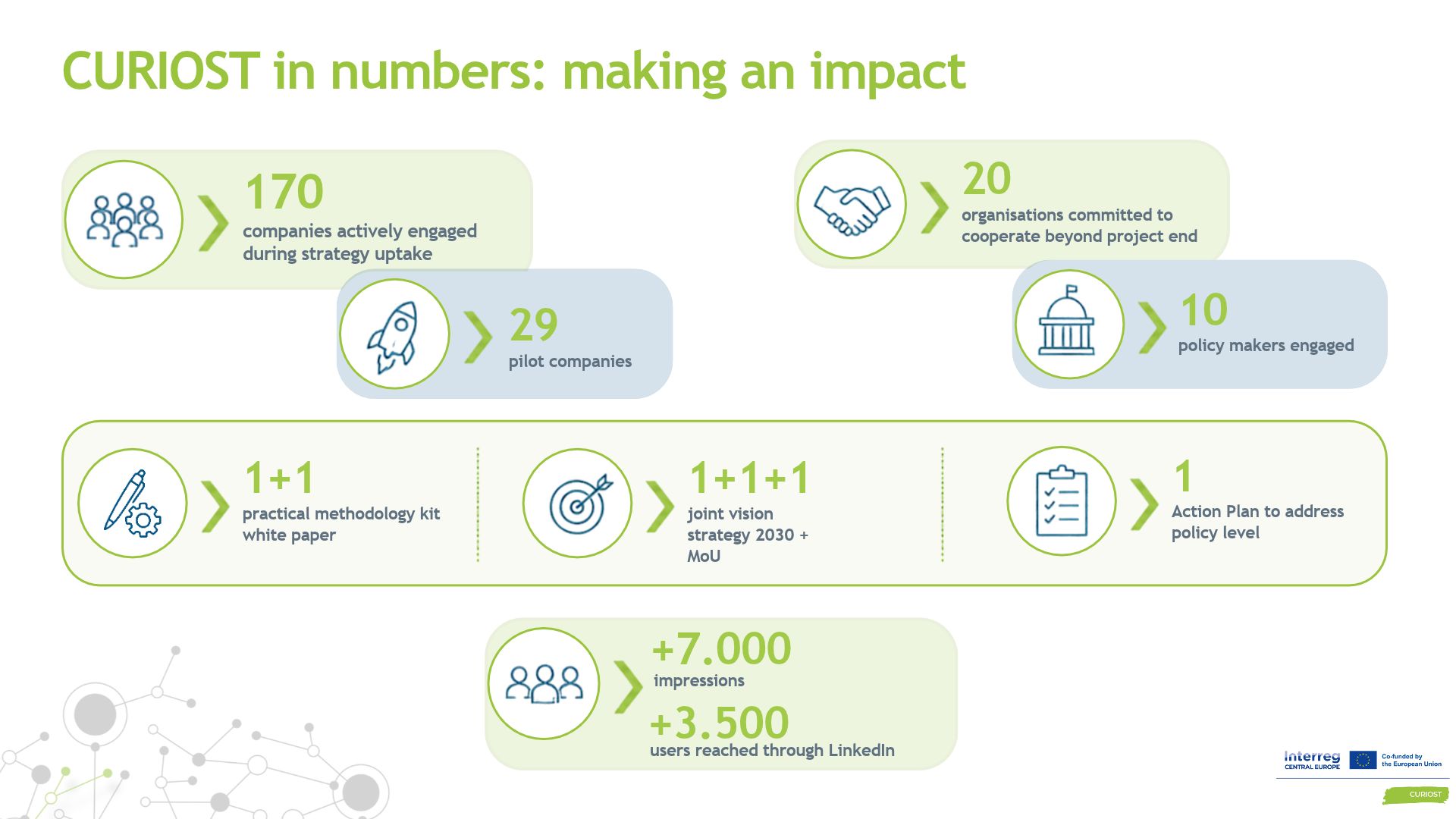
How can manufacturing SMEs make the transition towards a circular economy while remaining competitive? This was the challenge at the heart of CURIOST, bringing together 11 partners from seven countries to support companies in developing more sustainable products, processes and business models.
Working across four sectors – mechanics and mechatronics, plastics, packaging, and construction and building – the project addressed a common gap: while circular economy principles are increasingly recognised as essential, many SMEs lack the knowledge, tools and resources to put them into practice.
Over the course of the project, CURIOST worked to bridge this gap through research, training, transnational exchange and direct collaboration with companies.
From shared knowledge to company projects
The first step was to build a common understanding of the challenges and opportunities for sustainable product development in Central Europe. Partners analysed the state of the art, existing business models and good practices, as well as the market readiness of the four sectors. The work also explored regional needs, policy frameworks and Smart Specialisation Strategies, providing a shared basis for the project’s activities.
This knowledge was then translated into practical work with businesses. Through Design Thinking training and a two-stage process involving 30 companies, project partners and international experts (our Creative Heads), companies explored new approaches to circular product development.
The resulting company projects demonstrate how circular principles can be applied in different industrial contexts, from rethinking materials and production processes to exploring new services and business models.
Practical tools and strategic recommendations
A key achievement of CURIOST is the set of outputs developed to make the project’s knowledge accessible and useful beyond the participating companies.
For example, the Methodology kit for the development of an economically successful, circular product provides SMEs and small mid-caps with a practical framework, tools and templates to integrate environmental and economic considerations into product development.
The CURIOST Action Plan brings together the analysis of European policies, regional Smart Specialisation Strategies and the needs of SMEs. It translates these findings into recommended actions for policymakers and regional stakeholders, with the potential to be transferred and adapted across Europe.
A European exchange that continues beyond the project
Transnational cooperation was central to CURIOST. Workshops, international exchange webinars, company visits and partner meetings created opportunities for businesses and experts to share experiences, compare approaches and learn from different regional and sectoral contexts.
This exchange was also at the centre of the project’s final event, “Designing the Circular Future: From Pilots to Industrial Impact”, held on 30 October 2026 at Environment Park in Turin. More than 60 participants joined online and in person, bringing together companies, researchers, policymakers, innovation actors and young professionals.
The event provided an opportunity to present the project’s achievements, hear directly from companies about their experiences and discuss how circular solutions can move beyond individual projects and reach wider industrial application. Contributions from high-level speakers, including Tomislav Pinter from the European Commission’s DG REGIO, connected the experiences developed through CURIOST with the broader European policy framework, Smart Specialisation and interregional cooperation.
What comes next?
The conclusion of CURIOST marks the end of the project, but not the end of the work. Its methodology, company experiences, strategic recommendations and network of stakeholders provide a basis for further action by SMEs, clusters, research organisations and policymakers.
The challenge ahead is to keep these results in use: applying the tools, adapting the approaches to new contexts and strengthening cooperation between the actors who can turn circular economy ambitions into industrial practice.