
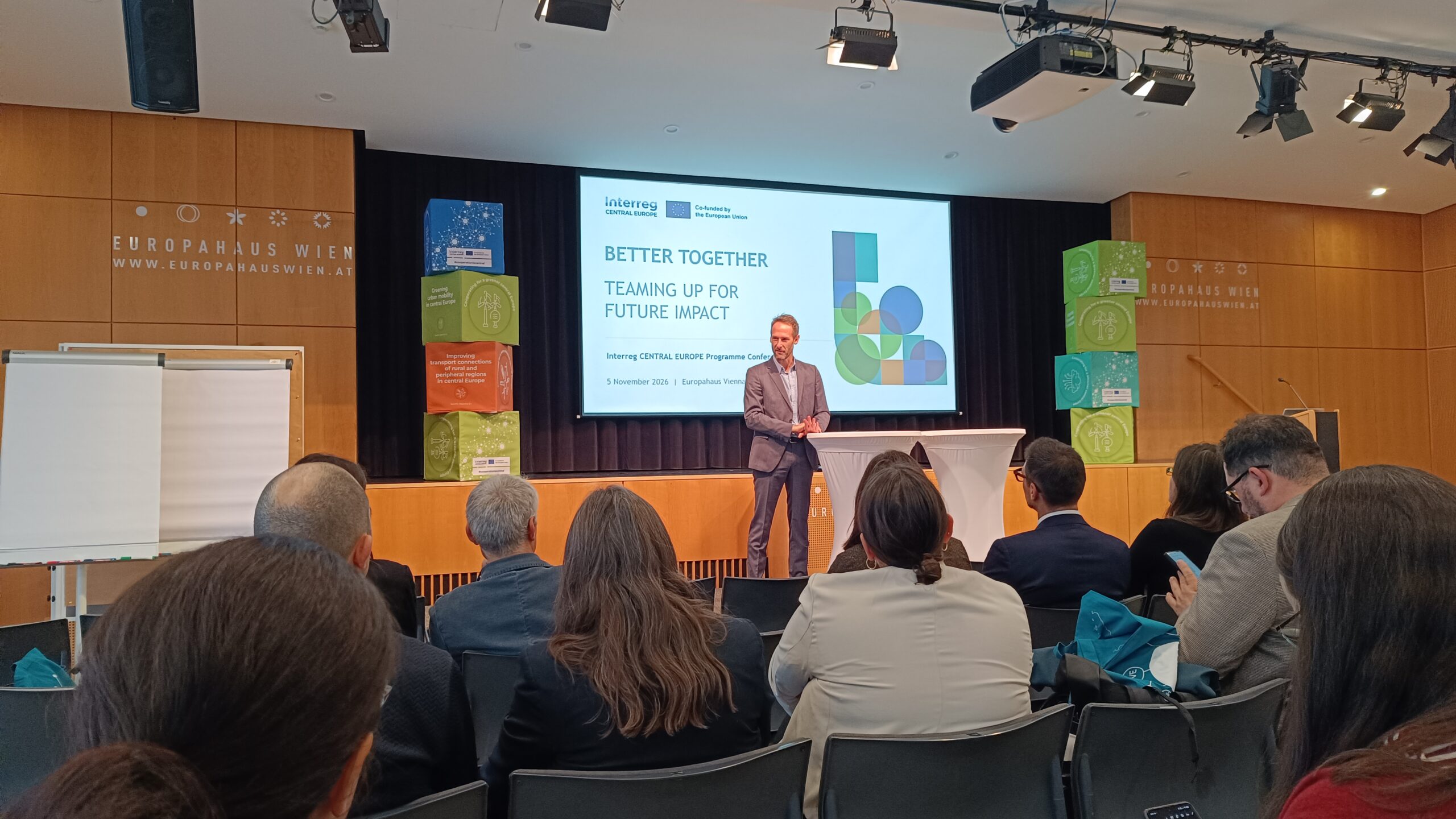
On 5 November 2026, representatives of the BIZ Mobility project attended the Interreg CENTRAL EUROPE conference “Better Together: Teaming Up for Future Impact” in Vienna. The event brought together around 200 participants from across Central Europe to exchange experiences, explore opportunities for cooperation and discuss the future of the Interreg programme.
The conference focused on creating synergies between projects, making better use of their results and informing about the next Interreg CENTRAL EUROPE programme for 2028–2034. One of the main messages was that valuable knowledge and partnerships developed during projects should not be lost once the funding period ends. Participants shared experiences of how cooperation between projects can lead to new initiatives and help existing solutions reach more regions.
For BIZ Mobility, the conference was an opportunity to connect with other projects working on similar mobility challenges. Particularly relevant were GreenPATH, which focused on mobility management for employees and students; MUTABLE, which explores the role of local mobility managers in rural areas; and DREAM_PACE, which is testing demand-responsive transport solutions in areas with limited public transport services.
A particularly interesting example came from Osijek, Croatia, where the completed GreenPATH project developed transport models for three business zones. This experience is especially relevant for BIZ Mobility, as both projects address the challenge of improving access to employment areas. The approaches used in Osijek could offer useful lessons for the activities in Škofja Loka, Čakovec and Nagykanizsa.
Discussions also highlighted the importance of cooperation between municipalities, employers and transport providers when addressing commuting challenges. Several projects are testing approaches that could be adapted to business and industrial zones, from coordinated mobility management to more flexible public transport services.
The conference provided BIZ Mobility with new contacts and ideas for further cooperation. Following up with these projects and exchanging practical experiences could help identify solutions for the three BIZ Mobility pilot areas and build partnerships that continue beyond the lifetime of individual projects.