
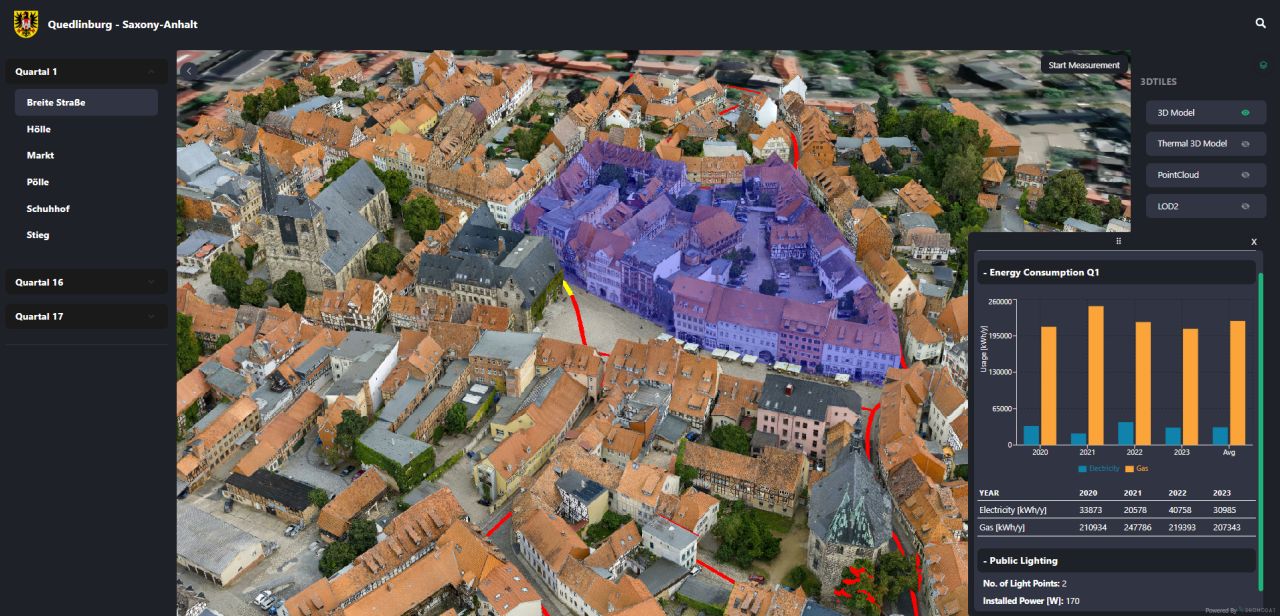
This tool integrates building metadata, energy performance data, and heritage constraints into a single, interactive environment and with that allows planners, local authorities, community members and other stakeholders to explore how energy-efficient upgrades (such as insulation, photovoltaics, or heat pumps) could reshape their neighborhoods. Accessible through a web browser, it removes barriers to entry, making planning tools available to all stakeholders.
Currently the platform is piloted in Quedlinburg (Germany), Karlovac (Croatia), and Palmanova (Italy), and enables users to navigate digital twins of chosen districts. By selecting a building, they can review its energy consumption, test renovation scenarios, and immediately assess the impact on costs, CO₂ emissions, and heritage preservation. A standout feature is its multi-criteria decision-making module, which lets users prioritize factors like cost efficiency, sustainability, or cultural compatibility. The tool then presents the results visually within the 3D model.
What makes this tool particularly valuable is its ability to bridge the gap between technical analysis and public engagement. It transforms abstract data into clear visuals, making the path toward Zero-Emission Neighbourhoods (ZEN) more transparent for everyone interested and involved.
Explore the VR tool here.