
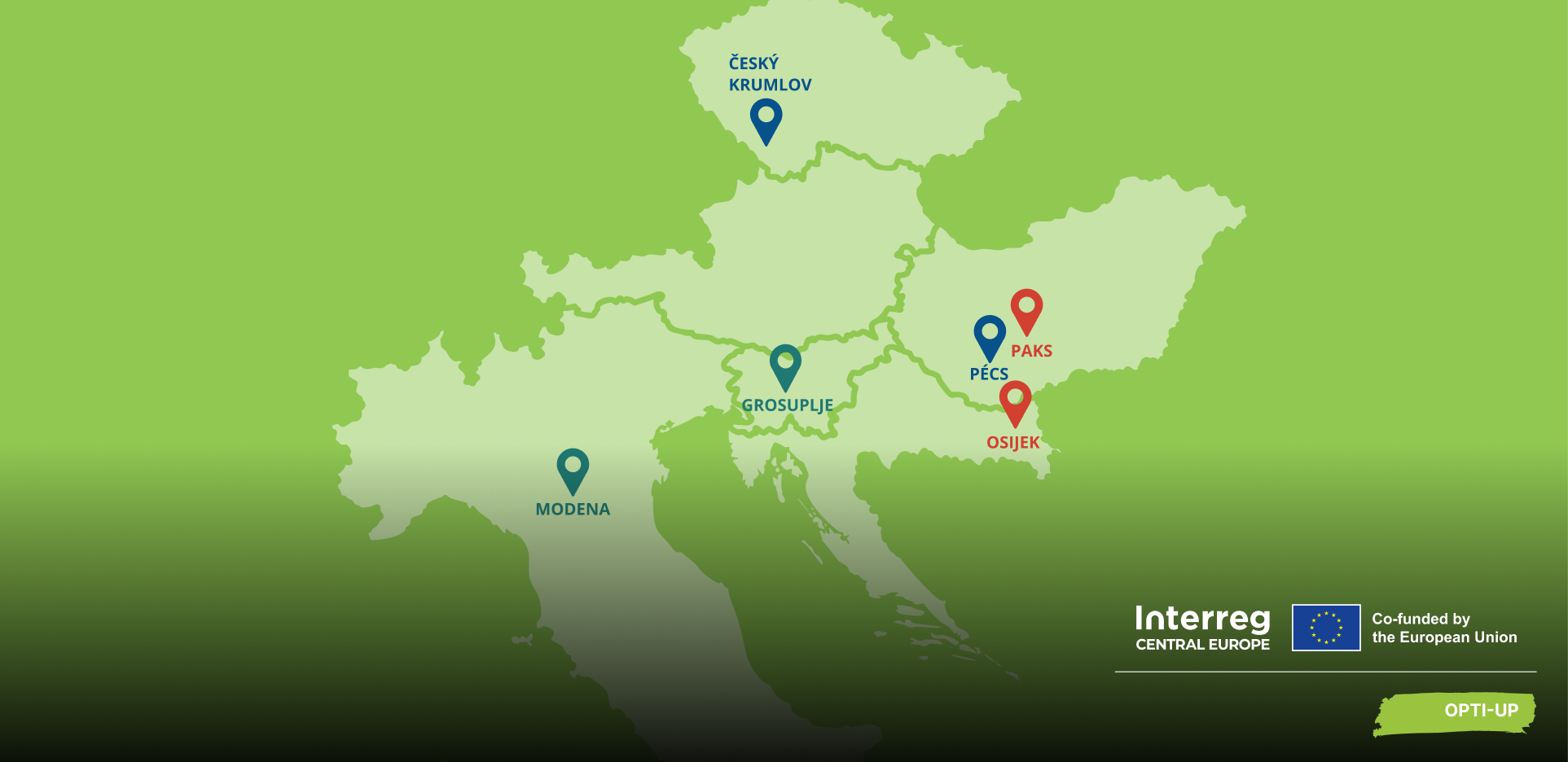
The new reports mark an important step in the project’s work on optimising and greening public transport in small and medium-sized cities. Through the OPTI-UP pilot actions, tailored public transport solutions were tested in Modena, Grosuplje, Osijek, Paks, Pécs and Český Krumlov, covering three thematic fields: demand-responsive transport, public transport network optimisation and alternative fuel technologies.
The newly published deliverables are:
D.2.1.1 – Pilot Action Report: Modena and Grosuplje project areas
This report focuses on demand-responsive transport (DRT) solutions implemented in Modena and Grosuplje. The pilots explored how flexible public transport can improve accessibility in low-demand areas while supporting more efficient and financially viable services.
D.2.1.2 – Pilot Action Report: Paks and Osijek project areas
This report presents the implementation of public transport network optimisation pilots in Paks and Osijek, focusing on adjusting routes and schedules to improve service coverage and respond better to local mobility needs.
D.2.1.3 – Pilot Action Report: Pécs and Český Krumlov project areas
This report covers pilot actions related to alternative fuel technologies in public transport. The pilots in Pécs and Český Krumlov tested electric vehicles and assessed their contribution to energy efficiency, passenger comfort, service quality and environmental sustainability.
D.2.2.1 – Comprehensive Evaluation Report and Recommendations for Thematic Solutions Scaling Up
The evaluation report brings together the results and lessons learned from all six pilot actions. It compares the performance of the tested solutions, analyses strengths and weaknesses, reviews user satisfaction and provides operational and financial recommendations for scaling up the solutions.
What the pilot actions showed
Across all six pilots, the tested public transport services proved to be technically and operationally stable, but the results also showed that successful implementation depends on practical factors such as clear user information, well-placed stops, suitable timetables, strong communication and stable financing. The pilots provided valuable real-life evidence on what works, where adjustments are needed, and which conditions are important for scaling up similar solutions in other cities.
The evaluation also confirms several important lessons for future planning. Data and transport modelling helped cities make better-informed decisions before launching new services. At the same time, practical service design details, such as stop locations, clear signage, logical timetables and easy-to-understand information, had a strong influence on how quickly users adopted the new services.
The DRT pilots demonstrated that flexible transport can improve accessibility in low-demand areas, especially when vehicles are matched to actual demand. The network optimisation pilots showed that even targeted route and timetable adjustments can help fill real mobility gaps, while the alternative fuel pilots confirmed that electric vehicles can perform reliably in small and medium-sized cities, including in challenging terrain.
The reports also point to the conditions needed for long-term success: stable funding, flexible contracts, strong communication with users, reliable data, well-prepared infrastructure and early involvement of local communities, operators and authorities.
Together, these deliverables provide a practical evidence base for cities that want to improve public transport through flexible services, better network planning and cleaner vehicle technologies, while also understanding the operational, financial and user-related conditions needed for long-term success.
We invite you to take a closer look at the newly published deliverables and explore the pilot results, lessons learned and recommendations in more detail.
Pilot Action Reports (D.2.1.X)
OPTI-UP D.2.1.1 Pilot Action Report Modena and Grosuplje Project Areas
OPTI-UP D.2.1.2 Pilot Action Report Paks and Osijek Project Areas
OPTI-UP D.2.1.3 Pilot Action Report Pécs and Český Krumlov Project Areas
Comprehensive evaluation report and recommendations for thematic solutions scaling up (D.2.2.1)