
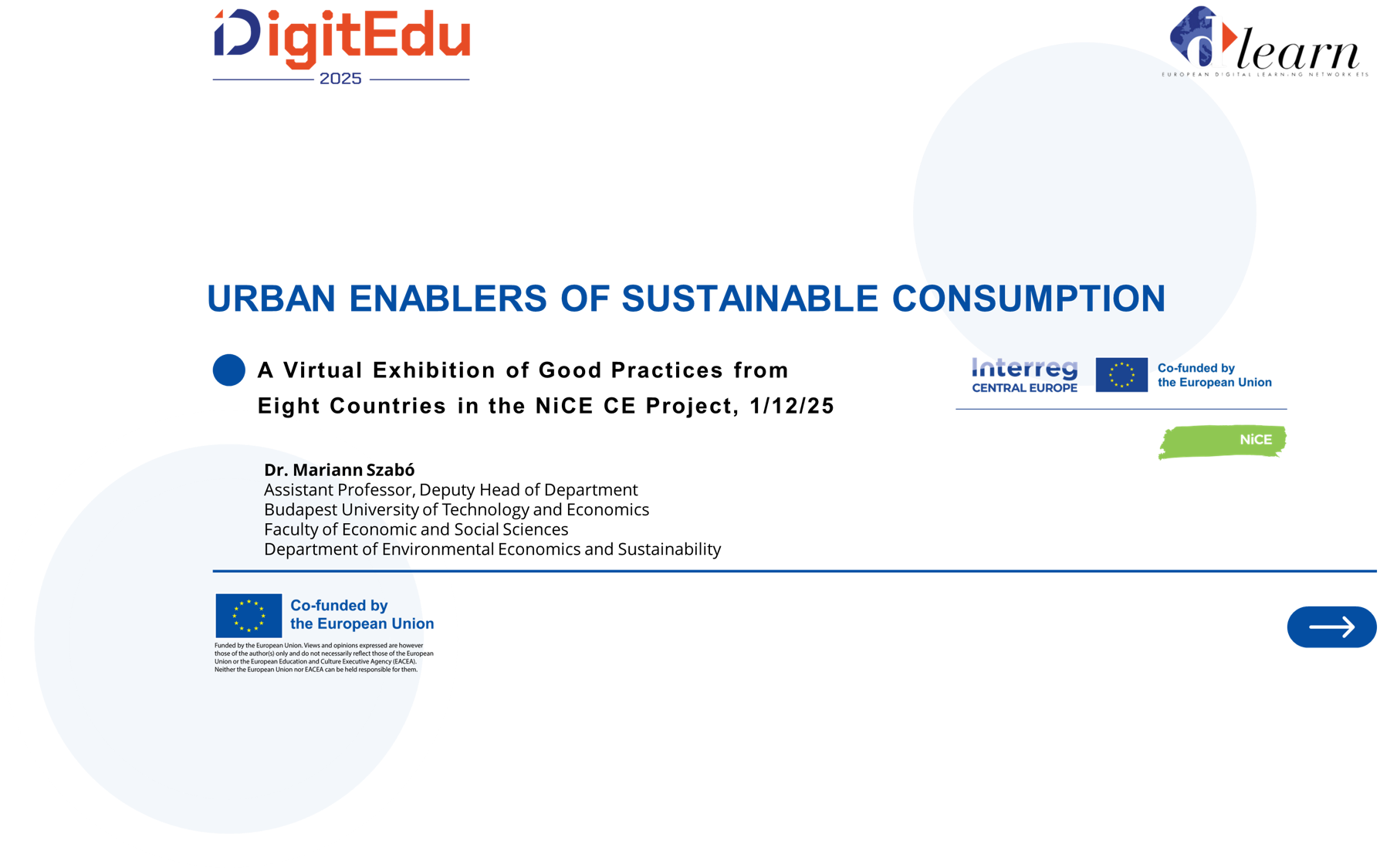
Dr. Mariann Szabó Pioneers Integration of Digital Literacy and Circular Economy Education
BUDAPEST, 1 December 2025
The vital intersection of digital literacy and sustainability took centre stage at the DigitEdu 2025 webinar, “Practical methods to promote digital literacy among students in primary and secondary schools”. The event, organized by the European Digital Learning Network ETS and CAM Consulting, Hungary convened leading experts to explore hands-on strategies for preparing the next generation for the digital world.
Participants could learn about practical European methods, solutions and tools from Slovenian, Turkish and Hungarian experts.
A contribution came from Dr. Mariann Szabó, Assistant Professor and Deputy Head of Department at the Environmental Economics and Sustainability Department of the Budapest University of Technology and Economics (BME) on behalf of the NiCE Project: From Niche to Centre-City Centres as Places for Circular Lifestyles, which is co-funded by the Interreg Central Europe Programme.
Dr. Szabó, who also serves as a Work Package Leader for the NiCE Project, delivered a presentation titled: “Urban Enablers of Sustainable Consumption: A Virtual Exhibition of Good Practices from Eight Countries in the NiCE CE Project.”
Her presentation demonstrated how cutting-edge digital platforms can be leveraged not only to teach technical skills, but to fundamentally shift citizen behaviour towards circular lifestyles.
“Engaging citizens in circular lifestyles can be implemented through new ways of awareness-raising initiatives”, stated Dr. Szabó during her presentation. “The Virtual Exhibition developed in the NiCE Project is a unique, one-of-a-kind experience demonstrating how circular lifestyles can be mainstreamed in cities”. The Virtual Exhibition serves as a crucial educational tool, showcasing successful models of sustainable consumption from eight European countries. By translating complex concepts of circularity into an accessible, immersive digital format, the project addresses the need for engaging, non-traditional educational content required for a successful green transition.
Dr. Szabó emphasized that digital literacy extends beyond operating technology; it is a critical tool for transmitting core European policies and values, such as sustainability and the drive towards a circular economy.
Highlighting the broader mission of the DigitEdu initiative, Dr. Szabó concluded: “Platforms dedicated to improve digital literacy are means to transfer European values and policies, such as sustainable consumption and transformation in the circular economy”.