
How can circularity become the new normal for electronics? What needs to change in the way we design products, recover materials and create business models? And how can we communicate the complexity of electronic waste in a way that engages people rather than simply presenting them with another environmental problem?
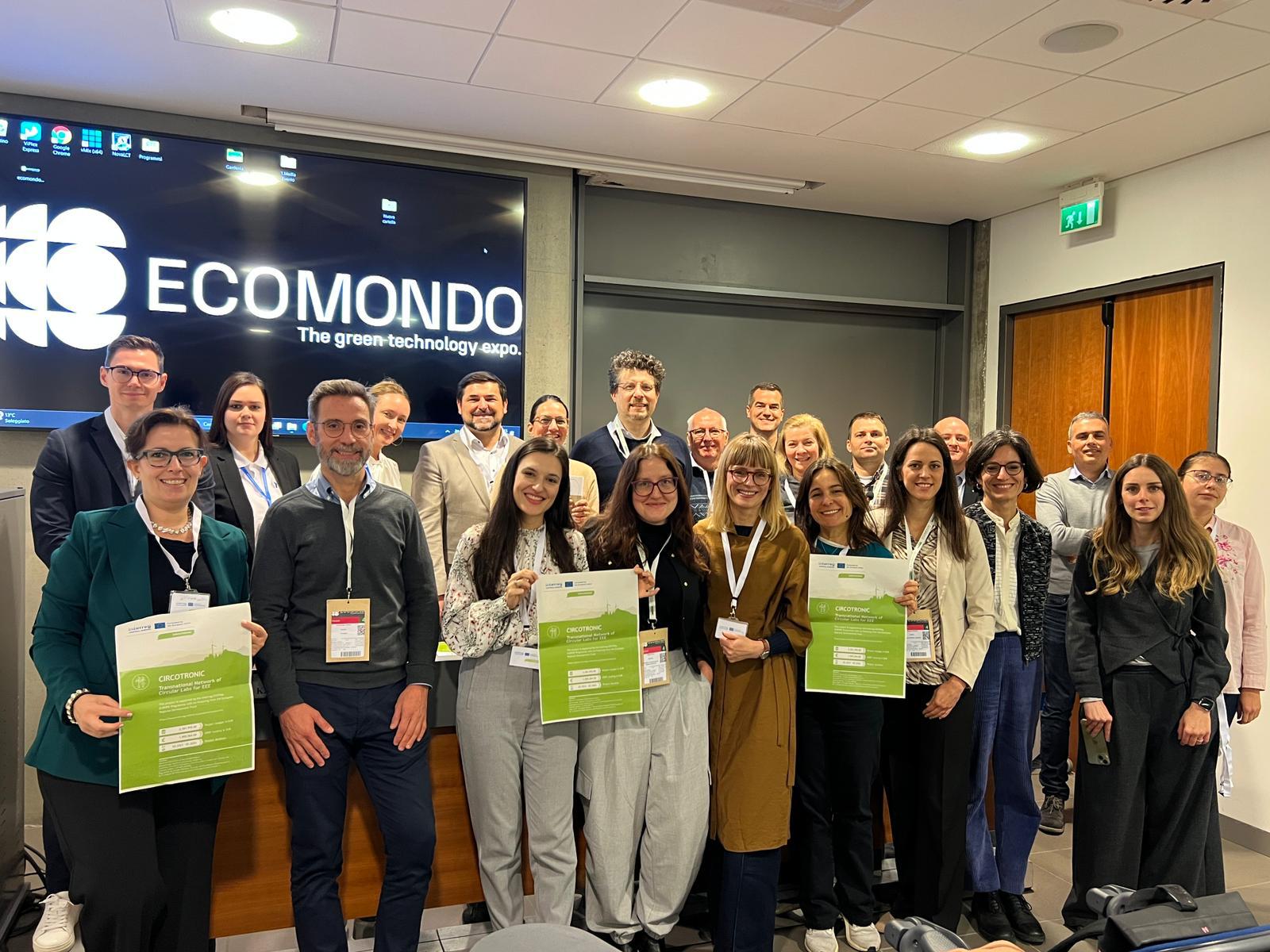
These were some of the questions accompanying the CIRCOTRONIC partnership during its three-day final event in Italy. Held between Bologna and Rimini and connected with ECOMONDO, one of Europe’s leading events dedicated to ecological transition and the circular economy, the meeting created an opportunity not only to present the results of three years of work, but also to exchange knowledge, confront different perspectives and discuss what should happen next.
Funded by the Interreg CENTRAL EUROPE programme, CIRCOTRONIC brought together partners working to accelerate the circular transformation of the Electrical and Electronic Equipment (EEE) sector. The final event reflected this diversity, connecting representatives of research organisations, regional institutions, businesses, industry organisations and circular economy experts from across Europe.
A meeting within a wider circular economy ecosystem
The programme began at ECOMONDO in Rimini. Rather than immediately moving into project presentations, partners had an opportunity to explore the fair, participate in workshops and encounter solutions related to sustainability, circularity and emerging technologies.
An event organised by ERION on Waste Electrical and Electronic Equipment (WEEE) provided a particularly relevant context. Claudia Romano, Head of the Energy and Green Economy Area of the Emilia-Romagna Region, shared insights into regional policies and circular strategies for electronics, opening a wider discussion about the opportunities and barriers facing the sector.
The following day placed CIRCOTRONIC itself on the ECOMONDO stage.
The project’s final workshop moved from results towards a broader conversation about transformation. Urška Spitzer from the Chamber of Commerce and Industry of Slovenia introduced CIRCOTRONIC’s vision, strategic goals, tools and Circular Labs. Rainer Pamminger from TU Wien and Nivedita Mahida-Königsdörfer from the Bavarian Research Alliance then explored the transition from linear to circular, presenting the project’s Guidebook and experiences gained through regional pilot activities.
But perhaps one of the most important moments came when presentations gave way to a question:
How do we make circularity the new normal for electronics?
The roundtable brought together expertise in circular economy strategy, public policy, critical raw materials, WEEE recovery and waste management. Danilo Bonato from ERION, Klara Grašič from the Chamber of Commerce and Industry of Slovenia, Amalia Zucaro from ENEA and André Rückert from ECOLOGICON approached the question from different professional perspectives.
There was no single answer—and this was precisely the value of the conversation. Circular transformation requires changes across an entire system: from design decisions and material flows to regulation, infrastructure, business models and consumer relationships.
Connecting circularity with people
The workshop concluded by adding another perspective to the discussion: communication.
The session “UNPLUGGED: Connecting with People When Dealing with Electronics”, led by Magdalena Małachowska, researcher and designer at the Academy of Art in Szczecin, demonstrated how design, storytelling and exhibition formats can make the challenges hidden inside our electronic devices visible and accessible.
Circularity is ultimately not only about materials circulating through industrial systems. It also depends on people’s ability to understand those systems, question established patterns of production and consumption, and imagine alternatives.
This connection between knowledge and practice continued outside the conference setting. In the afternoon, CIRCOTRONIC partners travelled to Marzabotto to visit Dismeco, an Italian company specialising in WEEE treatment and material recovery. Seeing electronic waste being processed provided a tangible counterpart to the discussions held at ECOMONDO and an opportunity to observe how circular principles operate in a real industrial environment.
Knowledge that continues beyond the project
The final day brought the partnership back to Bologna for technical presentations, reflection and project closure. Partners discussed the results of CIRCOTRONIC’s work on circular electronics solutions, regional Circular Labs, pilot activities and communication, including the project’s virtual and travelling exhibition.
The meeting therefore became more than a formal conclusion to a European project. Across three days, participants moved between policy and practice, research and industry, strategic discussion and direct observation.
Perhaps this is one of the most valuable roles such events can play in the circular transition: creating a temporary space where different forms of knowledge meet.
Projects produce tools, reports and methodologies. But transformation also requires conversations—opportunities to compare experiences, challenge assumptions and formulate questions that no organisation can answer alone.
CIRCOTRONIC’s final event demonstrated that sharing knowledge is not simply about transferring what we already know. Sometimes its greatest value lies in helping us identify the questions we still need to ask.