
Zilina pilot – resident parking in Hájik: data-driven and participatory approach
Based on the ParkPAD audit, the city has piloted resident parking in the Hájik district. Prior to implementation, data collection (night vehicle censuses, measurement of traffic load and occupancy of parking spaces) was carried out, which revealed a lack of capacity. Monitoring technologies and sensors were deployed in the area to monitor traffic and driver behaviour, supporting data-driven decision-making. To support this new resident parking system, the city also launched a dedicated digital online portal for residents, enabling citizens to easily handle registration, request resident parking cards, and manage vehicle transfers fully online.
Citizen pilot:
The project was accompanied by a participatory approach: to initiate the discussion with the citizens a supportive data collection system on traffic load has been designed by the project partner CityOne and has been co-designed with the Department of mobility. The purpose of the system is to:
- Provide a dashboard on Facts and Figures (traffic statistics to public as well as politicians) to enhance communication and public consultation
- Provide an analytical tool for evaluation and decision making for parking measures
- Provide useful data for NXTLVL citizen driven event on parking policy in the Hájik area
- Enhance digital culture based on open data with the aim to provide Hájik citizens with basic statistics and a comparison with other areas (adjacent areas)
The system consists of 10 profiles monitoring covering the area of Hájik.
The experience from the pilot provided the basis for the expansion of regulated parking to other parts of the city and supports the vision of Žilina, where parking serves as a tool for regulating traffic, protecting public space and promoting sustainable mobility and prioritizing residents over long-term commuters.
Zilina pilot – bicycle parking mapping
The City of Žilina carried out a comprehensive mapping and evaluation of bicycle parking in order to support sustainable mobility across key locations such as schools, public institutions, transit hubs, and the central railway station. The activity included field data collection directly on the city streets, processing into digital form and analysis using GIS tools. More than 180 sites were examined, cataloging hundreds of individual parking spaces, including public bike racks and selected private facilities. For each location, capacity, type of stands, accessibility, technical condition and safety were evaluated.
The result was a central bicycle parking database ready for further update and use in the city’s geographic information system. The analysis revealed key problems – lack of capacity in exposed locations, inappropriate types of stands (such as outdated wheel-clamp style racks compared to secure, frame-anchored Sheffield-style stands) and lack of covered parking.
The output included concrete suggestions for improvement, including a recommendation for the uniform use of safe stands and a gradual increase in capacity. This output provided a professional and data-based basis for the planning, modernization and systematic development of bicycle parking and supported the connection of parking policy with sustainable cycling transport in the city of Žilina.
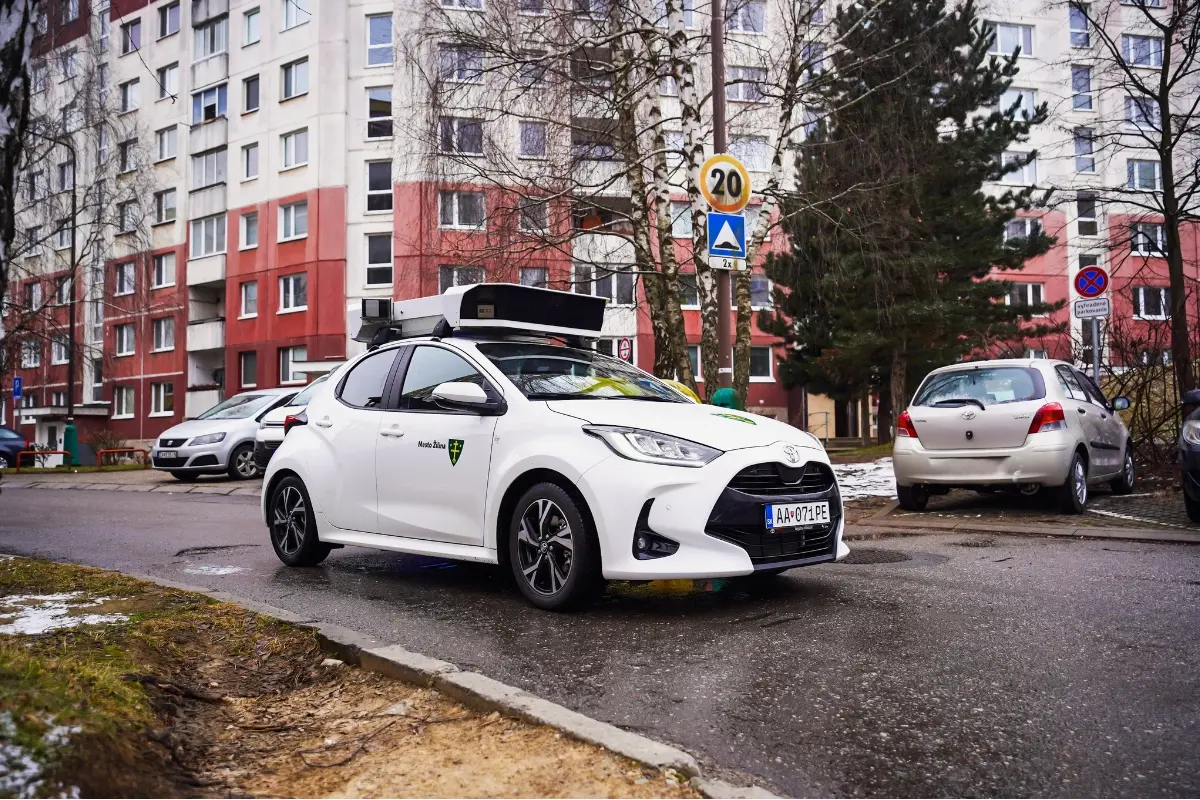
Zilina pilot – scanning vehicle for automatic parking control
The City of Žilina has introduced a pilot project of a scanning vehicle for automatic parking control, especially in the Hájik housing estate, with the aim of increasing the efficiency and transparency of parking supervision. The vehicle is equipped with 2D and 3D cameras that automatically scan vehicle license plates and verify the validity of parking fees while driving, and can check up to 80 vehicles per minute. This automated system directly links with Municipal Police operations for targeted enforcement.
The pilot deployment has brought a significant improvement, with the number of vehicles inspected rising from 30-50 per hour to more than 1,000, with dozens of parking rule violations identified daily. The project allowed for more precise planning of measures and improvement of the organization of parking spaces.
Residents reacted mostly positively, especially after the information campaign and the public presentation of the vehicle. The project promoted fair application of the rules and transparency of control. The web, social networks, regional media, newspapers and radio were used for communication.
The results of the pilot showed that modern technologies can increase driver discipline and efficient use of parking capacities. The city plans to gradually expand the system to other locations and continue to improve parking infrastructure, with an emphasis on cooperation with citizens and sustainable parking management.
See the video about the pilots: https://www.youtube.com/watch?v=08yzk4LyArU