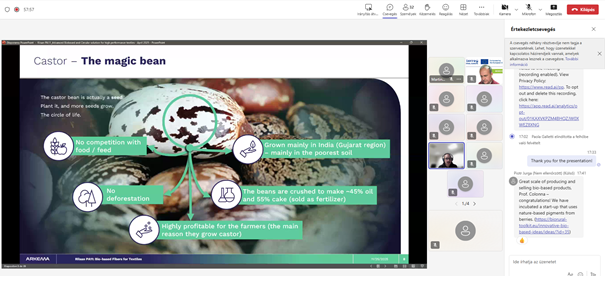
The first in a series of webinars dedicated to the role of the bioeconomy in various sectors, with a particular focus on the role of the bioeconomy in sport, was held on January 25, 2025. This dissemination activity is part of the Interreg Central Europe BIOECO-UP project. After a brief introduction by Professor Fabrizio Cavani, a member of the UniBo (University of Bologna, Italy) team participating in the project, Professor Chiara Samorì briefly provided an overview of the bioeconomy and circular economy in sport, their development prospects, and the main challenges from a scientific perspective. Professor Martino Colonna, CEO of the spin-off Re-Sport (Italy), presented the company’s activities, specializing in the recycling of multi-component sports equipment, such as shoes, helmets, ski boots, and skis. These are typically not recycled due to their complex composition, as they contain multiple polymers. The developed processes involve selectively dissolving the polymers with bio-based solvents, such as limonene from citrus peel waste and ethyl acetate; the solvents are then recovered and reused multiple times. Dr. Colonna illustrated several practical examples of how used equipment is treated to reintroduce its various components into the supply chain. In the case of helmets, it was possible to separate polystyrene, ABS, and polycarbonate, which maintain their original mechanical properties. Several processes have been developed that will soon be implemented on an industrial scale. Dr. Gábor Gremsperger, CEO of Climate Action Ltd. (Hungary), described the company’s activities, an environmental consultancy firm focused primarily on integrating sustainability principles into the sports sector, collaborating with sports federations and associations to improve the social, financial, and environmental sustainability of sports activities. For example, the “Legacy Forest” project, launched during the Budapest Athletics Championships, aimed to redevelop and enhance ten hectares of urban land in Budapest with new trees (5,000 seedlings of different tree species per hectare) to improve the area’s biodiversity. The initiative was supported by sponsors (clubs and sports federations) and involved the athletes at the sporting event. Dr. Thibaut Savart of Arkema (France), reported about company’s activities, amongst which the production of high-performance bio-based polymers, such as PA11 and PA12, currently commercially available for fibers for textiles used in sportswear. The supply chain begins with castor beans, which pose no competition for human consumption and are also a profitable crop for farmers. Every part of the seed is utilized, the main component being the oil for polyamide synthesis, used in sports and leisure. A detailed environmental impact assessment has shown that the carbon footprint of these bio-based polymers, the use of agricultural land and the water consumed for growing the castor plants are lower than those of fossil-based polyamides. Professor Artur Bartkowiak, co-founder of Bio2Materials (Poland), presented the NUTICO project, which develops next-generation circular materials similar to natural leather, starting with food waste as the raw material. “Chocolate leather” was the first commercial B2M product, named after the nut waste from a chocolate production facility in Szczecin. Other food industry waste used includes coca husks and ground walnut shells from Ukraine. The waste is Page 2 used as a bio-based filler and mixed with bioplastics, while the bottom layer of the material is made of organic cotton or other cellulose-based polymers. The material was treated with natural dyes and, importantly, is biodegradable. About 30 people attended the online webinar; it is available on the project’s YouTube channel: Transnational bioeconomy webinars on bioeconomy in sport appareil – YouTube