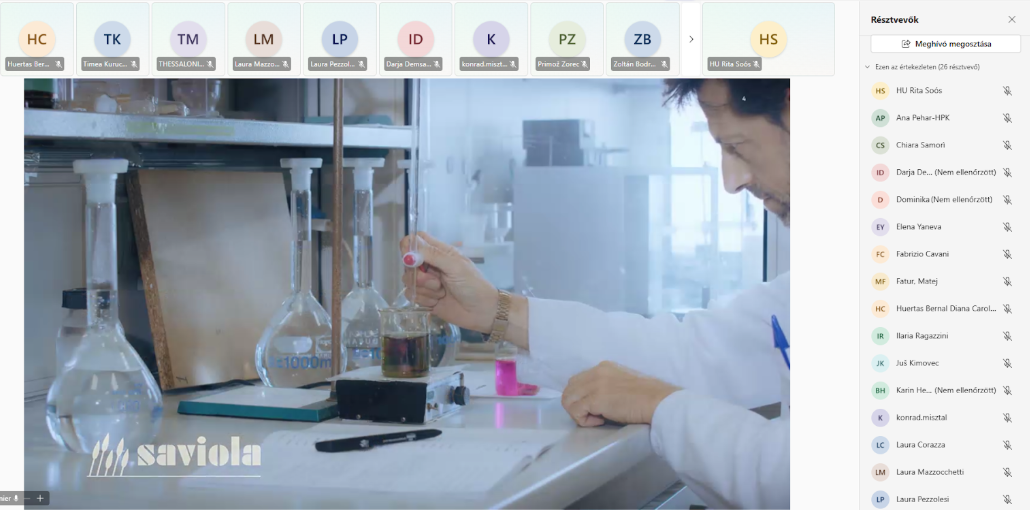
The second of a series of 3 webinars, dedicated to the role of Bioeconomy in construction and furnishing, was held on December 16, 2025 After a brief introduction by Professor Paola Galletti, Professor Fabrizio Cavani briefly provided an overview of the bioeconomy and circular economy in construction and furnishing, their development prospects, and the main challenges from a scientific and technological perspective. Dr Ilaria Ragazzini presented the activities of ALPI Wood by Design (Italy). ALPI offers an extensive range of high-quality, sustainable reconstituted wood veneers that combine avant-garde industrial processes with craftsmanship and design potential. The company provides innovative and bespoke wood solutions to the architecture, furniture, automotive, and nautical industries. ALPI collaborates with renowned international designers to create a variety of unique patterns, textures, and color variants that can replicate natural wood or offer original effects not found in nature. To ensure complete transparency in environmental and social responsibility, all wood sources from certified, responsibly managed forests (FSC® certified), and the entire production chain from trunk to finished veneer is controlled. This commitment also involves minimizing environmental impact, promoting workplace safety, and contributing to the growth of local communities. Dr Lorenzo Venier presented the activities of Gruppo Saviola (Italy) and of associated enterprises. GS is an “Eco-Ethical Company” focused on biocircular economy, recycling post-consumer wood to create new products, so contributing to saving trees, reduce CO2, integrating sustainability into all business, from furniture to life sciences, through innovation, respect for people, and ethical practices. GS aims to show that business success and environmental responsibility can go hand-in-hand. Gruppo Saviola achieves this mission through a vertically and horizontally integrated model across four main divisions: Saviola (Wood): production of 100% recycled ecological panels; Sadepan (Chemicals): sustainable production of resins and glues with low formaldehyde emissions; Composad (Furniture): creation of ready-to-assemble (RTA) eco-friendly furniture; Saviolife (Life Science): development of low-impact products for agriculture and animal nutrition. Dr. Elena Yaneva illustrated the activities of Hempstatic (Austria), a startup pioneering recyclable, carbon-negative insulation and acoustic panels made from the woody core of hemp, mixed with lime-based binders. Hempstatic turns agricultural waste into materials that are naturally resistant to fire, mold, and pests, all while improving indoor air quality by regulating humidity and temperature. The strategy of Hempstatic is to establish new, regional, bio-based value chains to develop the potential of industrial symbioses in construction, to promote biodegradability and circularity in products, which are designed to be reused or recycled at the end of their lifespan, and advancing innovation in the field of biocomposites to accelerate their industrial adoption and make “designing with nature the new norm”. Dr. Marcin Górnicki and K. Misztal presented the activities of ReedBirds (Poland), whose mission is to build the next generation of sustainable, carbon-negative materials to eliminate pressure on forests and provide a reliable, climate-friendly source of raw materials for Europe. ReedBirds produces low-carbon, sustainable biocomposites from wetland plants, primarily common reed, to replace wood and plastics across industries like construction, furniture, automotive, and packaging. This raw material is sourced from through wetland cultivation (paludiculture) from non-agricultural areas, ensuring a deforestation-free value chain that does not harm existing forests or farmland. Therefore, this model supports the restoration of wetland ecosystem services, which aids in water retention, biodiversity enhancement, and carbon storage. By developing scalable, climate-resilient alternatives to traditional materials, ReedBirds aims to support Europe’s transition to a circular, resource-independent economy. Dr. Primož Zorec presented the activities of CoGreen (Slovenia), whose mission is to provide healthy, safe, and environmentally friendly construction solutions using natural, bio-based materials like hemp (Hemp Building Solutions). The company aims to offer natural alternatives to traditional, carbon-intensive building materials, transfer scientific knowledge and research on natural construction materials into industrial practice, promote sustainable and energy-efficient construction with a goal of achieving zero-carbon buildings. Hemp is a fast-growing, renewable resource that captures carbon, so actively storing carbon in the fabric of buildings, thus reducing the construction industry’s environmental footprint. CoGreen seeks to reshape the construction industry by building healthier, more sustainable living spaces and supporting the circular economy through the use of regenerative, natural materials. CoGreen also hosts the Hemp2Cogreen conference website. About 25 people attended the online webinar. It is available on the project’s YouTube channel at the link: https://www.youtube.com/watch?v=EMhj0fghH8E Follow us and join us on the final webinar on 20th January 2026 !