
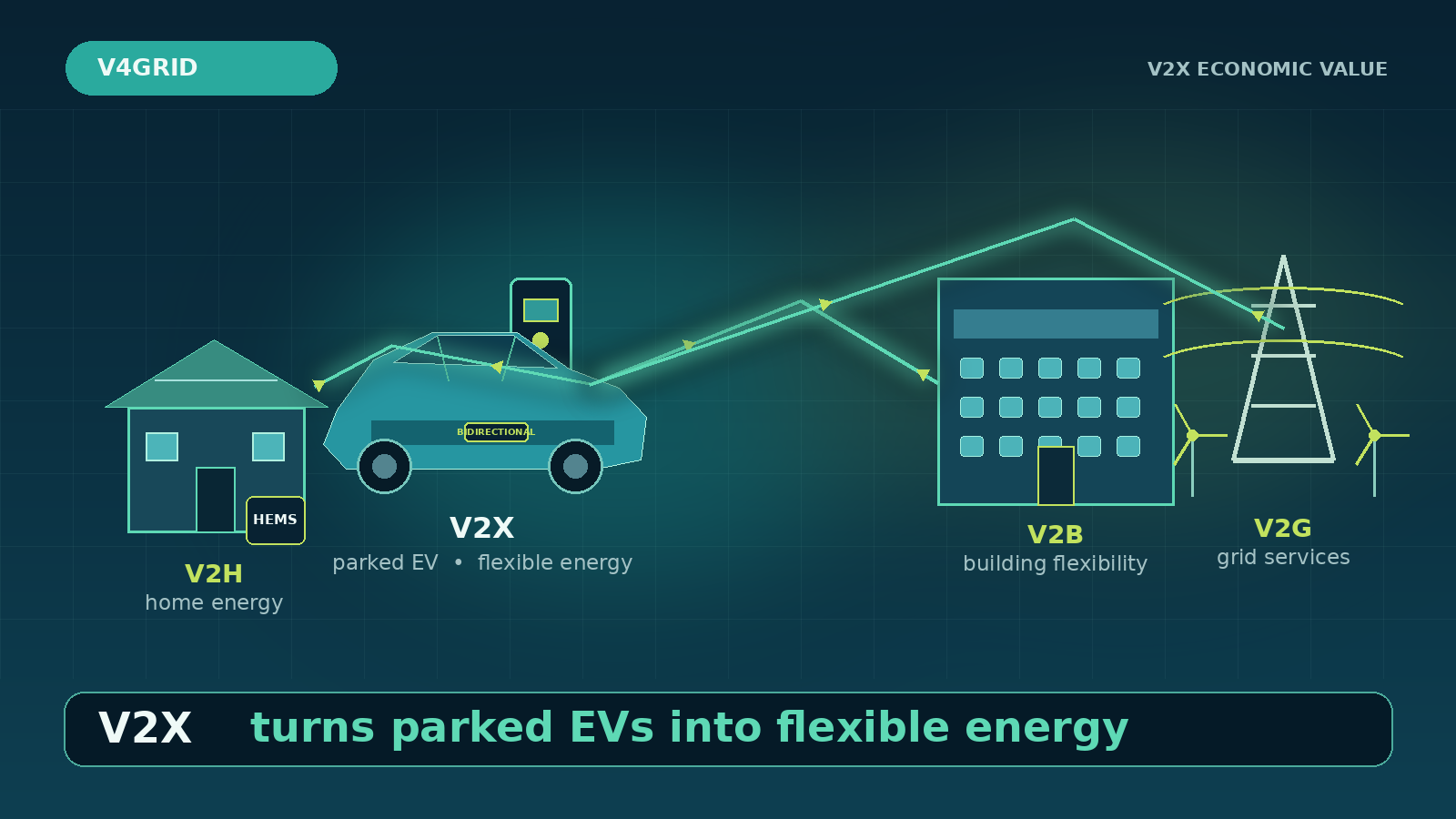
Electric vehicles can contribute to energy management while continuing to serve their primary purpose: transport. With compatible vehicles and charging equipment, bidirectional charging allows electricity stored in a vehicle battery to supply a home, a commercial building or the grid. V4Grid has examined the conditions under which these applications could create economic value in Hungary, Slovakia, Czechia and Poland.
The assessment brings together technical capabilities, investment and operating costs, potential energy savings and commercial arrangements. It provides a framework for evaluating opportunities before investment. The findings are based on modelled scenarios and should not be interpreted as measured commercial returns.
Three applications are considered. Vehicle-to-home (V2H) can help households use more locally generated solar electricity, depending on household demand and when the vehicle is connected. Vehicle-to-building (V2B) can coordinate fleet charging with building consumption and help reduce costly demand peaks. Vehicle-to-grid (V2G) explores opportunities for price-responsive energy exchange and coordinated flexibility services, subject to market access and reliable vehicle availability.
Commercial buildings and fleets emerge as a promising early setting under the assessment’s assumptions. Predictable parking patterns can make it easier to align vehicle availability with building energy needs. Household opportunities depend more closely on existing solar generation and energy-management infrastructure. For grid-facing services, combining several vehicles through aggregation may improve market access and share service costs, although a larger fleet does not automatically guarantee dependable capacity or profitability.
A central question is how to assess the investment. Where charging infrastructure is already planned, the additional cost of bidirectional capability may be the relevant comparison. Where an entirely new installation is needed, the full investment must be considered. In both cases, the assessment must include integration, maintenance, energy losses, battery use and any intermediary fees. Benefits also need to be compared with an appropriate baseline, including smart one-way charging where relevant.
The analysis combines application-specific scenarios with country-level comparisons and examines how changes in key assumptions affect the outcome. Tariffs, network conditions and commercial arrangements differ across the four countries, so local verification is essential. Vehicle availability and users’ required departure energy also place practical limits on the services that can be offered.
Successful business models require clear agreements between vehicle owners, building operators, technology providers and market partners. These should explain operational responsibilities, participation conditions and how costs and benefits are shared. Combining several services can create additional value only where their commitments are compatible.
The next step is to test the assumptions against operating evidence, linking charging behaviour and building demand with delivered flexibility and actual costs. This will help identify where benefits can be repeated and where further development is needed. Through this work, V4Grid supports informed decisions on how electric mobility can contribute to more flexible energy use across Central Europe.