
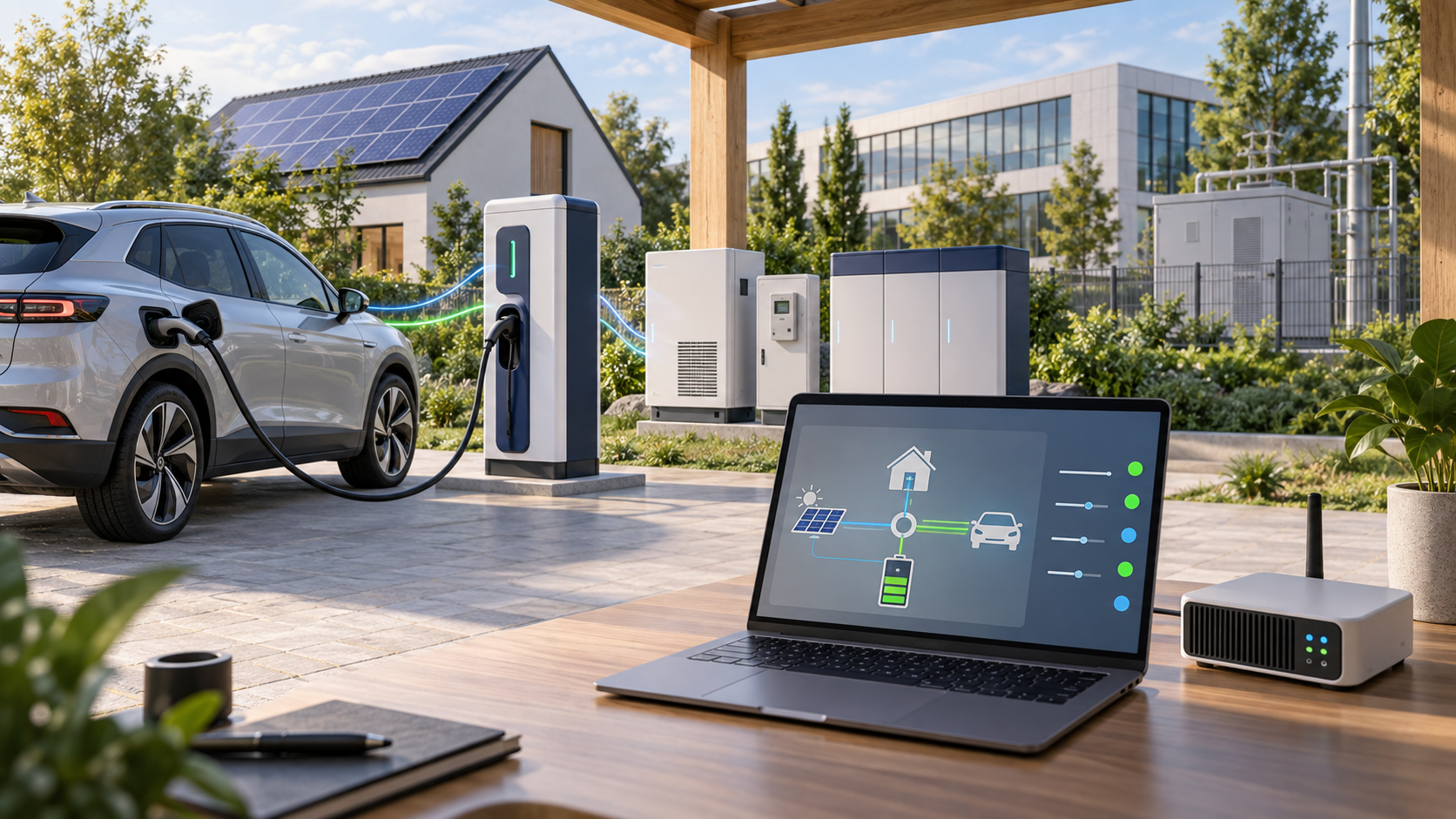
Electric vehicles can offer flexibility to homes, buildings and the electricity system, but their availability for transport remains essential. V4Grid is examining how energy optimisation can coordinate charging and discharging with local electricity demand, renewable generation and users’ travel requirements.
The work focuses on energy management at the electricity connection point of a household, commercial building or fleet site. These locations may combine electric vehicles with solar panels and stationary batteries. Coordinating these resources creates opportunities to use more local renewable electricity and manage periods of high demand. The approach establishes a methodological basis for development and evaluation; actual performance requires separate validation.
Four applications are considered. Vehicle-to-home can help align household consumption with solar generation by using a compatible vehicle’s battery when it is connected. Vehicle-to-building addresses coordinated charging and energy use at commercial premises, taking fleet schedules and site capacity into account. Price-responsive vehicle-to-grid operation explores the timing of electricity purchases and exports. Aggregated vehicle-to-grid services consider how several participating resources could jointly respond to external requests for flexibility.
Each application has different requirements. A household may generate solar electricity while its vehicle is away, limiting how much energy the vehicle can store. At a business site, several vehicles may need to charge before similar departure times, creating concentrated demand. An effective approach must therefore consider when vehicles are connected, how much energy they need for their next journey and what the site can accommodate.
The driver’s expected departure and required battery energy are central to this planning. Battery operating limits, charger capabilities and the electricity connection also define what is possible. An action that appears attractive from an electricity-cost perspective may be unsuitable if it leaves a vehicle unprepared for use. Likewise, additional energy exchange needs to be assessed against battery wear and unnecessary cycling.
Local conditions strongly influence the opportunity. Homes, offices and fleet depots have different consumption patterns, tariffs and parking schedules. Renewable generation and vehicle availability can also change after a plan has been prepared. An approach suitable for one location cannot be assumed to produce the same outcome elsewhere.
Grid-facing applications introduce further conditions. Technical bidirectional capability must be supported by appropriate connection arrangements, permitted electricity exchange and operational and commercial agreements. Coordinating a group of vehicles also requires a realistic assessment of the flexibility they can actually provide. These applications should therefore be evaluated according to their specific readiness and operating context.
V4Grid’s contribution is a common framework for considering energy objectives together with mobility and site requirements. It helps define the questions that future evaluation must answer: whether an energy benefit can be demonstrated, whether users’ transport needs remain protected and whether the intended service can operate within local constraints.
This work supports the development of V2X applications that make better use of connected energy resources while keeping vehicles available for everyday journeys. Further validation will be needed to establish the benefits and limitations in practice.