
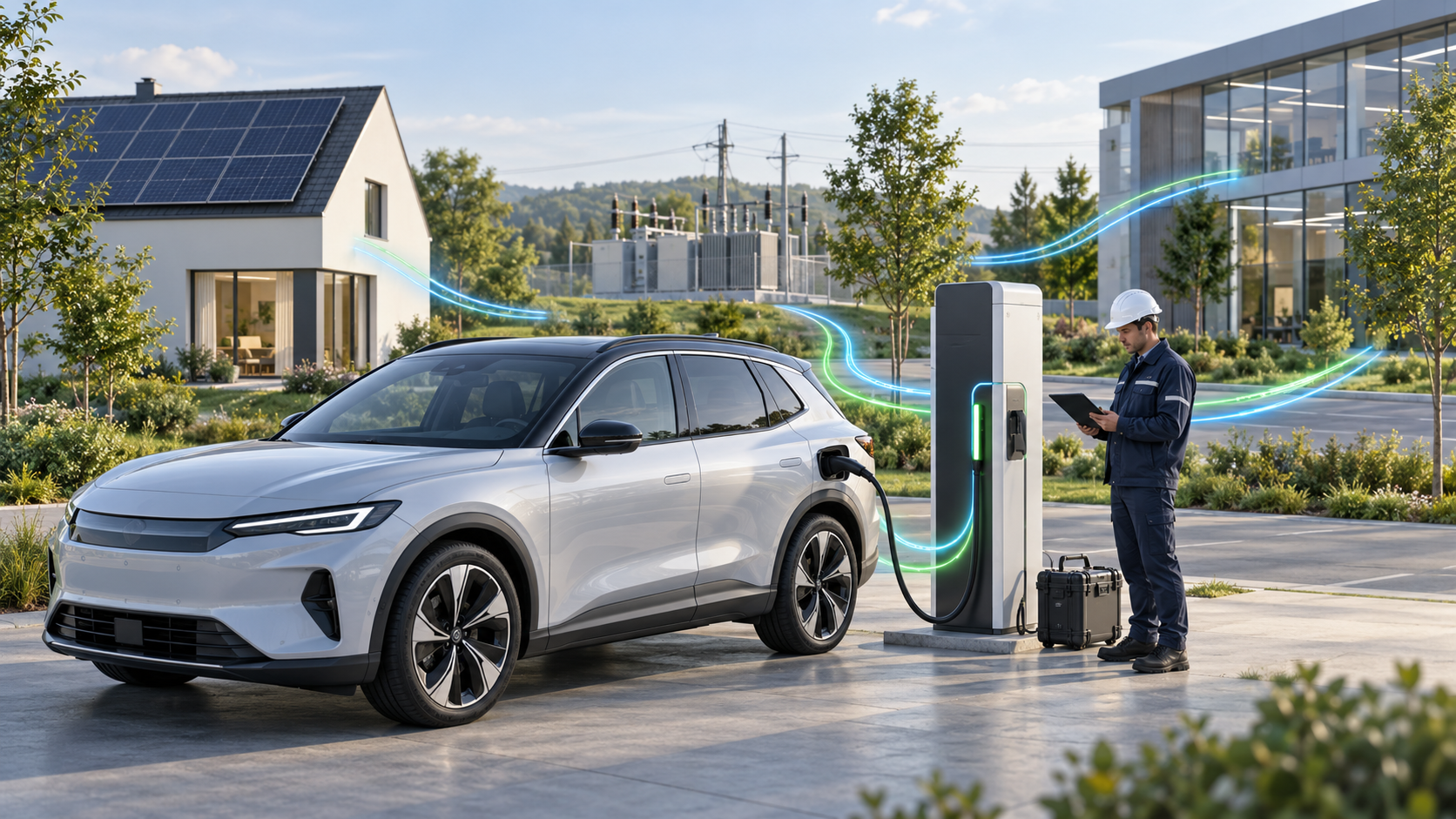
When should an electric vehicle charge, and when could its stored energy support a home, a building or the electricity grid? The answer depends on changing conditions, including electricity demand, solar generation and the driver’s next journey. V4Grid is exploring how artificial intelligence and machine learning can help bring this information together to support energy management decisions.
The work outlines a design framework for vehicle-to-everything (V2X) applications, connecting energy forecasting, simulation of vehicle use and optimisation. It reviews possible methods and development directions. The intended benefits include better use of renewable electricity, lower demand peaks and more effective coordination of flexible resources; these remain objectives for evaluation rather than demonstrated operational results.
Three modelling tasks form the basis of the approach. Forecasting estimates future conditions, such as solar production and building electricity demand. Simulation explores possible situations, including when vehicles might arrive, connect or leave. Optimisation uses this information to select charging and discharging actions within defined operating limits. Keeping these tasks distinct helps clarify how each contributes to a decision and how its performance should be assessed.
The framework covers household, building and grid-facing applications. At home, intelligent management could coordinate vehicle charging with local solar generation and household consumption. In commercial buildings, it could help manage several vehicles with different departure times and shared power limits. Grid-facing applications explore responses to electricity prices and the coordination of resources for external flexibility needs. Equipment compatibility and the relevant operating arrangements determine which applications are possible.
Forecasts can draw on historical measurements, weather information and calendar patterns. The reviewed approaches range from statistical methods to machine learning and neural networks. Their suitability depends on the quality of the available information, the task and the need to understand the resulting predictions. A more complex model does not automatically produce a better decision.
Vehicle availability presents a particular challenge. Previous charging behaviour can reveal patterns, but it cannot establish an individual driver’s future plans. Simulated scenarios can support development, while actual operation still requires current vehicle and charger information and available user input. Energy management must preserve sufficient charge for the next journey and respect equipment and battery limits.
The design also considers approaches that update plans as conditions change. Reinforcement learning, in which a controller learns from the consequences of its actions, is identified as a potential development direction. Simulation can support the exploration of such strategies before practical use. Any method developed in one setting still needs assessment before being applied to a different site.
Evaluation is therefore central to the framework. Forecasts should be checked against later observations that were not used during training. Control strategies need comparison with suitable reference approaches and assessment against user requirements and operating limits. Simulation enables repeatable comparisons, while observations from real sites are needed to establish practical relevance.
Through this work, V4Grid provides a foundation for investigating how intelligent energy management can support electric mobility and renewable energy integration. The next challenge is to turn promising methods into evidence-based decisions that remain dependable as energy conditions and users’ needs change.