
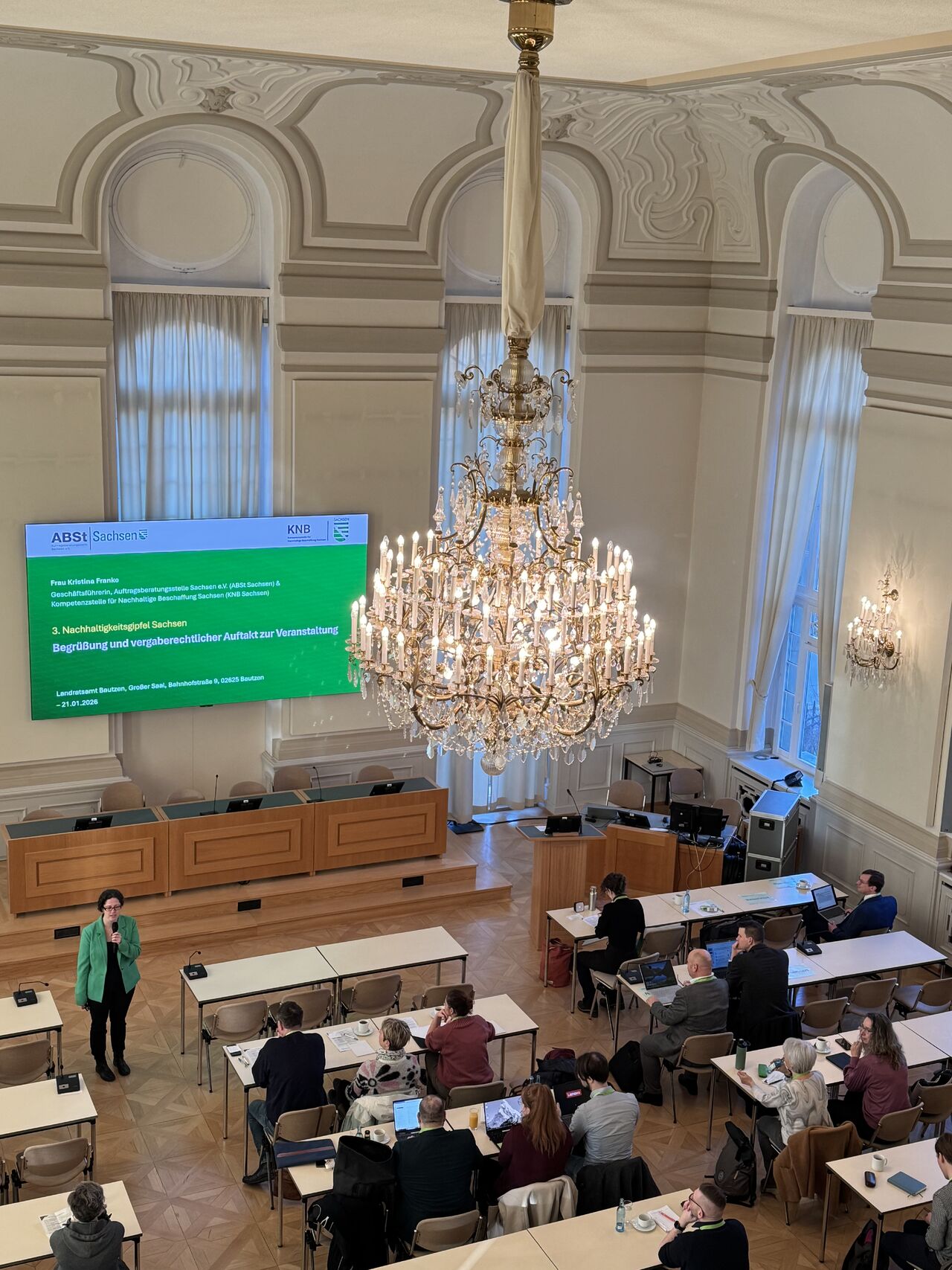
On 21 January 2026, the 3rd Sustainability Summit Saxony took place at the District Office Bautzen. Organised by the Competence Centre for Sustainable Procurement Saxony (KNB Sachsen), the annual opening event brought together about 50 representatives of public procurement offices, contracting authorities, demand units, institutions, procurement experts and other stakeholders from Saxony and beyond.
The event focused on current and practice-oriented topics related to sustainable public procurement, green tendering and future-oriented municipal development. Throughout the day, participants discussed how sustainability considerations can be integrated into procurement procedures in a legally sound, practical and effective way.
Prof. Dr. Matthias Knauff from Friedrich Schiller University Jena and the Thuringian Higher Regional Court provided an overview of European legal requirements that increasingly shape procurement practice. His contribution showed how sustainability criteria have developed from formerly external considerations into central elements of strategic procurement. Among the topics addressed were the Ecodesign Regulation, the procurement of energy-related products, requirements for clean vehicles and provisions concerning sustainable construction products.
Uwe Kluge from the Saxon Energy Agency SAENA GmbH presented municipal heat planning in Saxony. He explained the objectives and background of this planning process, which aims to systematically assess energy consumption and identify future perspectives for heat supply. Municipalities are required to prepare the relevant planning documents by 30 June 2028, with SAENA providing advisory support and expertise across Saxony.
Dr. Andreas H. Glas from the University of the Bundeswehr Munich addressed the current status of sustainable procurement in Germany. Drawing on procurement statistics, he pointed out that many procedures are still primarily price-oriented, while quality criteria tend to gain importance as contract volumes increase. His contribution underlined that sustainability can be understood as a quality criterion and may therefore justify higher costs where appropriate.
Marc Wolinda from the Bertelsmann Stiftung introduced the CO2 shadow price as an environmental-economic instrument for public procurement. By taking external environmental costs into account, the approach can make low-emission goods and services more competitive in tender evaluations. The instrument follows the price-oriented logic of procurement law while helping to reduce the risk of inefficient investments and supporting emission reductions.
Theresa Güldenring from the Service Agency Communities in One World presented practical tools for sustainable procurement, including Kompass Nachhaltigkeit and the certification label finder. She explained the role of labels in the context of procurement law and emphasised that while labels are not a universal solution, transparent and valid certifications can provide valuable guidance when applied appropriately.
Florian Wendler from BUND Dresden introduced the sponge city principle and presented a future-oriented vision for Dresden’s Postplatz in 2045. His contribution illustrated how sustainable urban transformation can combine accessible public spaces, sustainable mobility, urban greenery, biodiversity and renewable energy.
Roman Hillebrand from Aufbauwerk Region Leipzig GmbH provided an update on the EU project CE-PRINCE. The project aims to promote circular economy approaches through public procurement and strengthen related practices in Central Europe. He also reported on the cooperation with KNB Sachsen to develop a series of events for public administrations and companies in Saxony, focusing on green and circular economy criteria in tendering procedures.
After each presentation, participants had the opportunity to ask questions and exchange experiences. The event offered a broad and practice-oriented overview of developments in sustainable public procurement and highlighted how legal, environmental and strategic aspects can be connected in day-to-day procurement practice.