
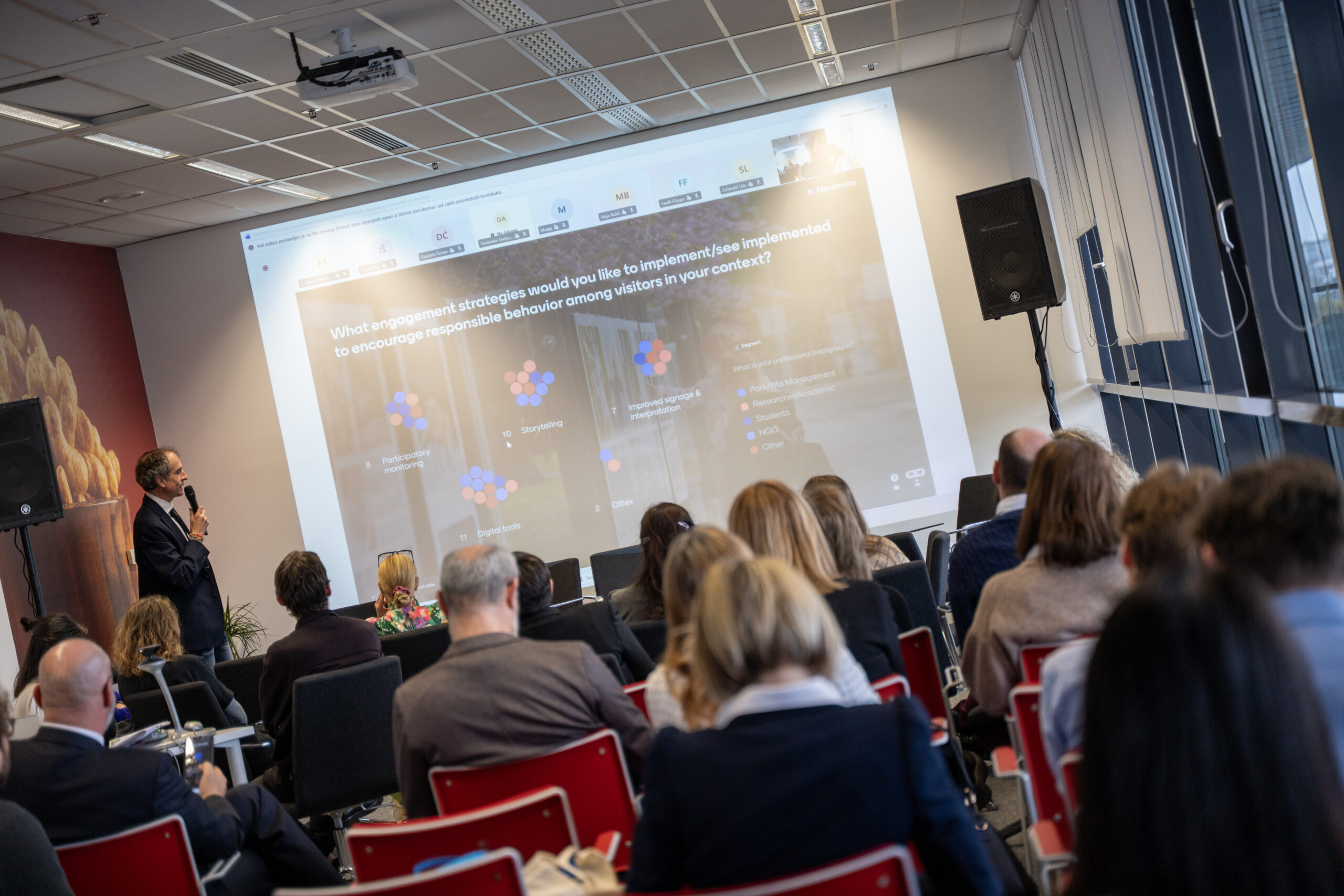
On February 24, 2026, Zagreb hosted the international conference The HUMANITA Summit: From Visitor Impact to Nature Protection – Building a Human–Nature Harmony, the final event of the EU project “HUMANITA – Human–Nature Interactions and Impacts of Tourist Activities on Protected Areas” supported by the Interreg Central Europe Programme 2021–2027.
The HUMANITA project brings together 10 partners from Austria, Croatia, Hungary, Italy and Slovakia to address one of today’s key environmental and social challenges: how to manage tourism in natural protected areas without compromising ecological integrity.
From the perspective of the Lead Partner, Dana Sitanyiova from the University of Žilina in Slovakia, the HUMANITA project at its core supports protected area managers by providing new monitoring strategies, pilot actions, and actionable insights to guide smarter decisions and safeguard natural heritage for future generations. This collaborative effort also contributes to the creation of common transnational policy recommendations that strengthen sustainable tourism governance throughout Central Europe. HUMANITA illustrates how cross-border cooperation can unite science, policy, and community engagement to foster a balanced relationship between tourism and nature conservation.
The final conference of the project, The HUMANITA Summit, was one of the few international conferences in Croatia dedicated to one of today’s most pressing challenges – the environmental impacts of mass tourism. Moving beyond declarations and theory, the event demonstrated how real tourism pressures on nature can be measured, and what concrete measures are already being implemented to safeguard the most valuable protected areas.
The programme focused on expert and scientific solutions, as well as practical examples from Croatia – including Krka, Mljet, Telašćica and Kamenjak – together with partner experiences from Slovakia, Italy, Austria, Slovenia and Hungary.
While Croatia was at the centre of the discussion, the issue was framed within a broader European context, enabling comparisons of approaches and the transfer of good practices among partner countries.
The conference brought together high-level decision-makers and experts who rarely have the opportunity to be heard in the same place. Participants included representatives of the Ministry of Environmental Protection and Green Transition of the Republic of Croatia, the Ministry of Regional Development and European Union, the Zagreb County Tourist Board, directors of national and nature parks in Croatia, and representatives of protected areas from across Europe.
The event also welcomed Croatian and international representatives from academia and research institutions, including the Faculty of Electrical Engineering and Computing, University of Zagreb, the University of Žilina, the University of Parma, Carinthia University of Applied Sciences, EURAC Research, CEEweb for Biodiversity, the Italian Ministry for Environment and Energy Security, and the Czech Institute for Heritage Interpretation, among many other experts.
The conference opened a dialogue on a question that has rarely been addressed through concrete operational solutions: how to preserve nature and the environment while ensuring that tourism remains sustainable and economically viable in the long term. Responsibility towards future generations emerged as a key theme, as the way tourism is managed today will directly determine whether the natural heritage, on which Croatia’s identity and economy rely, will still exist tomorrow.
Once again, the HUMANITA Summit confirmed that the future of nature and protected areas depends on achieving a balance between visitor experience and conservation, as well as on the ability of different sectors to develop and implement a shared vision of sustainable human–nature harmony.