
Record Season Confirms Potential of Enhanced Service Along the Štrekna Cycling Route
In summer 2025, the Štrekna Bus service in the cross-border Koroška region was upgraded as a pilot activity within the TRANS-BORDERS+ project, part of the Interreg CENTRAL EUROPE programme. Building on several years of operation, the enhanced service delivered its best season so far – transporting more passengers and bicycles than ever before and further strengthening cross-border mobility between Slovenia and Austria along the popular Štrekna cycling route.
From Early Success to a Needed Reset
The Štrekna Bus was first introduced in 2019 and was immediately recognised as a successful and innovative service for cyclists and other passengers in the border region. Over time, however, various management challenges and organisational issues began to affect service quality. Timetables, coordination and the overall user experience gradually deteriorated, and a service with exceptional potential was at risk of being discontinued. The TRANS-BORDERS+ project provided the opportunity to reverse this trend. Through a structured process of analysis, planning and stakeholder cooperation, the partners were able to fully tap into the service’s potential and restore a high-quality user experience. The 2025 pilot season therefore marks not only an upgrade, but also a “reset” of the Štrekna Bus as a flagship example of sustainable cross-border mobility.
Building on a Proven Concept
Instead of launching a completely new bus line, partners decided to upgrade the existing Štrekna Bus service. This choice followed the analytical work carried out within the TRANS-BORDERS+ decision-making tool for modern cross-border bus services, which highlighted the advantages of improving a well-known and well-used service with clear demand and strong local support. By refining an established line rather than starting from scratch, the project could respond quickly to user needs while making efficient use of public resources.
The Štrekna Bus connects key access points along the Štrekna cycling route and links them to wider regional and cross-border public transport, including services towards Carinthia in Austria and multimodal hubs on the Slovenian side. It also lies on the main corridor providing access to the new intermodal passenger terminal in St. Paul (St. Paul im Lavanttal) on the Austrian side. In the future, partners aim to develop a regular cross-border public transport line that will ensure reliable, sustainable access to this important passenger terminal.
More Days on the Road and Better Bicycle Transport
The 2025 pilot season introduced a significantly expanded operating pattern. The Štrekna Bus now runs every day in July and August, as well as on weekends in September – a substantial step forward compared to previous years, when services were available only on weekends during the same period. This extended season better reflects actual demand along the route and offers greater flexibility for both local users and cycling tourists planning multi-day trips.
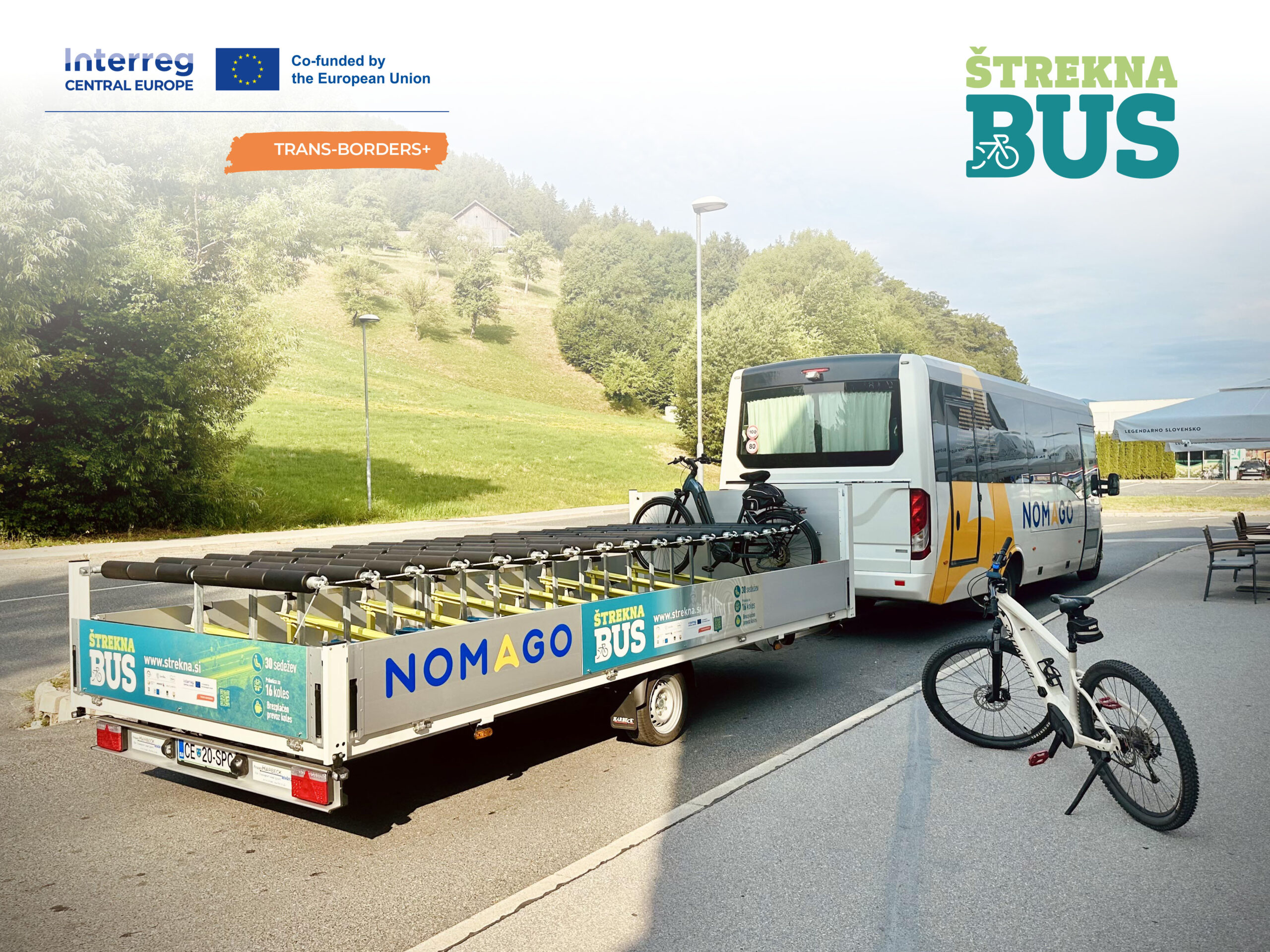
At the same time, the transport operator Nomago provided a new, modern bike trailer, designed to handle a higher number of bicycles more safely and efficiently, improving bicycle transport. Together with adjustments to boarding procedures and passenger information, this has made it much easier for groups and families to travel with their bikes, even at peak times.
The visual identity of the Štrekna Bus was also refreshed. Updated graphics and clearer branding on the bus and trailer help passengers recognise the service at a glance and underline its role as a flagship example of sustainable mobility and cycle tourism in the region. A dedicated subpage for the Štrekna Bus, containing all relevant information and data, was also set up on the Štrekna website (https://strekna.si/en/strekna-bus-en/).
Strong Cooperation for Cross-Border Public Transport
The upgrade of the Štrekna Bus is the result of close cooperation between many partners. RRA Koroška led the pilot in collaboration with regional and local stakeholders in both Slovenia and Austria. A key role is played by the Public Passenger Transport Management Company (DUJPP), which provided expert support in planning and coordinating the enhanced service.
On the Austrian side, partners from Carinthia, together with municipalities along the route, contributed to aligning timetables and ensuring smooth cross-border operation. In parallel, the project has started to address the broader governance challenges of cross-border public transport. One important goal is to work towards an intergovernmental agreement between Slovenia and Austria that would make it easier to establish and maintain regular cross-border bus lines in the future – including those providing access to the St. Paul intermodal terminal.
Towards a Model Season for the Future
Looking ahead, partners plan to use the experience from 2025 to design a “model season” for the Štrekna Bus – a service pattern that can be maintained in the coming years after the project ends. This includes refining timetables, further improving the integration with regional rail and bus services, and testing new digital information tools developed within TRANS-BORDERS+.
By delivering an upgraded, user-friendly, and well-coordinated service, the Štrekna Bus pilot demonstrates how targeted improvements to an existing line can significantly enhance cross-border mobility in a rural border region. It is another concrete step in the TRANS-BORDERS+ ambition to make public transport in Central European border areas more connected, attractive, and sustainable – for cyclists, commuters, and visitors alike.