
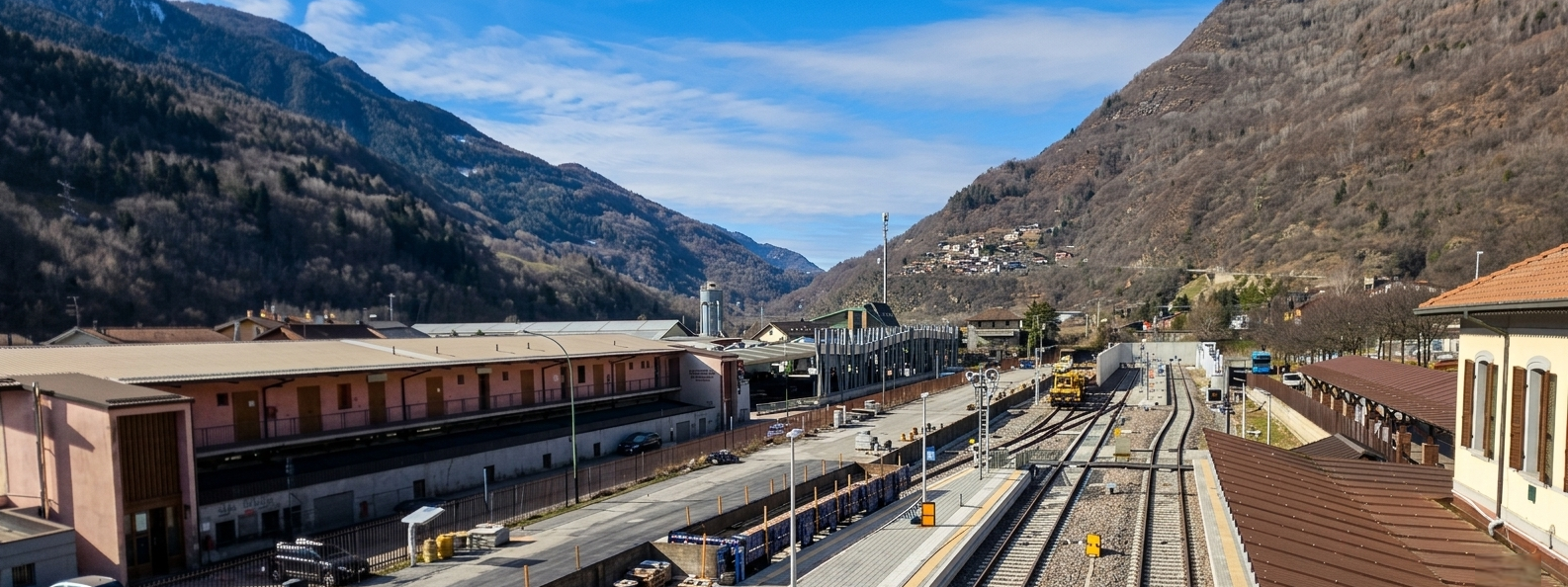
Edolo is a small mountain town located in Northern Italy, in the Lombardy Region, close to the Alpine border with Switzerland. The municipality lies at 699 metres above sea level and covers a wide, predominantly mountainous territory with low population density. With fewer than 4,400 inhabitants, Edolo typifies many rural and inner European areas where settlements are dispersed, accessibility is limited, and daily mobility strongly depends on a small number of local infrastructures.
The town is structurally distant from major transport nodes such as motorways, airports, and high-speed rail corridors. Access to the wider region relies mainly on secondary roads and a regional railway line, of which Edolo represents the terminal station, connecting the mountains to the city of Brescia. Being the end of the line gives the station a special role: here, travellers shift from train to bus, from rail to road, to reach smaller villages, mountain resorts and remote communities in the upper valley.
Edolo faces long-term demographic decline and population ageing. Over one quarter of the residents are aged 65 or more, while the natural population balance remains negative. At the same time, the town hosts key public services, notably healthcare and higher education such as UNIMONT, a university centre specialised in mountain studies, that serve a wider mountain catchment area. This creates regular mobility needs for residents, students, workers, and visitors who rely on public transport.
Despite this central role, mobility remains a challenge. Rail services on the Edolo–Brescia line operate at a bi-hourly frequency, with approximately 14 trains per day in each direction. Daily passenger numbers are moderate but stable, with around 350 arrivals and 350 departures per day, reflecting a consistent demand rather than peak-based flows. For this reason, Edolo depends heavily on bus connections, which fan out from the station and connect neighbouring towns and tourist destinations. The system works, but only when schedules align: limited frequencies mean that even small mismatches can turn short trips into long waits.
This is precisely where Edolo station becomes especially relevant for RAISE‑CE. Here, a rural station is not defined by high passenger numbers, but by its potential to act as a local mobility hub—a place where better coordination, shared services and digital tools can make a real difference. Improving integration between transport modes, offering accessible information, and creating welcoming spaces can significantly enhance everyday mobility and reduce isolation in a fragile mountain context, where access to information, services, and networks is often fragmented or distant.
Edolo is not an exception. It is a recognisable European rural story, shared by many Alpine and inner regions where stations remain essential but underexploited. This makes it an ideal pilot location for RAISE‑CE: a place where small, well-targeted interventions can strengthen connectivity, support local communities and demonstrate how rural stations can once again become active, meaningful nodes in wider mobility networks, reducing isolation, countering outmigration, and improving territorial cohesion.
Disclaimer
This publication has been developed within the RAISE-CE project, supported by the Interreg CENTRAL EUROPE Programme with co-financing from the European Union. Its content is the sole responsibility of the authors and the project partnership and does not necessarily reflect the views or positions of the Interreg CENTRAL EUROPE Programme, its programme bodies or the European Union. Neither the programme authorities nor the European Union can be held responsible for any use that may be made of the information contained herein.