
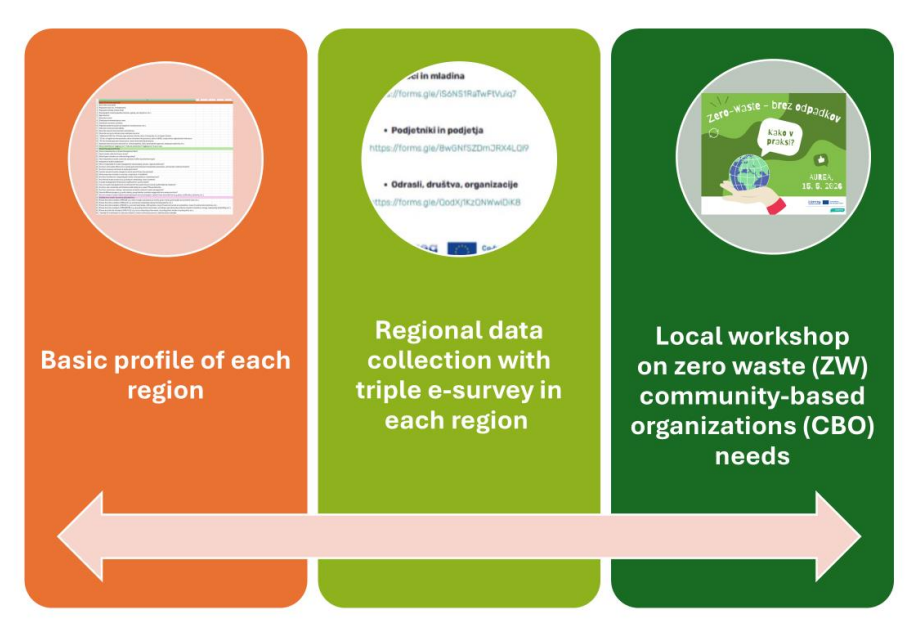
Rural and peripheral communities across Central Europe face shared territorial pressures, including population ageing, youth out-migration, and rising per capita waste volumes. Project partners first identified the needs in lagging areas, including regional waste profiles and existing grassroots initiatives to build a reliable evidence baseline for future activities.
How the Data Was Collected
To gather representative and comparable insights across borders, project partners conducted a comprehensive, multi-tiered data collection campaign, which included over 1300 participants, capturing perspectives from young people (schools), local households, entrepreneurs, public authorities and other target groups on waste reduction, sorting routines, and repair habits.
Additionally each partner region hosted a local workshop focused on hands-on capacity building – including textile and household repairs, circular public space management, and low-waste local production.
Key Findings and Next Steps
- The most relevant fact is that the amount of waste per capita generated annually is steadily increasing: in 2024 it was reaching 374 kg in LAG From Pohorje to Bohor in Slovenia, 286 kg in Krapina-Zagorje County in Croatia, and 360 kg in Partnership LAG Barycz Valley in Poland.
- All three regions identified that households account to the largest share of waste generation, whilst companies are showing tendency to reduce the amount of waste they produce. Evidences report that tourists generate up to twice per capita solid waste of local residents, with a particular increase in packaging and single-use items.
- For the purposes of RUREVIVE it is relevant to underline several the community-led initiatives addressing ZW.
- ZW awareness-raising or educational activities are mostly driven by public utility companies which provide different activities (i.e. workshops) for educational institutions, schools and NGOs (e.g. extracurricular education centers in Poland).
- Rural Youth. A total of 1,372 young people responded to the questionnaire, including 760 Croatians (representing 55% of all participants), 354 Poles (26%) and 258 Slovenians (19%). A comparison across countries shows that the sources of knowledge about waste reduction and the ZW approach among young people are similar in all three countries. Most of their knowledge on this topic came from school (SI 80%, HR 72%, PL 67%), followed by family (SI 71%, PL 44%, HR 40%) and the internet (HR 40%, SI 30%, PL 24%). Television was in fourth place in Croatia and Slovenia (HR 32%, SI 26%), while in Poland it was in fifth place (PL 12%). For Croatia in Slovenia social media was in fifth place (HR 22%, SI 16%) and in Poland it was in fourth (PL 21%). Multiple answers were allowed for this question.
- Rural Households. A total of 207 adults responded to the questionnaire, including 103 Poles (50% of the total), 59 Slovenians (28%) and 45 Croatians (22%). Before taking the survey, 82% of Poles, 81% of Slovenians and 73% of Croatians had already heard of the ZW concept. 46% of Slovenians, 36% of Croatians and 34% of Poles strongly agree that ZW initiatives (thrift stores, swap events, repair cafés, etc.) could strengthen the local community. Furthermore, 53% of Croatians, 46% of Poles and 44% of Slovenians agree with this.
- Entrepreneurs in Slovenia. A total of 24 entrepreneurs responded to an online questionnaire. We were interested in finding out in which situations entrepreneurs most often decide to implement ZW practices. Most (18) do so because of personal values and cost savings (12). The rest (7) do so because of funding, customer expectations or legislation. Nevertheless, entrepreneurs face various obstacles that prevent them from implementing the aforementioned practices more frequently. The biggest problems are lack of time (13), high costs (8) and lack of information (8). These are followed by lack of support (6), lack of market interest (5) and unclear legislation (4). One respondent noted a lack of interest among employees, another stated that their business does not generate waste and yet another believes that, with sufficient will and interest, there are no obstacles to implementing ZW practices.
- Public servants in Croatia. Seventeen people responded to the questionnaire. We asked them about the types of activities in which they would be willing to participate as part of the RUREVIVE project. They could select more than one activity. The most frequently selected response (13) was exchanging knowledge and experience with other cities/municipalities. This was followed by training and workshops on sustainable management, ZW and nature-based solutions (12). In third place in terms of popularity were pilot projects (11), in which new approaches are tested in the field. Eight respondents said they would participate in involving the local community in activities. Seven see themselves involved in demonstration sites, such as showcasing best practices from their region.
- Event organizers in Poland. Fourteen adults responded to the questionnaire. Respondents most frequently (six responses) expressed a need for support in the form of workshops (e.g., on creating various items using unwanted items or waste or on how to plan an event step by step in accordance with ZW principles). This was followed by three responses expressing a wish for systemic and organizational support (e.g., clear waste management policies, clear environmental guidelines) and for raising awareness among tourists and the general public. Two respondents would like to exchange experiences with more experienced event organizers both in Poland and abroad and see practical examples of ZW implementation. One respondent would like to have a dedicated staff member (a specific position) responsible for implementing and monitoring environmental solutions.
- Based on information in the Regional needs assessment report (provided by DAKO, ZARA and PdDB) we are able to conclude that all regions are at the bottom of the Zero Waste Hierarchy Pyramid. We were also informed about the perceptions, needs and realistic expectations of local stakeholders related to ZW (via local workshop and via e-surveys).
These findings will directly inform the development of the upcoming RUREVIVE Pilot Training Guide and Dynamic Zero Waste Handbook, which will be tested in local Rural Demo Centers across all three partner regions.