
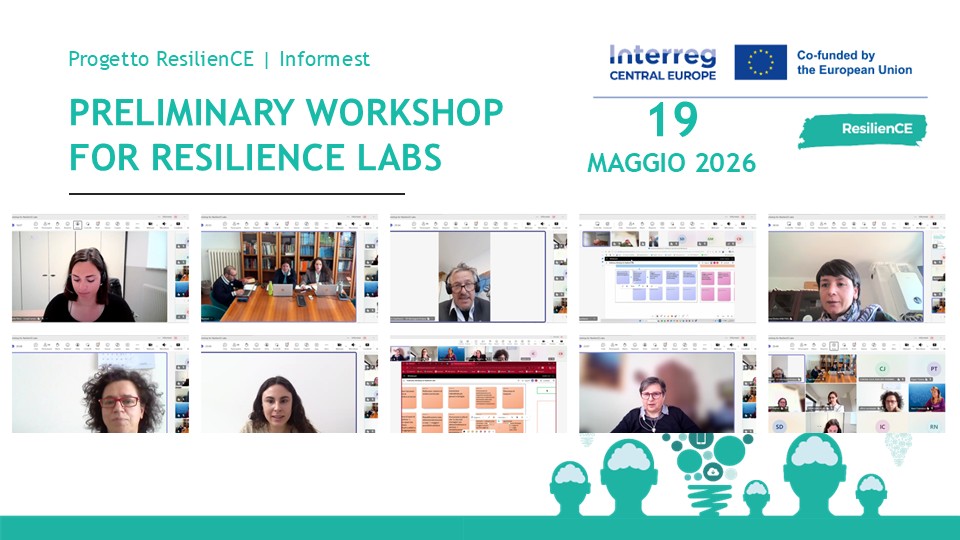
The event marked the starting point of a participatory process aimed at actively engaging regional actors in shaping innovative solutions to support social economy enterprises (SEEs) in peripheral areas.
A strong multi-actor participation
The workshop gathered representatives from:
• regional institutions
• local development organisations
• research bodies and universities
• clusters and foundations
• training organisations and social economy actors
This diversity ensured a multi-actor perspective on the challenges and opportunities affecting the Carnia territory.
Launching the Resilience Labs process
The workshop introduced the Resilience Labs, a series of participatory workshops that will:
• analyse territorial needs and challenges
• explore development trajectories in the short, medium and long term
• co-design sustainable business models and support schemes
• identify replicable and scalable solutions
Participants were actively involved in a first co-creation exercise, working in groups to:
• review and prioritise economic, social and environmental needs of the territory
• discuss possible development pathways
• contribute to a preliminary SWOT analysis of the local context
Key insights from the discussion
Although preliminary, the workshop highlighted several shared priorities, including:
• addressing demographic decline and depopulation trends
• improving accessibility and service provision
• supporting sustainable territorial development, particularly in tourism, energy and bioeconomy
• strengthening cooperation among local actors
• enhancing adaptation to climate change and environmental challenges
Participants also stressed the importance of stronger links between enterprises, communities and education systems, as well as the need for innovative services and digital solutions tailored to mountain areas.
Looking ahead
This preliminary workshop represents the first step in a broader co-design journey.
The next stages will include a series of in-person Resilience Labs, starting in summer 2026, where stakeholders will further develop the ideas and priorities identified, contributing to the definition of innovative support schemes for social economy enterprises.
This publication has been developed within the ResilienCE project, supported by the Interreg CENTRAL EUROPE Programme with co-financing from the European Union. Its content is the sole responsibility of the authors and the project partnership and does not necessarily reflect the views or positions of the Interreg CENTRAL EUROPE Programme, its programme bodies or the European Union. Neither the programme authorities nor the European Union can be held responsible for any use that may be made of the information contained herein.