
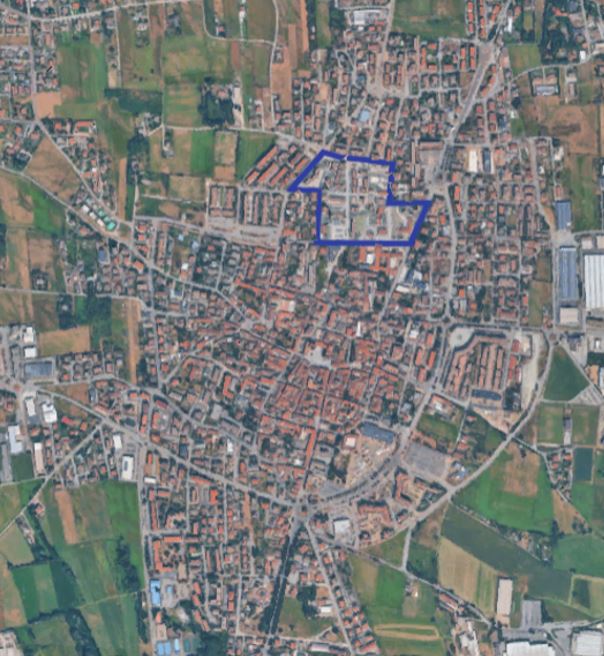
The municipality of Leinì has decided to focus on two neighborhood areas, both closed to the city centre. The first neighborhood selected, Via Ronco Area, is located in the south part of the city and the municipality is planning some renovation interventions for it, while the second neighborhood selected, Mahatma Gandhi Area, is in the north part of the city and it has been recently built.
“Via Ronco Area” is the result of an expansion of the city of Leinì which took place in the 70s and it is mainly made up of residential buildings, social housing in most cases, having the typical features related to the Italian construction industry of that period. The covered area is about 18,5 km2 and it is densely populated, indeed, many children and lots of elderly people live in the area because of the high number of residential buildings. People living in “Via Ronco area” have low/medium incomes and, since there are a huge number of vulnerable people living in “Via Ronco area”, the attention to climate adaptation of the neighborhood must be high, above all on extreme temperatures risk. Indeed, many parking areas and streets are not shaded, there are few trees and green areas available, so they must be increased in order to decrease heat island effects, making the neighborhood more resilient to climate change effect.
Furthermore, in the neighborhood there is also a quite big urban area (5800 m2), owned by the municipality of Leinì, that needs to be renovated. The municipality has already an urban planning project which foresees the renovation of the historical villa located in the area, the construction of social housing buildings and the management of the rest of the area through social activities for the inhabitants. This represents a valuable occasion for the improvement of climate resilience of the neighborhood.
The Municipality of Leinì has the will to review its General Urban Plan and to elaborate its SECAP (Sustainable Energy and Climate Action Plan). The pilot action foresees the analysis of the climate risks in the neighborhood, in particular for the extreme heat and heavy precipitations, risks, which are the ones that most affect the city. Through a decision-making process, the optimal measures to increase the level of adaptation and resiliency of the “Via Ronco Area” will be identified and implemented, addressing great attention to the high number of vulnerable people living in the neighborhood.
Based on the climate risk assessments results, focused mainly on extreme heat and heavy precipitations, specific adaptation measures will be elaborated for “Via Ronco Area” which is densely populated by vulnerable people. The resilience of the neighborhood will be enhanced making a more liveable urban context.
“Mahatma Gandhi Area” is located in the north part of Leinì and it has been recently built (after the year 2000). The area covered is about 7 km2 and it is manly composed of residential buildings both, low-rise multi apartment and single-family houses. The area is densely populated with children, indeed, two playing zones have been built for them, and a quite big portion of elderly people. One of the most relevant buildings in the neighborhood is the Capirone Health Care Residence, a private dependent elderly facility for health care.
Since “Mahatma Gandhi Area” has been recently built, the existing infrastructures in the neighborhood are modern, anyway, there are some aspects that must be improved, as for example the transport connection and the adaptation to extreme temperatures risk of the parking areas, the streets and the square, which are not shaded, poor in green and not permeable to water. Furthermore, the neighborhood suffers flooding during extreme precipitation events, so this aspect will be deeply analysed.
The Municipality of Leinì has the will to review its General Urban Plan and to elaborate its SECAP (Sustainable Energy and Climate Action Plan). The pilot action foresees the analysis of the climate risks in the neighborhood, in particular for the extreme heat and heavy precipitations risks, which are the ones that most affect the city. Through a decision-making process, the optimal measures to increase the level of adaptation and resiliency of the “Mahatma Gandhi Area” will be identified and implemented, addressing great attention to the high number of children people living in the neighborhood and the presence of the Capirone Health Care Residence.
The specific adaptation measures developed for extreme heat and heavy precipitations climate risks, which mostly affect the “Mahatma Gandhi Area”, will allow the municipality of Leinì to improve its resilience to climate change, ensuring a more liveable and adapted context for the inhabitants, represented above all by children and elderly people living in the Capirone Health Care Residence.
For both neighborhoods the municipality has a strong interest in evaluating the climate risk related to the main hazards affecting Leinì.