
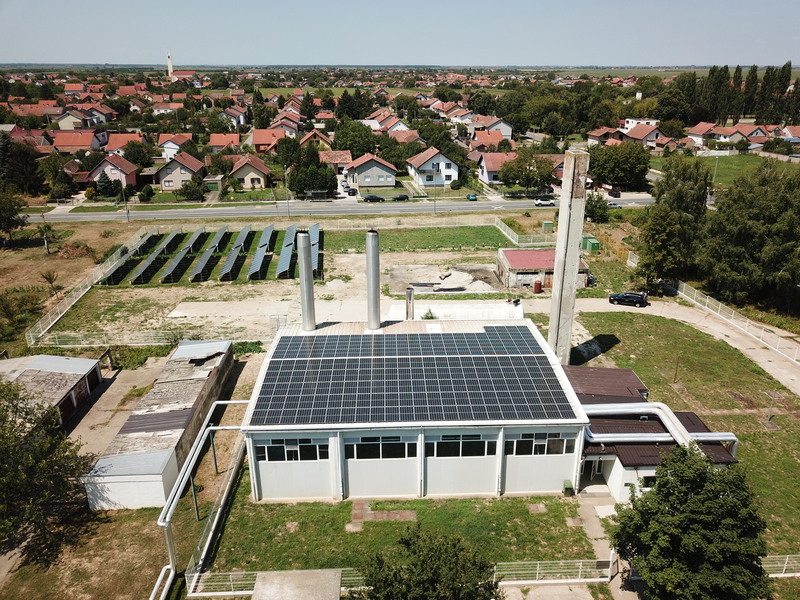
Vukovar’s District Heating System Today
Vukovar’s district heating system is managed by the municipally owned company Tehnostan d.o.o., which provides heating and hot water to more than 3,500 customers.
The city currently operates six heating systems, with a total network length of 7.7 kilometres. Most of the heat is produced using natural gas, which accounts for almost 96% of the energy used. This means that the city still relies heavily on fossil fuels.
Through the HEAT35 project, Vukovar is exploring ways to reduce this dependence, improve the efficiency of its heating network and introduce cleaner energy sources.
Exploring New Energy Opportunities
To identify the best solutions for Vukovar, project partners examined several possible energy sources, including waste heat, geothermal energy, solar energy and biomass.
The assessment identified two nearby sources of waste heat that could potentially be reused for heating buildings. Additional opportunities to recover heat from local industries were also explored.
Geothermal energy, which uses heat naturally stored underground, is another promising option. Investigations are underway in the Vukovar 2 area, with plans for the first exploration well near the Borovo Naselje heating plant.
Solar energy is already part of Vukovar’s heating system, with 822 m² of existing solar panels. The project also examined whether locally available biomass could be used, but the results showed that it is currently not a practical or cost-effective solution for the city’s heating network.
These findings helped project partners identify the most suitable combination of energy sources and technologies for Vukovar’s future heating system.
Vukovar’s Action Plan for 2035
By 2035, Vukovar aims to produce at least 50% of its district heating from renewable energy and recovered waste heat.
To achieve this goal, several improvements are planned in the two main heating areas.
In Borovo Naselje, the plan includes installing a new heat pump, expanding the use of solar energy with 3,000 m² of solar thermal collectors and introducing a system for storing heat so it can be used when needed.
In Olajnica, a new heat pump is planned to recover heat from the local wastewater treatment plant. A modern, more efficient gas boiler will also be installed to support the transition to cleaner heating.
The city also plans to expand its heating network to connect more public buildings and new developments. Existing equipment will be upgraded to allow the system to operate at lower temperatures, helping reduce energy losses and improve overall efficiency.
The transformation will involve cooperation between the City of Vukovar, Tehnostan, public institutions, local industries, energy experts, researchers and residents. Their involvement will help ensure that the planned improvements respond to local needs and support the city’s long-term energy goals.
Looking Ahead to 2050
Vukovar’s plans do not stop in 2035. The city aims to continue expanding and modernising its district heating network, connecting more homes, public institutions and businesses.
In the longer term, geothermal energy could play an increasingly important role by providing a reliable source of heat from underground. Together with solar energy, heat pumps and recovered waste heat, it could help Vukovar further reduce its dependence on fossil fuels.
Continued improvements to the heating network, more efficient technologies and regular monitoring will support the city’s transition towards a cleaner and more reliable heating system.
Through HEAT35, Vukovar is laying the groundwork for a more sustainable heating future, demonstrating how cities can make better use of local energy resources while improving heating services for their communities.