
Nature as an opportunity: ICRA at the third transnational meeting of Central-BIC partners in Krakow
The Idrija-Cerkno Development Agency is one of thirteen partners from seven countries. It participates in joint activities within the project and develops solutions for the preservation and integration of natural resources into the sustainable development of the Idrija-Cerkno region.
The meeting was intended for an in-depth discussion of the results achieved so far and the coordination of the next steps, with a focus on the evaluation of ecosystem services (ESS) and their integration into local development strategies. The event was not just a working meeting, but also a space for exchanging good practices, presenting concrete results, and strengthening partnerships between participating organizations.
It is particularly important that the combined results of the work of all partners, compiled by the coordinators into comprehensive reports, were presented in Krakow. These reports clearly showed the progress made in individual work packages and provided an insight into the status of the project at the transnational level.
In the first work package, the partners presented the progress made in identifying key habitats and the ecosystem services they provide. Semi-natural grasslands, forests, and wetlands were highlighted as areas of high natural value. Based on a uniform methodological matrix, the partners jointly identified 167 different ecosystem services, which form the basis for further analysis and pilot measures.
A socio-economic model emphasizing the importance of the link between nature conservation and the resilience of the local economy was presented, along with a SWOT analysis. This showed that the regions have numerous opportunities for development (e.g., introduction of payments for ecosystem services (PES), product certification, networking with local communities), but at the same time face common challenges such as a lack of tools for evaluating natural resources, climate change, and limited institutional capacities.
A survey of consumers and users of products and services originating from local, including protected, areas was presented. The survey results show that more than half of those surveyed are aware of the importance of products and services related to nature conservation, but nevertheless buy them less frequently. The most common obstacles cited are higher prices, lack of information, and limited availability. Nevertheless, most are willing to pay up to 20% more if the natural value of the product is clearly stated.
In addition to expert presentations, the meeting also focused on future activities, among which the establishment of local biodiversity conservation communities (BSCs) is key. These will involve local farmers, suppliers, nature conservation organizations, and municipalities.
The meeting also featured a presentation of the activities of the Karpia Valley Association, which was presented in detail to the participants by its director, Anna Świątek. In her presentation, she highlighted the association’s key activities and the development of the local Karp Valley brand, which is based on combining quality local products and services with the rich natural and cultural heritage of the area. The visual image of the brand stands out with a colorful stained-glass motif of a carp, symbolizing the shimmer of fish scales and the historical diversity of the region.
The brand designates food, handicraft, and tourism products that meet high standards of quality, traceability, and environmental responsibility. It is designed as an instrument to promote sustainable development in the region, strengthen local identity, and build strong links between producers, suppliers, and users.
The meeting did not take place solely in conference rooms – Polish partners also organized a field trip to see examples of good practice in the town of Zator and its surroundings, where participants learned about the Carp Valley initiative, an example of successful coexistence between humans and nature based on a long tradition of sustainable fish farming. During a guided tour of the town, led by the former mayor of Zator, the importance of intertwining cultural heritage with the development of the local economy was emphasized.
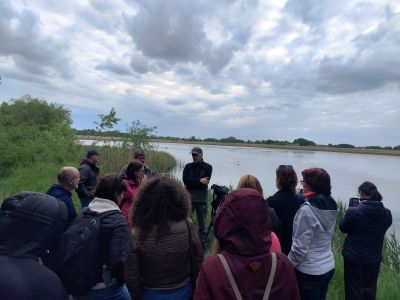
An interesting experience was the ornithological excursion along the Marynin educational trail, which runs through the Przeręb fish farm complex. Accompanied by two ornithologists, participants observed numerous rare and endangered bird species listed on the European endangered species list. The area is considered one of the most important wetland habitats in Poland, where human activity has been successfully intertwined with the preservation of high natural value for centuries.
The conclusion of the meeting focused on planning the next steps, among which the implementation of pilot activities will play a key role. The partners will meet again in the second half of 2025, when the concrete results from the pilot areas and the results of cooperation between individual partners facing similar challenges in the protection and development of (protected) areas will be presented.