
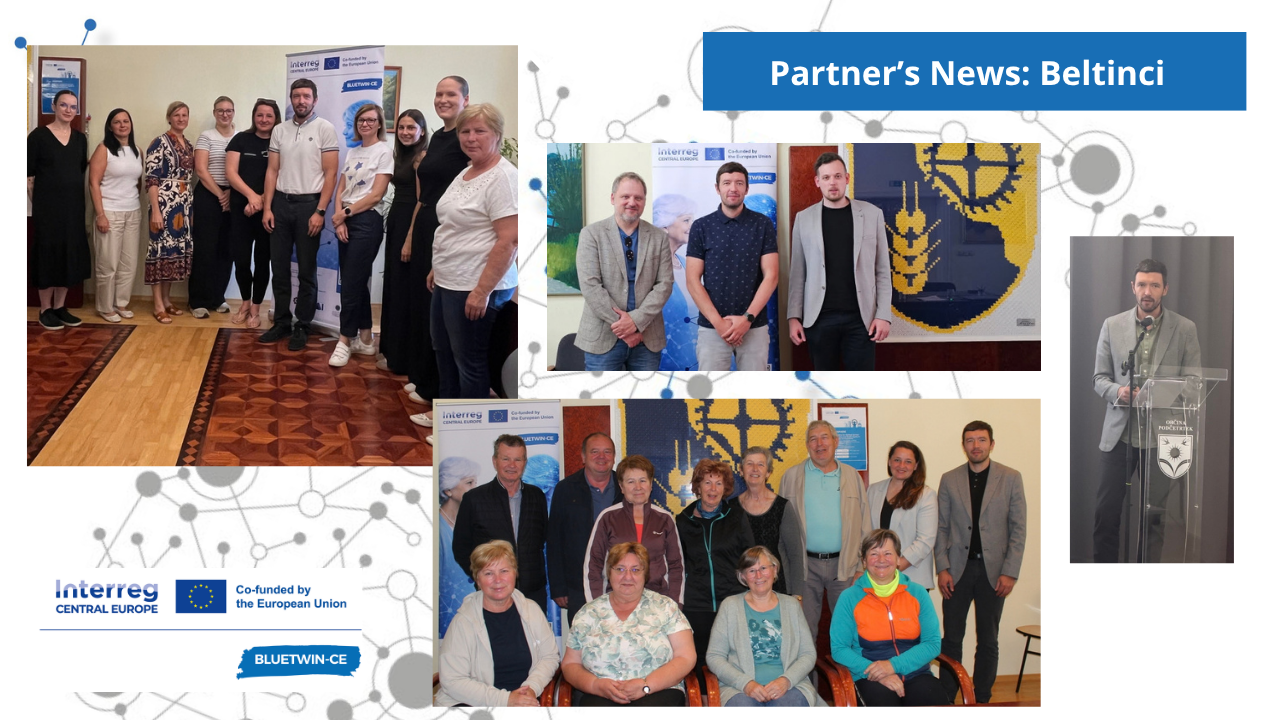
Our journey across the BLUETWIN-CE partnership continues, showing how our partners are turning the project’s shared objectives into concrete action in their territories. This time, we travel to Slovenia and visit not only one of our three pilot areas, but also the Lead Partner coordinating the entire BLUETWIN-CE partnership.
🇸🇮 Our next stop is Beltinci, Slovenia, where the Municipality of Beltinci combines two important roles: leading the transnational partnership and preparing its own community for the local Blue Zone pilot.
The Municipality of Beltinci leads BLUETWIN-CE and is at the same time one of its three pilot areas. With 3,781 residents aged 50 or over, almost half of the population, spread across eight villages, Beltinci is a typical rural community of Central Europe: rich in associations and neighbourly ties, but with services that are more often available than actually used. The last six months turned this diagnosis into concrete preparation for the pilot.
Knowing the local ecosystem. For the Governance Structure Assessment, Beltinci mapped who really shapes wellbeing in the municipality: the primary care unit ZP Beltinci and the Centre for Health Promotion of ZD Murska Sobota (our associated partner), the pensioners’ association DU Beltinci with its “Starejši za starejše” volunteers, the Prostofer volunteer transport service, youth organisations and the municipality itself. Interviews with managerial and operational figures fed into three pilot objectives: bringing preventive health programmes to all eight settlements, activating the intergenerational social fabric and streamlining coordination between health, social and civic actors. Four local intervention scenarios: preventive programmes, service accessibility, social connectivity and infrastructure, were prepared as the first inputs for the Digital Twin and discussed with partners in the two transnational validation workshops.
Feeding the Digital Twin with real data. The Digital Twin, developed by Alma Mater Europaea, is only as good as the data behind it. Beltinci licensed the EQ-5D-5L quality-of-life, produced a paper collection kit and a digital questionnaire hosted on beltinci.si, and collected the first baseline responses among older residents. Together with a regional IT partner, a data portal was set up in September to store and export survey data securely for all three pilot areas. A refreshed municipal dataset, population by settlement and age, national public-health indicators from the NIJZ, and an expert-weighted indicator set developed with CKZ Murska Sobota complete the package handed over to the technical team.
Steering the partnership. As Lead Partner, Beltinci chaired the steering committee meetings, submitted the first joint finance report and aligned the project with its sister initiative SOSPHERE, which is building a one-stop-shop for older adults in Beltinci, so that the two projects reinforce each other instead of running in parallel. The project is also reaching beyond the partnership: on 24 September Mayor Marko Virag and Rok Šavel, project coordinator, presented BLUETWIN-CE along with SOSPHERE at the joint session of the Association of Municipalities of Slovenia and the Croatian Association of Cities in Podčetrtek, where keeping public services accessible in rural and border areas was the central topic, and the challenges on both sides of the border turned out to be strikingly similar.
What comes next. On 1–2 December 2026 the whole partnership meets in Beltinci: a local workshop with residents and stakeholders on the first day and the transnational validation of the Training Curriculum on the second. Beltinci is drafting the curriculum module on natural movement, with CKZ experts contributing on nutrition and stress reduction, and will run its local information campaign in November and December. Beltinci is ready to show what a Blue Zone can look like in the Pannonian plain.
#BLUETWINCE #InterregCentralEurope #PartnerNews #BlueZones #DigitalTwin #Beltinci #Slovenia #RuralInnovation #HealthyCommunities #CommunityEngagement