
Our journey through the BLUETWIN-CE partnership now turns to the technological heart of the project. After exploring how our partners are preparing the pilot territories and working with local communities, we take a closer look at the development of the tool that will bring data, Blue Zone principles and future scenarios together.
🇸🇮 Our next stop is Alma Mater Europaea University in Slovenia, where the BLUETWIN-CE Digital Twin is taking shape.
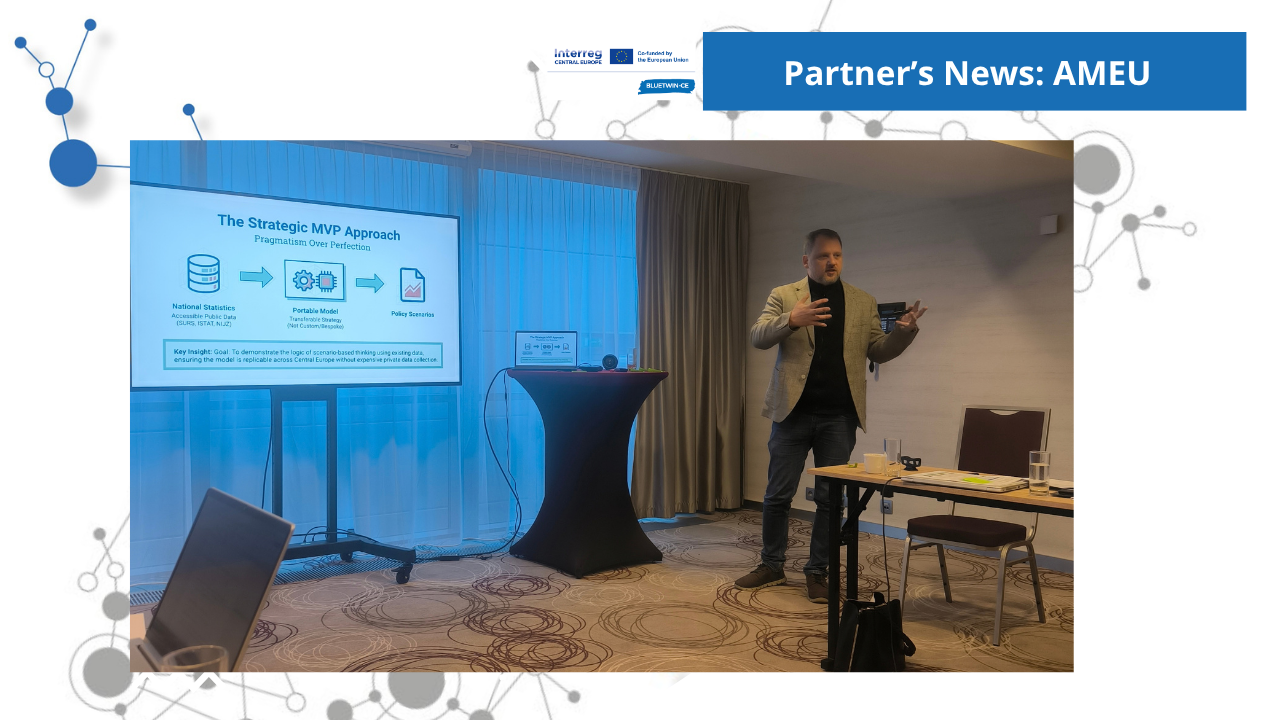
Alma Mater Europaea University is leading the development of the BLUETWIN-CE Digital Twin, which will bring together data, Blue Zone principles and simulation methods into a practical decision-support tool for rural municipalities. The Digital Twin is currently under development, with the present phase focusing primarily on preparing and structuring the data and indicators that will form its analytical foundation. The aim is not to monitor individual residents, but to support local decision-makers in exploring how changes in infrastructure, services and community programmes could influence health, well-being and social connectedness at population level.
Building the data foundation for the Digital Twin. During the first development phase, the team translated the project’s Blue Zone approach into a structured framework for data collection and analysis. Seven core data layers were defined: demographics, health and well-being, nutritional access, physical environment, social and community dynamics, mobility and accessibility, and economic and implementation factors. These layers provide a common structure for describing the baseline situation of the three pilot areas and will later serve as the foundation for scenario modelling. The current work therefore focuses on collecting, reviewing, harmonising and processing available data, as well as defining the indicators that can be meaningfully used across different local contexts.
Preparing the logic for future “what-if” scenarios. Alongside the data work, the team is defining how different indicators and Blue Zone dimensions can be connected within the future model. The Digital Twin is being designed around practical questions faced by municipalities: For example What could happen if access to walking infrastructure improves? How could a new community space affect social connectedness? What might change if preventive programmes become more accessible? At this stage, these questions guide the preparation of the model structure and the identification of the data and relationships needed for later simulations.
Developing a transparent and transferable methodology. Particular attention is being given to the selection of indicators, data quality and the relationships between different dimensions of community well-being. This is especially important because Beltinci, Svidník and Montegrotto Terme differ substantially in terms of available data, local conditions and governance contexts. The objective is therefore to develop a transparent and transferable modelling approach that is sufficiently flexible to reflect local specificities while maintaining a common methodological framework across all three pilot areas. The Digital Twin is being developed as a focused strategic prototype that will be understandable and usable for local authorities and based on realistically available data.
What comes next. Once the data preparation and indicator framework are sufficiently developed, the next phase will focus on integrating the processed data into the Digital Twin and implementing the simulation logic. This will enable the project to gradually introduce and test selected Blue Zone “what-if” scenarios and compare baseline conditions with potential interventions. The resulting visualisations and scenario comparisons are intended to help municipalities discuss alternative measures and support more evidence-informed local decision-making. The project foresees simulations related to areas such as natural movement, healthy diet, social connectivity and stress reduction.
#BLUETWINCE #InterregCentralEurope #PartnerNews #BlueZones #DigitalTwin #AlmaMaterEuropaea #Slovenia #RuralInnovation #EvidenceBasedDecisionMaking #HealthyCommunities