
Introducing the Project and the Benchmark Study
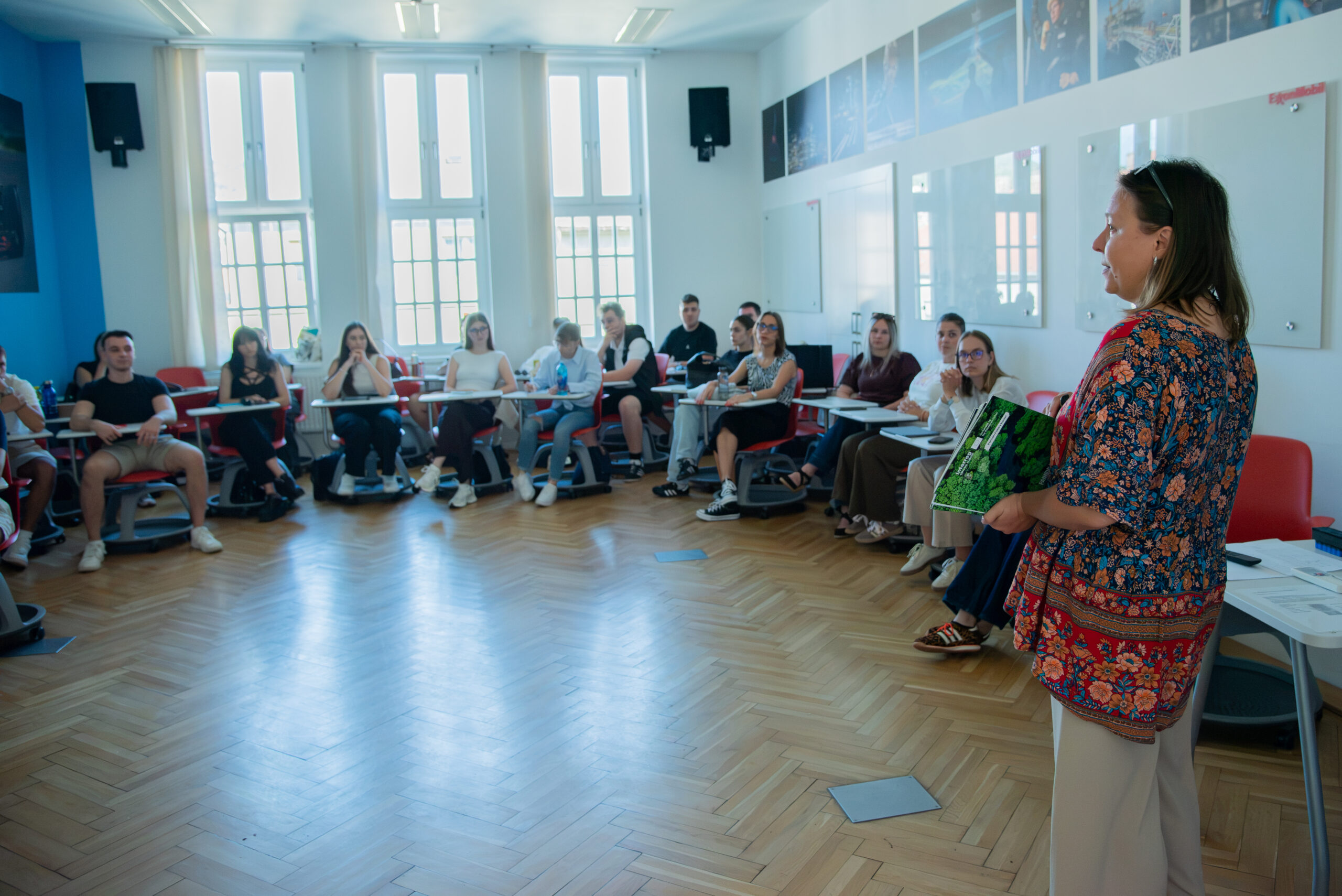
The session opened with a presentation by the PFF project manager on behalf of Pannon ETT, who introduced the project’s goals, partnership structure, and main activities. Particular attention was given to the project’s Benchmark Study, which maps nine thematic areas ranging from sustainable forest management and digitalisation to green business models, nature-based education, and regenerative tourism.
Students were given a closer look at the themes most relevant to the seminar, including nature-based recreation and wellbeing and their service-based business models, tourism opportunities built around non-timber forest products and experience gastronomy, and regenerative tourism — an approach that goes beyond minimising tourism’s negative impacts to actively support and restore local communities and natural environments.
Six Business Concepts as Starting Points
Building on the benchmark findings, six tourism business concepts were presented to spark discussion — among them a regenerative loyalty scheme rewarding sustainable visitor behaviour, a forest-based corporate wellbeing and team-building product, expert-led forest experience programmes, a network turning local forest and agroforestry products into bookable experiences, a gamified biodiversity and citizen-science concept, and a multi-day regenerative village tourism package. Two further concepts — on sustainable accommodation branding and a guided foraging experience — were also introduced as additional starting points. Mecsekerdő Zrt., the project’s other Hungarian partner, contributed several concepts tailored to its own forest areas and infrastructure.
Organisers were clear that none of these ideas are fixed or final: students were encouraged to critically challenge, adapt, and expand on them, or to bring entirely new concepts of their own.
Students Take the Concepts Forward — Toward the PFF Hackathon
Following the presentation, students discussed the concepts’ target groups, value propositions, and tourism and business relevance, and organised themselves into six working groups to develop the ideas further over the course of the seminar. Their work will cover areas such as target audience and buyer persona definition, market validation, customer journey design, pricing and revenue models, branding, partnerships, and measurable sustainability impact.
The groups are expected to deliver a short pitch and a one-page concept sheet by the end of October. These outputs will feed into the PFF Hackathon, to be held on 5–6 November 2026 at the University of Osijek, where the aim is to further develop pioneering business solutions — with an expected three to five initiatives per country selected for continued mentoring afterwards. Refined concepts will return in a full, validated business and marketing plan presented in December.
Through this collaboration with PTE KTK, the Pannon Future Forest project combines roadshow outreach, knowledge transfer, and co-creation, giving students the chance to develop real, applicable tourism marketing solutions for an active international project.