
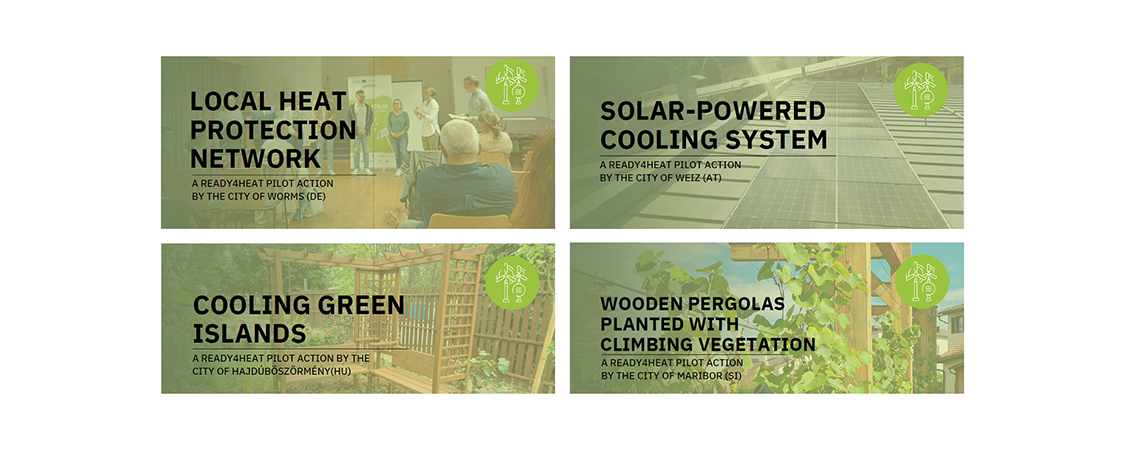
The Ready4Heat project has published its final Pilot Implementation Report and four easy-to-read infographics, summarizing tested heat adaptation measures from Slovenia, Germany, Austria and Hungary. The outputs showed how local actions such as solar-powered cooling, green islands and nature-based shading helped protect vulnerable groups and improve comfort during heatwaves. The materials were prepared in accessible formats so cities, partners and networks can quickly reuse or adapt them after the project’s closure. They highlighted clear results, practical lessons and visual examples that supported future planning and action.
Recommendations for Adaptation Planning
If you manage climate adaptation or urban planning in a city — here are some concrete takeaways from Ready4Heat that you can integrate into your strategy now:
- Start small, start green: Urban greening — benches, pergolas, shade-trees — is one of the fastest, least expensive and most socially inclusive cooling measures. Use heat-maps + local knowledge to prioritise “hot spots” (e.g. playgrounds, elderly homes, public squares).
- Combine low-tech with smart tech carefully: Solar-assisted cooling (or other renewable-powered cooling) for public buildings can be piloted in facilities serving vulnerable populations — e.g. care homes, kindergartens, community centers — and scaled later once energy performance is proven.
- Build heat resilience as a social mission: Heatwaves don’t impact everyone equally. Embed heat protection in wider social and health services and disaster response. Establish stakeholder networks across departments — social services, urban planning, health, environment, fire department and disaster reposinse — and involve citizens, NGOs, care providers.
- Institutionalise it via Heat & Health Action Plans (HHAPs): Don’t treat heat resilience as ad-hoc. Use HHAPs to formalise responsibilities, data gathering (heat maps, vulnerability mapping), early warning systems, awareness campaigns, and cooling measures — short-, mid-, and long-term.
- Monitor, evaluate, iterate: Pilot implementation must be followed by evaluation. Measure not only temperature reduction, but energy use, user satisfaction, maintenance costs — and feed this back into future planning.
Read more: Download our report and see the infographics here.