
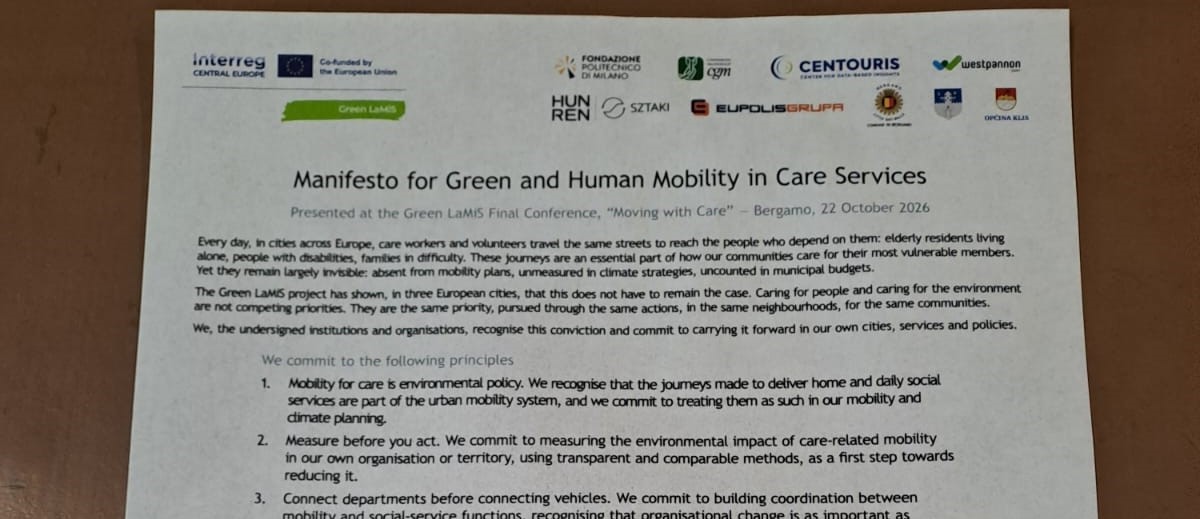
On 22 October 2026, the Council Chamber of Palazzo Frizzoni in Bergamo hosted the final conference of Green LaMiS, “Moving with Care”. The morning was open to citizens, local authorities, social enterprises and mobility professionals, and was streamed live to viewers in Italy, Croatia, Hungary, Germany and beyond. It followed the project’s transnational meeting of the day before and ended with the signing of the Manifesto for green and human mobility in care services.
The conference opened with greetings from Elena Carnevali, Mayor of Bergamo. Lucia Coletti of Fondazione Politecnico di Milano, the lead partner, then recalled the path of nine partners from four countries and the idea at the heart of the project: that social and environmental growth are two parts of the same journey. Marcella Messina, City Councillor of Bergamo, opened the discussion on a question that rarely gets asked, namely who thinks about how care reaches people’s homes. Elodie Villeneuve of the Interreg Central Europe Joint Secretariat, connected online, placed Green LaMiS among the programme’s cooperation projects and invited partners to keep its results alive, including by contributing to the next programming period.
Luca Studer of Politecnico di Milano explained why the last mile matters. Home-delivered social services have rarely been part of mobility planning, and measuring their impact meant building a shared method, a tool and a way of working with municipalities and social providers. The session “From pilot to practice: the next mile together” brought the voices of Oriana Ruzzini, Councillor for Ecological Transition, Environment and Green Spaces of Bergamo and Matteo Bianchi, Deputy Director of ANCI Lombardia.
The team from Politecnico di Milano presented the carbon footprint trends. Between 2023 and 2025, emissions from the social transport service in Bergamo fell by about 22%. In Klis, where two electric cars have served home-care staff since September 2025, the service’s emissions dropped by about 27% between 2024 and 2025. In Szombathely the electric vehicles entered service only in November 2025, so the first full-year effect will show in the 2026 data.
The round table on policy recommendations brought together Marco Berlanda, Mobility Councillor of Bergamo, Jakov Vetma, Mayor of Klis, and Adrienn Bokányi, Councillor for Economic Affairs and Urban Development of Szombathely, with Antonella Tagliabue of CGM as moderator. The conversation moved from the practical to the political: the difficulty of finding suitable electric vehicles on a thin used-car market, why charging, training and realistic range planning matter as much as the vehicle itself, and why the needs and wellbeing of the people receiving care must always come first.
Local teams from Bergamo, Klis and Szombathely then took the stage to describe what changed in everyday work, from caregivers who were wary of electric cars and now do not want to give the keys back, to a new way of thinking about mobility inside social services. “Behind every journey is a vulnerable person,” the Bergamo team said. “If we take care of the journey, we take care of the person.”
The morning closed with a look at what the project leaves behind: the common method and carbon footprint tool, the capacity building toolkit, joint strategy and action plans, and policy recommendations for local authorities. Partners and municipalities then signed the Manifesto, committing to keep measuring, sharing and improving the mobility that brings care to those who need it most.
The conference was held in partnership with L’Eco di Bergamo, media partner of the event.