
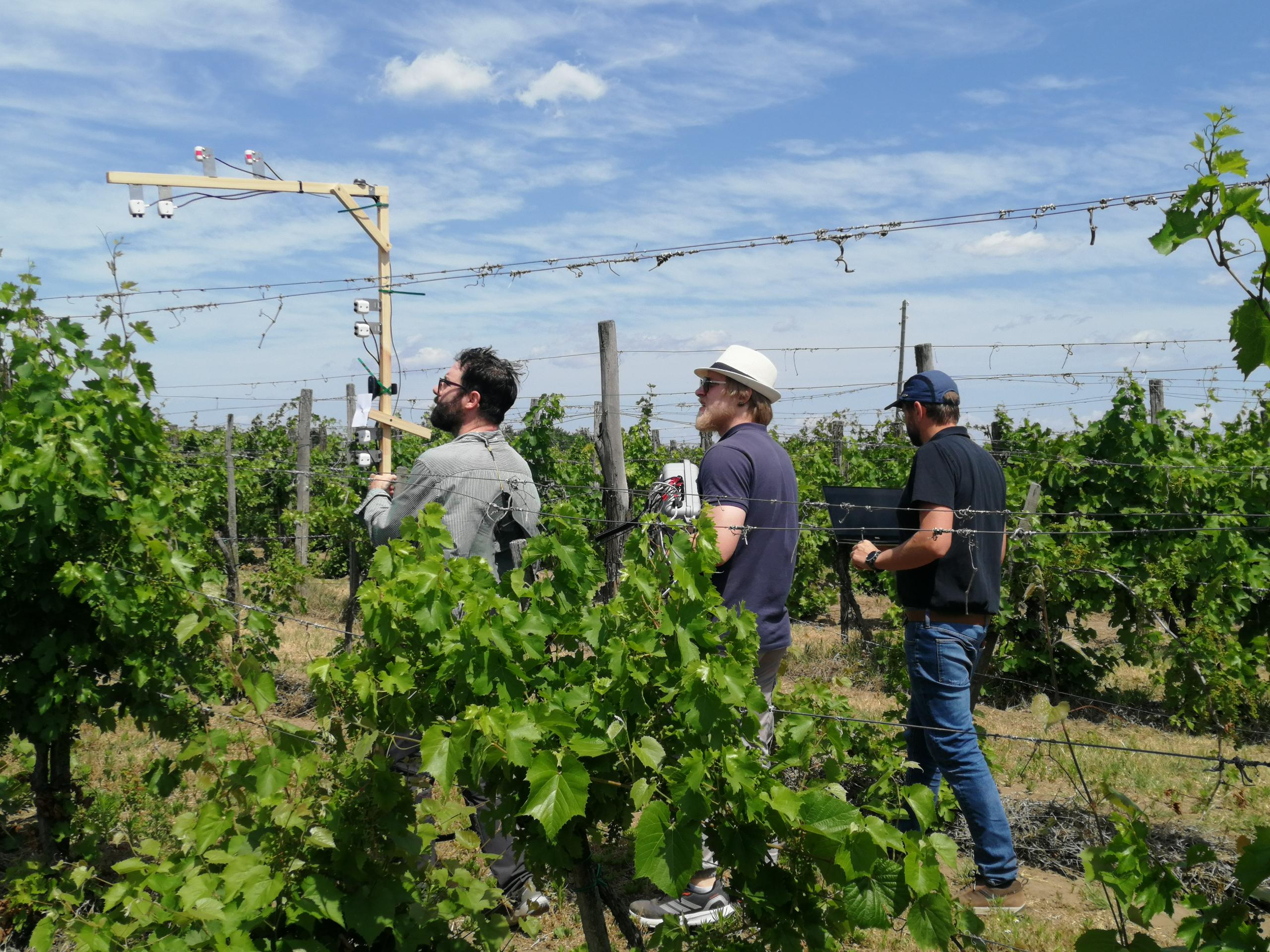
A vineyard canopy can look different depending on where it is observed. Leaves at the top and along the sides vary in age and physiological condition, while symptoms of stress or disease may appear at different heights. Images taken from above capture only part of that picture.
The Agri-Digital Growth Living Lab led by the Hungarian University of Agriculture and Life Sciences (MATE), in collaboration with Linz Center of Mechatronics (LCM), examined how mobile sensors could provide a more detailed view of grapevine canopies. The work took place at MATE’s research station in Kecskemét, Hungary.
The Living Lab focused on two vegetation indices: NDVI, which provides information related to chlorophyll content and plant condition, and PRI, which can help assess changes in photosynthetic activity. By taking measurements at different canopy heights, the team set out to investigate variations that may be missed when observing vineyard rows from above.
To collect the data, LCM developed a portable acquisition system called DisDAQ-agri. It brought together NDVI and PRI sensors, an RGB camera and GPS tracking on a mobile frame. The system recorded the location of each measurement, allowing the team to examine how readings changed both along the rows and across the height of the canopy.
The mobile design also addressed a limitation of an earlier stationary sensor configuration. The team could move through the vineyard and collect georeferenced measurements along the rows and at different canopy heights.
Field trials took place in June 2025 in two experimental vineyards at Kecskemét. Four rows were monitored in each vineyard, and the collected GPS, NDVI and PRI data were filtered and analysed to investigate canopy variability.
The trials produced georeferenced datasets combining spectral measurements and RGB images. They showed that the mobile system could collect data at a higher spatial and temporal resolution than the earlier stationary setup. The results also provide a starting point for exploring how different measurements might be combined to assess vineyard conditions more fully.
Some questions remain open. Further work will examine the integration of additional sensors and the use of the system at more locations. The team also plans to investigate vegetation indices that combine RGB, NDVI and PRI data. Beyond vineyards, the adjustable sensor frame could potentially be adapted to orchards, vegetable crops and arable fields.
The Living Lab brought the technology into teaching as well as research. MATE used the experience in practical field courses for secondary school students and in training for university students at bachelor’s, master’s and doctoral level. The portable system helped participants see how measurements are collected in the field and what they can reveal about the plants.
At Kecskemét, the Living Lab looked beyond the top of the vineyard rows to examine differences across the grapevine canopy. The mobile sensor system made it possible to collect more detailed field data, while the trials gave students practical experience with the tools used in precision viticulture.