
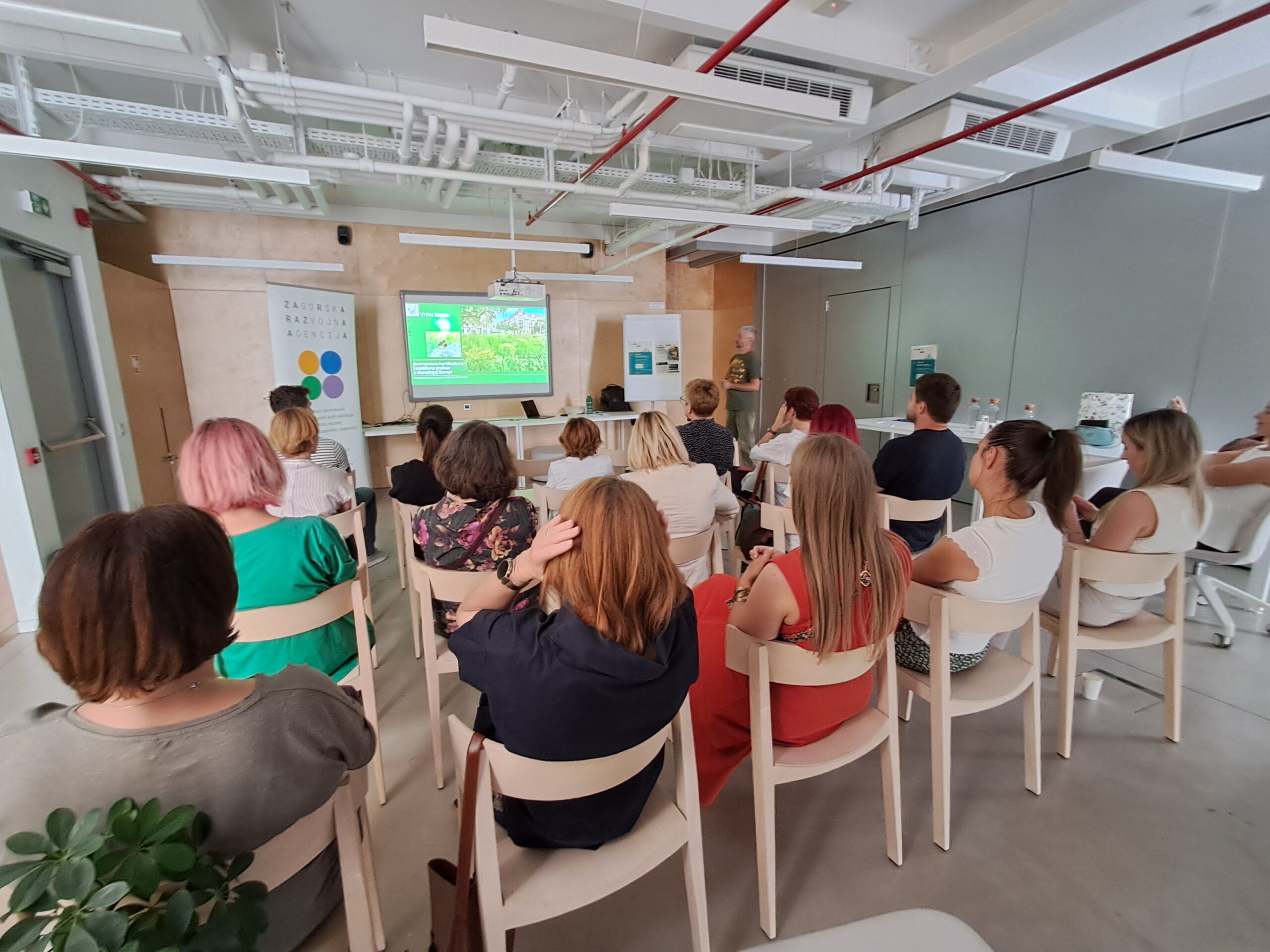
On 28 May 2026 a professional lecture entitled “Modern Horticulture and Positive Practices in Today’s Europe” was held at Regenerator Zabok. The lecture was delivered by Kruno Pekas, a horticultural designer, florist, and author of the well-known environmental blog Vrtlar Kruno.
Prior to the lecture, a field visit of public green spaces in the City of Zabok was organised. The visit was attended by Kruno Pekas, Nenad Miletić, Head of the Department for Municipal Services, Spatial Planning and Environmental Protection of the City of Zabok, Sonja Horvat, Director of the municipal company Plavinka Ltd., and Dijana Hršak, Director of the Public Institution for the Management of Protected Natural Areas of Krapina-Zagorje County, Zagorje zeleno.
During the visit, participants exchanged experiences and discussed the current management of public green areas. Numerous examples of good practice were identified, alongside opportunities for further improvement through the implementation of modern European approaches to urban greenery management, biodiversity enhancement and tree protection.
The lecture focused on current trends and successful examples from across Europe related to sustainable management of public green spaces. Particular attention was given to the protection and maintenance of urban trees according to modern standards, biodiversity conservation, pollinator-friendly planting, delayed mowing practices, proper pruning techniques, and the application of zero-waste principles in horticulture and landscape management.
Participants learned how sustainable approaches to green space management can help reduce maintenance costs, optimise the use of available resources, and create healthier, more attractive and climate-resilient environments for citizens. The examples presented demonstrated how thoughtful management of green infrastructure can contribute to environmental sustainability, climate adaptation and improved quality of life in both urban and rural communities.
The event was organised within the framework of the RUREVIVE project, implemented through the Interreg CENTRAL EUROPE Programme. One of the project’s objectives is to strengthen knowledge, skills and capacities for smart specialisation, sustainable development and innovative approaches that support the green transition and more efficient use of natural resources.
The strong interest shown by participants and the lively discussion following the lecture confirmed the growing need for knowledge exchange and the dissemination of positive practices among municipalities, public institutions, utility companies and other stakeholders involved in the management of public spaces.
The event provided valuable insights and practical recommendations that can support the development of greener, more sustainable and biodiversity-friendly communities across the region.