
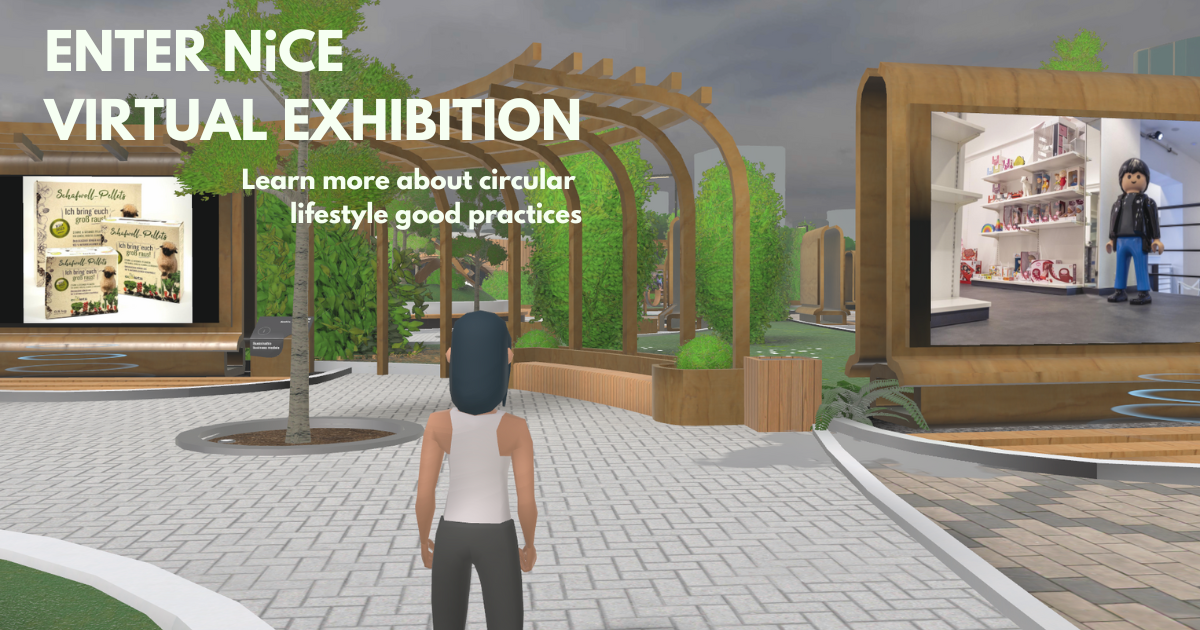
NiCE project partners have published a research article in Social Sciences & Humanities Open. In the article we have identified how cities can bridge the “provisioning gap” and move beyond the throw-away society, by analysing the NiCE (From Niche to Centre) project’s Virtual Exhibition.
The “take-make-dispose” cycle is a hard habit to break. Despite global sustainability frameworks, resource consumption in the EU continues to rise. In our urban centres, this creates a specific challenge: while we talk about “circularity” at a policy level, the infrastructure for a circular life (for e.g. repair cafés, sharing hubs, renting businesses and reuse networks) is often missing or culturally disconnected from everyday needs.
This is the core challenge addressed in our latest research. In addition, our study focuses specifically on Central Europe, a region where the transition to circularity is uniquely shaped by socio-historical legacies. Here, the drive for individual ownership (often a hard-won symbol of status) sometimes collides with the collaborative nature of the circular economy.
To understand how to overcome these hurdles, we analysed 30 Good Practices (GPs) across eight regions. These aren’t just theoretical models; they are real-world solutions provided by a mix of businesses, NGOs, and municipal organizations that are making “Circular Citizenship” a reality.
What makes a circular Good Practice successful?
Through systematic analysis, our research identified four recurring patterns that define highly effective circular initiatives:
- Prioritizing “short-loop” strategies: The most successful urban practices focus on Refuse, Reduce, Reuse, and Repair. These “high order” strategies keep products at their highest value and fill the gap where traditional waste management ends.
- Collaborative ecosystems: No one does it alone. We found that the most resilient solutions emerge when municipal authorities provide the “enabling environment”, while NGOs and businesses drive the social innovation.
- Social impact over technical maturity: Surprisingly, the success of a project often depends less on high-tech solutions and more on local governance, community empowerment, and social needs.
- High replicability: The practices featured in the NiCE Virtual Exhibition were chosen not just for their local success, but for their potential to be adapted and scaled in other cities.
The path forward: facilitative governance
Our findings offer valuable insights for policymakers, municipalities, urban planners. To mainstream circular lifestyles, cities must move beyond simple awareness campaigns. Instead, they should:
- Map local resources: identify the “hidden” circular providers already working in the community.
- Reduce “administrative friction”: simplify the path for small-scale repair and reuse initiatives to access funding and space.
- Focus on citizen engagement: treat residents as “co-producers” of the circular economy, not just passive consumers.
The full research paper, “Engaging consumers in circular lifestyles: Analysing innovation patterns through a virtual exhibition designed to counter the throw-away society” is now available via Open Access.
👉 Explore the NiCE Virtual Exhibition here
This research was supported by the Interreg Central Europe NiCE Project.