
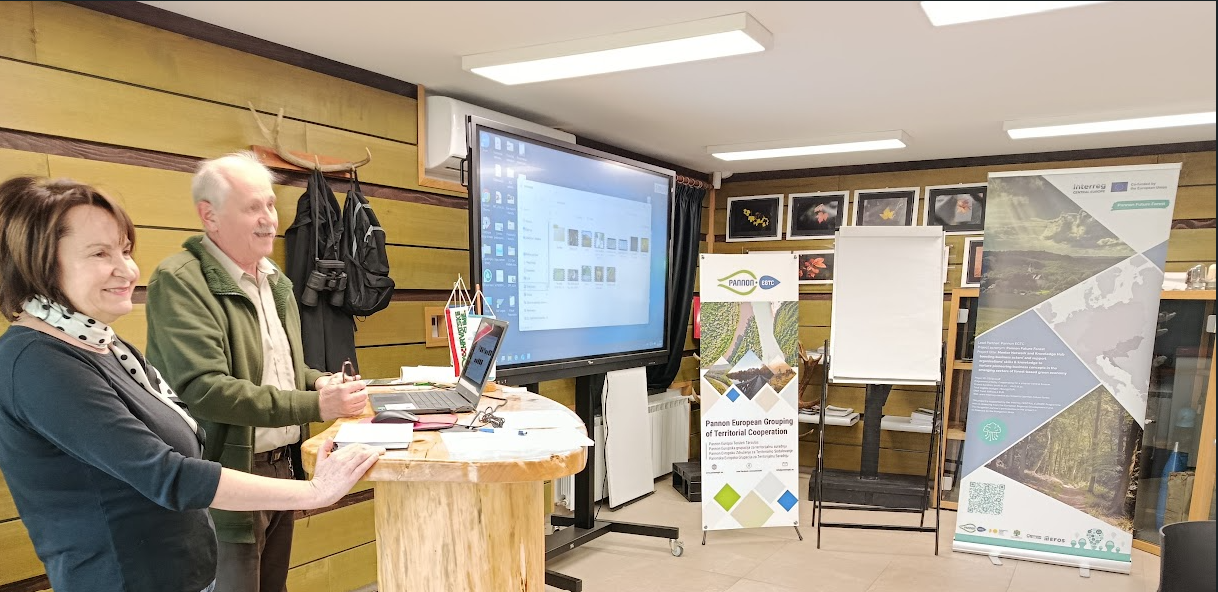
The aim of the Pannon Future Forest project is to introduce new approaches and practical forms of cooperation for making better use of green economy opportunities linked to forests in the Hungarian–Croatian–Slovenian border region. The project does not only address traditional questions of forest management, but also explores how forests and natural resources can become a basis for innovation, business development, knowledge transfer, regenerative tourism and nature-based business models.
The central topic of the meeting was the Benchmark Study entitled “Forest as a reinterpreted product”, which serves as a professional starting point for the project. The study collects good practices, international examples and emerging business directions that can provide a basis for future local activities. The partners reviewed the main findings of the study and jointly discussed how this knowledge could be transferred to business support organisations, forestry and nature conservation stakeholders, universities, civil society organisations and local businesses in the region.
The professional work was structured around nine thematic areas. These include sustainable forest management, innovation and digitalisation; wood-based design; agroforestry; the voluntary carbon and biodiversity markets; nature-based solutions supporting landscape regeneration; business development based on entrepreneurial skills and novel ecological ideas; environmental education and nature-based wellbeing; the potential of non-wood forest products in food industry innovation; and regenerative tourism. The topics were presented by the project partners based on their own professional experience, laying the groundwork for the capacity-building programmes to be launched in the coming months.
The partners agreed that the results of the Benchmark Study should not be treated as a stand-alone document, but as a practical knowledge base for activating local stakeholders. To this end, capacity-building workshops will be organised in Hungary, Croatia and Slovenia. Their aim is to involve business development organisations, chambers, development agencies, forestry and nature conservation actors, universities, civil society organisations and frontrunner businesses as “catalysers” in the project. The objective is for these actors not only to become familiar with new green economy opportunities, but also to actively support their practical use in the region.
The preparation of the Transnational Valorisation Strategy also started during the meeting. This joint strategy will define how concrete and feasible initiatives can be launched in the project regions in the fields of forest-based bioeconomy, nature-based solutions and new business opportunities. For the strategy, partners will collect local data, stakeholder maps and action proposals, which will be further refined during the upcoming workshops and online consultations.
On the second day, the practical implementation of the project came into focus. Partners discussed project management, internal financial monitoring, communication tasks, as well as the development of the joint knowledge platform and mentor network. According to the plans, the project platform will function as an easily accessible English-language online knowledge hub, where the results of the Benchmark Study, further professional materials, events, mentor profiles and later also developed business ideas will be presented.
An important decision was also made regarding the preparation of the autumn hackathon, which will be jointly organised by Croatian Forests and the Faculty of Economics and Business of the Josip Juraj Strossmayer University of Osijek in the second half of October 2026. The aim of the hackathon is to transform challenges related to the project’s themes into concrete and further developable business ideas. The programme is expected to involve students, entrepreneurs, experts and local stakeholders, and will be one of the key innovation events of the project.
The partner meeting was complemented by a professional study visit to Kopački Rit Nature Park, which provided a good example of how nature conservation, ecotourism, the local economy and regional identity building can be connected. The visit fitted particularly well with the project’s ambition to interpret forests and natural areas not only as ecological assets, but also as resources for sustainable economic and community development.
In the coming months, the Pannon Future Forest project will continue with local workshops, roadshow-type events, the involvement of mentors, the development of the knowledge platform and the preparation of business ideas. The aim is to create a transnational knowledge network and practical cooperation framework that can support the long-term development of the forest-based green economy in the Hungarian–Croatian–Slovenian region.