
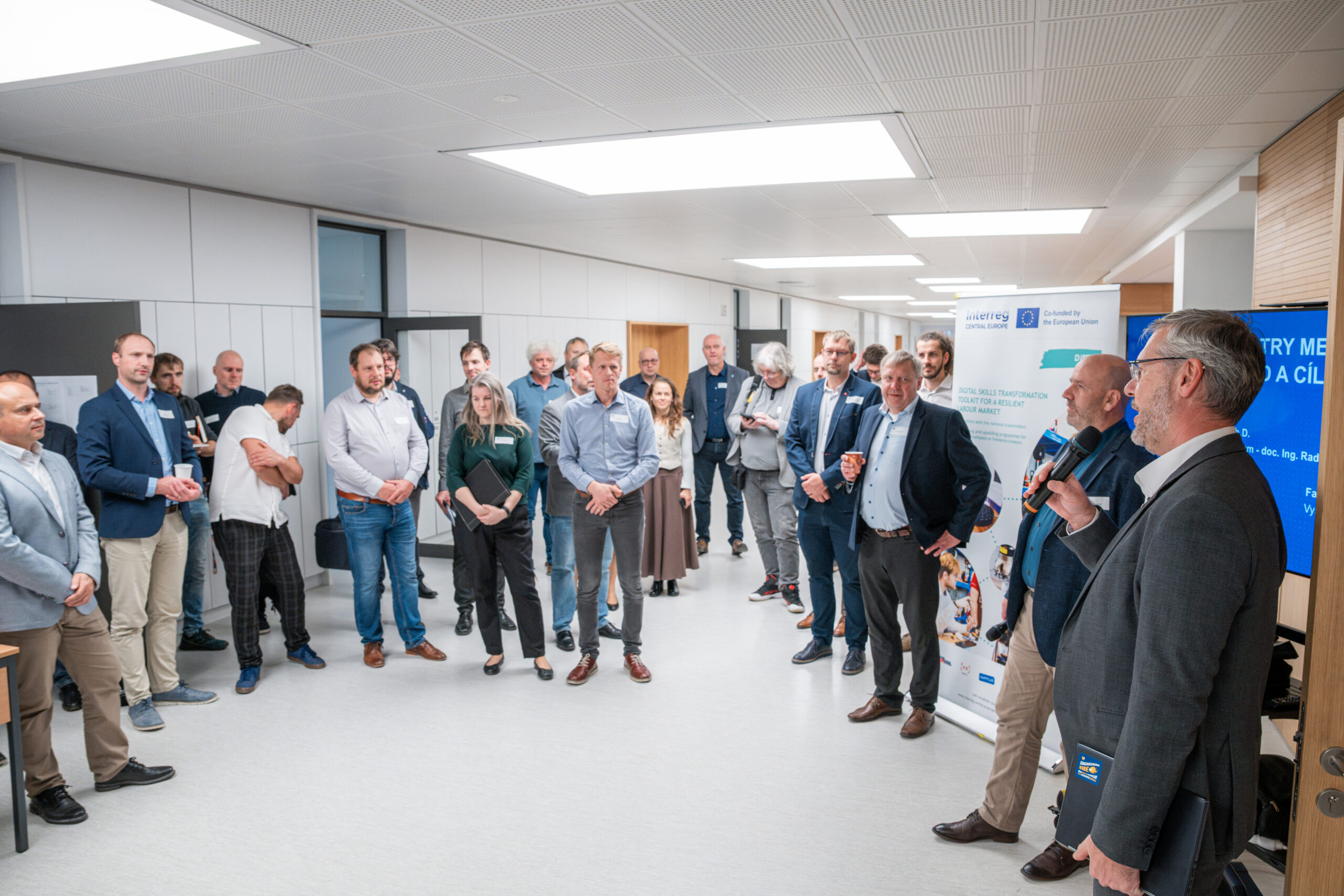
The international DiSTT project, implemented under the Interreg CENTRAL EUROPE programme, focused on developing technical and digital skills through innovative educational approaches based on hands-on experience, creative problem-solving and the use of digital fabrication technologies. Project partners from the Czech Republic, Austria, Germany, Italy and Croatia jointly developed and pilot-tested educational programmes designed for use in university and community FabLabs.
The final event at FSI provided an opportunity to present the project results directly to representatives of industry, academia and students, and to discuss how they could be applied in educating future engineers.
strojLAB: A Space Where Theory Meets Practice
The university makerspace strojLAB at the Faculty of Mechanical Engineering, BUT, brings together activities focused on hands-on engineering education, experimentation and creativity. University makerspaces provide an important environment for implementing the educational approaches developed within the DiSTT project.
“Today’s engineers need more than theoretical knowledge. They must be able to put their ideas into practice, experiment, seek solutions and learn from their own mistakes. This is precisely the kind of environment that strojLAB offers students. Here, they can work with modern technologies, develop both technical and creative skills, and gain experience that is difficult to provide through conventional teaching. Our goal is for FSI graduates not only to understand technologies, but also to be able to apply them meaningfully in practice,” said David Škaroupka, Head of the DiSTT project from the Brno University of Technology.
From Pilot Workshops to an Open Educational Platform
The DiSTT project introduced new educational formats focusing on areas such as 3D printing, digital design, prototyping, robotics and other digital fabrication technologies. In addition to technical knowledge, these formats emphasise teamwork, problem-solving, creativity and the application of design thinking principles.
The educational programmes were developed through cooperation between universities, FabLabs and other partners, and pilot-tested with various target groups, ranging from secondary school and university students to independent makers and others interested in technical education.
One of the project’s main outputs is the SkillNest.app platform, which provides access to tested educational formats and related materials. These also include methodological resources for instructors, enabling other universities, schools, community FabLabs and companies to adopt and deliver the workshops.
The final event was therefore not only an opportunity to present the project’s achievements, but also to explore specific ways of putting them into further use. Discussions focused, for example, on involving industry experts in teaching, integrating company-defined assignments into student workshops, and organising hackathons in which students tackle real-world technical challenges.
DiSTT Results Will Continue to Be Used Beyond the Project
The DiSTT final event demonstrated the potential of hands-on, maker-based education to connect academia, industry and community learning centres. Thanks to openly accessible educational materials and the SkillNest.app platform, other organisations can use the project’s results and further develop them according to their own needs.
BUT intends to build on the experience gained during the project through the activities of its university makerspace, strojLAB, and continued cooperation with industry partners. The experience gained through the international DiSTT project can thus contribute to innovation in engineering education even after the project has ended.
Interested in collaborating with us? Please feel free to contact David Škaroupka.