
From Digital Skills Gaps to Practical Learning Opportunities
How can we better prepare students, employees and professionals for the rapidly changing world of work? And how can FabLabs and makerspaces help bridge the gap between traditional education and the practical skills required by modern industry?
These questions brought together six partners from Czechia, Austria, Germany, Italy and Croatia in May 2024, when the DiSTT (Digital Skills Transformation Toolkit for a Resilient Labour Market) project was launched under the Interreg CENTRAL EUROPE programme.
The project set out to explore the potential of FabLabs as flexible learning environments where people can develop digital and technical skills through experimentation, creativity and hands-on experience.
Over 30 months, the partners identified skills gaps, collaborated with educational institutions and industry stakeholders, and transformed their findings into practical training programmes for different target groups.
Six Partners, Six Educational Solutions
One of the most valuable outcomes of DiSTT is a portfolio of six tested and refined educational programme solutions. Each partner contributed its own expertise, target groups and learning approaches.
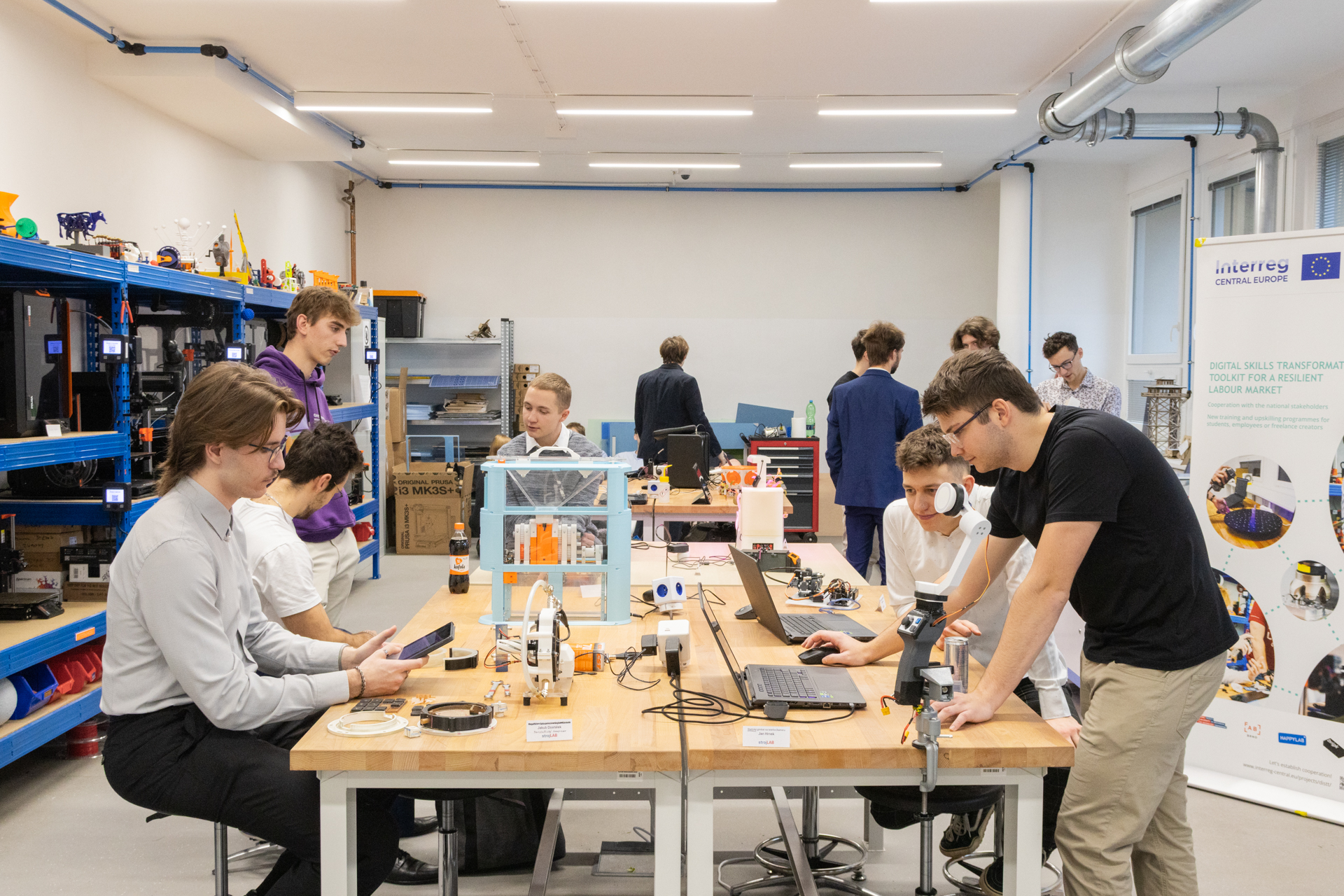
Brno University of Technology / strojLAB (Czechia) developed the Maker Engineering and Digital Manufacturing Engineering programmes. Their activities combined university education, engineering practice and digital fabrication, offering everything from introductory workshops to project-based courses and specialised professional training.
FabLab Brno / JINTEK (Czechia) focused on secondary-school students through the High School Competition and TechSprint programmes. Students worked in teams on practical challenges, combining 3D printing, laser cutting, electronics and prototyping to develop and present their own solutions.
Happylab Vienna (Austria) created Digital Tools in Vocational Training, an intensive three-day programme introducing apprentices to CAD modelling, 3D printing, laser cutting, robotics and programming. Participants applied these technologies to create and test a shared robotic prototype.
brigk (Germany) developed the Digital Transformation Skills Programme, combining introductory technology workshops with longer mentoring and innovation activities. The programme addressed topics including digital fabrication, generative AI, programming and prototype development for students, apprentices and businesses.
NOI Techpark / Maker Space (Italy) developed the LEARN IT! and MAKE IT! formats for employees, artisans, entrepreneurs and other adult learners. Structured technical courses and practical maker workshops helped participants acquire skills in CAD, CNC machining, electronics and digital manufacturing.
FabLab Zagreb (Croatia) created the Idea to Prototype programme, bringing practical digital fabrication and innovation education to secondary-school students. Its modular approach guided learners through creative problem-solving, design, prototyping, electronics and materials exploration.
Together, these six solutions demonstrate that digital skills training can take many forms, from a short introductory workshop to a multi-day challenge or an advanced engineering course.
What Did We Learn?
Across the partnership, pilot activities generated approximately 1,000 recorded participant places and modular participations, with more than 1,500 hours of reported training delivery.
The joint evaluation identified positive developments in participants’ technical skills and confidence across all six partner programmes.
One finding was particularly consistent: people learn digital technologies most effectively when they can put new knowledge into practice immediately.
Rather than focusing only on software or machines, successful programmes encouraged participants to design, build, experiment, solve problems and produce tangible results.
Practical challenges also helped learners develop complementary skills such as teamwork, communication, creativity and independent problem-solving.
These experiences provided valuable insights into how educational programmes can be adapted to different learners, institutions and regional needs.
SkillNest.app: The Project’s Legacy in One Place
The main practical outcome of DiSTT is the Digital Skills Transformation Toolkit, a collection of tested and adaptable educational solutions designed for FabLabs, makerspaces, schools, universities, vocational training providers and other organisations.
The Toolkit brings together:
- Six educational programme solutions developed and tested by the DiSTT partnership.
- Teaching and learning resources, including workshop materials and guidance for educators.
- Assessment tools supporting the evaluation of participants’ skills and learning progress.
- An Implementation Guide explaining how organisations can select, adapt, deliver and evaluate the programmes.
- The SkillNest.app platform, connecting educational resources with laboratories and technical experts.
The Toolkit is not intended as a fixed educational model. Its programmes can be adapted to different learning environments, target groups, technologies and available resources while preserving their essential learning objectives.
This approach allows organisations to build on proven experience rather than starting from scratch.
How Can You Benefit from DiSTT After the Project Ends?
Are you an educator or teacher?
Explore the workshop catalogue and discover ready-to-use teaching resources. Adapt practical activities to your students’ needs and introduce digital fabrication into your lessons.
Do you represent a FabLab, makerspace or training organisation?
Use the Digital Skills Transformation Toolkit to expand your educational offer. The Implementation Guide will help you select a programme, prepare the necessary equipment and expertise, and organise your own workshops.
Are you a student, maker or lifelong learner?
Discover educational activities, explore new technologies and find laboratories or experts who can support your learning journey.
Are you a company or industry representative?
Explore how hands-on training can support employee development, address digital skills gaps or connect your organisation with educational institutions and technical experts.
The programmes are available through SkillNest.app. Some teaching resources require registration or educator access.
The Project Has Ended. The Learning Continues.
DiSTT officially concluded in October 2026, but the collaboration, knowledge and educational resources developed during the project are intended to create value well beyond its formal lifetime.
The six project partners can continue using the programmes in their educational activities, while other organisations across Europe are invited to explore, adopt and adapt the Toolkit.
We would like to thank all our project partners, educators, technical experts, companies and institutions who contributed to the development and testing of the programmes. Special thanks go to the students, apprentices, employees and makers who took part in the pilot activities and helped shape the final results through their experiences and feedback.
Now it is your turn to build on what we have created together.
Explore the workshops, discover teaching materials and connect with experts at www.skillnest.app.
For questions about the project results, programme adoption or future cooperation, contact David Škaroupka, the project’s lead representative at Brno University of Technology: david.skaroupka@vut.cz.
The DiSTT project has ended, but the opportunity to learn, create and innovate together continues.
The DiSTT project (CE0200661) was implemented from May 2024 to October 2026 under the Interreg CENTRAL EUROPE programme and co-funded by the European Union.