
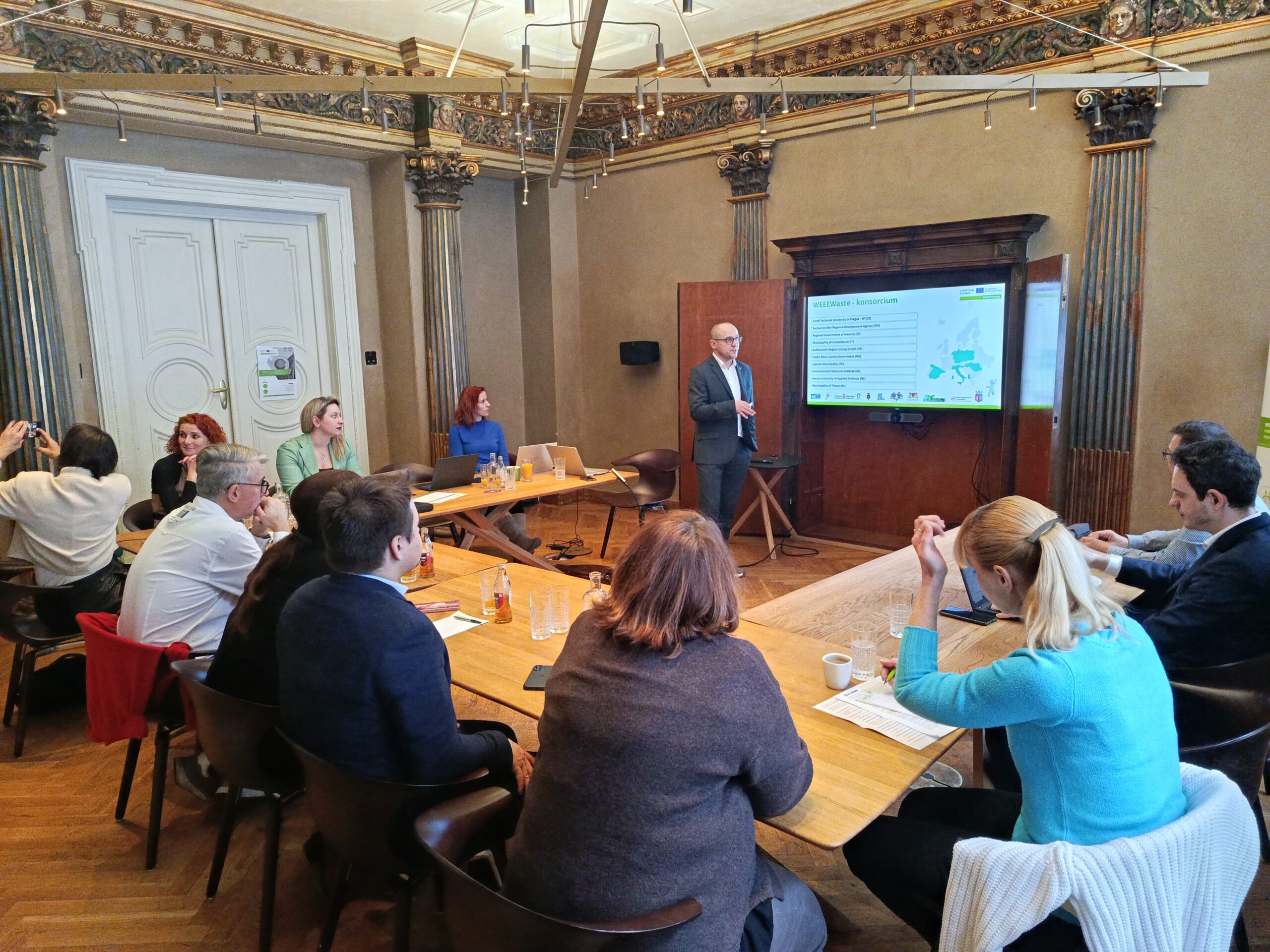
On 19 February 2026, CTU organised a Local Stakeholder Meeting in Prague at Červený Jelen, focused on the international projects WEEEWaste (Interreg Europe) and Circular WEEEP (Interreg Central Europe). Representatives of public authorities and the private sector attended, including ELEKTROWIN a.s., the Ministry of the Environment of the Czech Republic, State Environmental Fund of the Czech Republic, Ecobat CZ, Cyrkl, and WEEELABEX Organisation.
The meeting aimed to share proven European practices, present key project results, and discuss how to further strengthen circularity in e-waste management, from prevention and repair to high-quality recycling and the use of secondary raw materials. Project results were presented by Michal Tobiáš from CTU. The discussion confirmed that the greatest added value lies in linking data, regulation, and practical experience across the entire value chain, especially where systems face “grey zones” and hard-to-trace flows.
Circular WEEEP: piloting solutions and strengthening data & governance in WEEEP-CE
The Circular WEEEP project focuses on testing practical solutions and strengthening cooperation within WEEEP-CE (Waste Electrical and Electronic Equipment in Central Europe). At the meeting, key outputs included a strategy for transnational governance of WEEEP-CE and its integration into action plans, as well as a guidance package on open data and product information to improve the usability of data for repair, reuse, and recycling of electronic products. The project also presented a summary of final solutions and policy recommendations, together with an information platform on WEEE for the Czech Republic. In addition, project partners signed a Memorandum of Understanding, committing to continued cooperation beyond the project through regular exchanges and online meetings.
A core component of Circular WEEEP is the implementation of five pilot actions that test concrete approaches in practice. WEEE Design supports eco-design, repairability, and second-life products, including the use of open product data. WEEE Collect & Market focuses on the development of the online platform cweeepplatform.com, which gathers and shares pilot outputs in local languages. WEEE Social connects the WEEE sector with social economy actors, addressing employment and social inclusion, including the role of sheltered workshops. WEEE Lives promotes repair, reuse, and circular economy principles through activities involving schools and municipalities. Finally, WEEE Aware delivers awareness-raising and collection activities in schools with measurable results.
The Czech Republic in the European context: a mature system and strong practice
One of the key conclusions of the meeting was a shared understanding that the Czech Republic ranks among the more advanced EU countries in e-waste management – thanks to a robust system, an experienced network of stakeholders, and long-term cross-sector cooperation.
According to the presented data, in 2023 the EU collected 11.6 kg of WEEE per capita, compared to 16.8 kg per capita in the Czech Republic. The discussion highlighted the importance of comparing not only collection rates, but also the quality of treatment and the real environmental impact.
A key direction for the coming years is also better alignment of WEEE topics with new requirements for measurable environmental impact (e.g. ESG/CSRD) and future tools such as the Digital Product Passport – ensuring that data supports longer product lifetimes, repairability, and transparent material flows.
Next steps and continued cooperation
Stakeholders expressed strong interest in continuing cooperation, especially in strengthening control of free riders and cross-border sales, addressing missing WEEE streams, developing reuse and repair ecosystems with clear standards, improving data reporting across the value chain, and preparing for new waste streams such as batteries and renewable-energy-related equipment.
The meeting confirmed that combining research, policy, and practice helps move the circular economy from ambition to implementation.