
At the core of the activity was the assessment of three pilot energy communities located in Poland, Hungary and Germany. These assessments were carried out using a combination of a data-driven tool (REC Manager), a structured engagement methodology, and a comprehensive Risk Management Plan. The overarching objective was to evaluate current performance, identify development opportunities, and establish pathways for long-term sustainability.
The activity was led by DDRIÜ / STRIA, which coordinated the professional content of the mentoring sessions, oversaw the assessment process, and monitored the implementation of the Risk Management Plan. Forschung Burgenland provided key professional support throughout the process. Importantly, all project partners actively participated in the mentoring sessions, ensuring a collaborative learning environment where experiences from the different pilot regions could be shared and leveraged. Associated Strategic Partners (ASPs) also contributed valuable local expertise and insights, further enriching the exchange of knowledge and best practices.
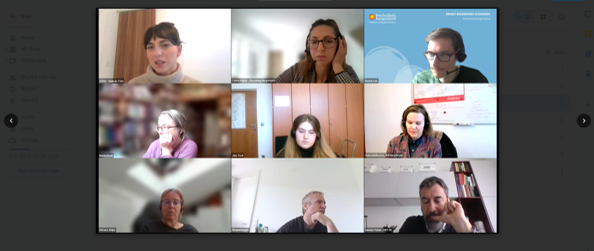
The cross-border mentoring process consisted of eight interconnected sessions held between October 2025 and April 2026. The first session, organised on 20 October 2025, focused on the practical application of the REC Manager tool. Partners developed a shared understanding of how to use the tool across different pilot contexts, addressing methodological and data-related challenges. The session led to the creation of a dedicated FAQ document, supporting consistent and effective tool usage.
Subsequent sessions broadened the scope of learning. On 7 November 2025, participants explored successful Austrian energy community models, including developments in Burgenland, the Raiffeisen Energy Cooperatives, and solidarity-based initiatives aimed at combating energy poverty. These real-world examples provided valuable insights into sustainable business models and member engagement strategies.
Further sessions highlighted advanced digital tools and innovative concepts. Presentations on the PowerQuartier Web Portal and OPTIVICE.energy demonstrated how energy flows can be visualised, analysed and optimised using smart meter data and forecasting solutions. A dedicated session in Eisenstadt on 11 December 2025 allowed partners to directly compare the REC Manager with the Optivise Energy tool, enhancing their understanding of optimisation and forecasting capabilities.
The mentoring programme also addressed community-building aspects and international experiences. A January 2026 session showcased the development of Verona’s first community-driven REC, emphasizing the importance of trust-building and bottom-up processes. Additional sessions explored lessons learned from Hungarian projects, interconnections between energy efficiency and district heating systems, and hybrid energy solutions integrating renewable sources.
The final session, held in Milan on 14 April 2026, introduced a human-centred engagement methodology, underlining that the success of energy communities depends not only on technical and financial factors but also on social dynamics, community involvement and trust.
Throughout the entire process, the Risk Management Plan played a crucial role as a dynamic quality assurance tool. Rather than serving as a static administrative document, it enabled continuous identification and mitigation of risks such as low participation levels, financial uncertainties, technical challenges, regulatory barriers and limited data availability. Partners addressed these risks through adaptive strategies, including enhanced stakeholder engagement, exploration of alternative technical solutions and ongoing monitoring.
As a result of Activity A2.1a, the HERCULES-CE partnership established a strong, shared knowledge base for assessing energy community performance. The mentoring process significantly contributed to improving partners’ capacities in evaluating energy efficiency and business models, while also laying the groundwork for comprehensive local assessment reports.
Overall, the activity demonstrated the value of cross-border collaboration and structured mentoring in accelerating the development of resilient, efficient and community-driven renewable energy systems across Europe.