
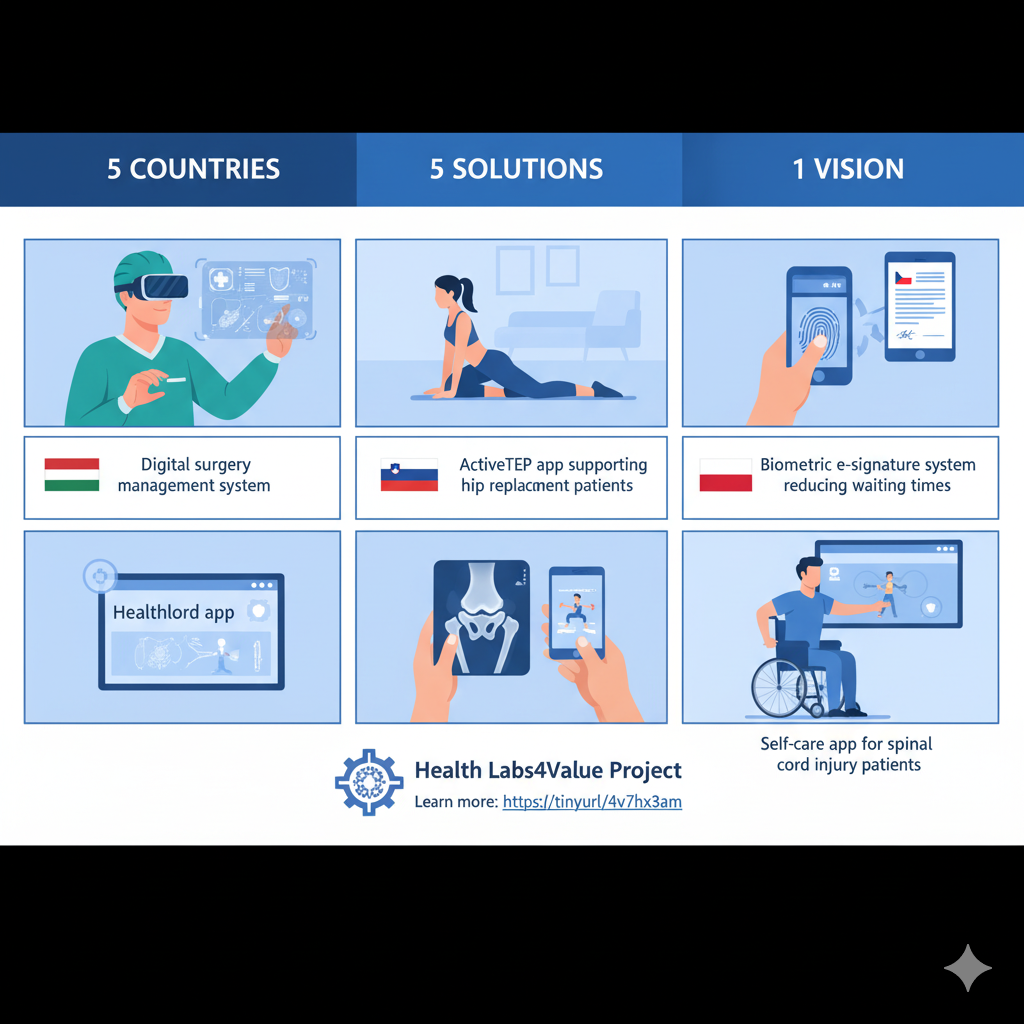
Five territorial Living Labs across Central Europe engaged patients, clinicians, managers, policymakers and industry partners in real‑life experimentation. When viewed together, their journeys reveal a set of cross‑cutting lessons about how healthcare systems can change — sustainably, collaboratively and with people at the centre.
1. Co‑creation takes time — but saves time later
Across all territories, partners emphasised that co‑creation is not a consultation exercise but a continuous process: identifying needs, mapping care journeys, developing prototypes, testing, adjusting and testing again. While this approach requires patience in the early phases, it consistently reduced rework, resistance and implementation delays later on. Solutions born from co‑creation proved more relevant, more acceptable to professionals and more intuitive for patients.
2. Patients redefine priorities
When patients and families participate from the beginning, the definition of “value” shifts. Instead of optimising processes around institutional constraints, teams refocused on outcomes that matter in daily life: safety, confidence, autonomy, clarity, continuity. Patients drew attention to gaps that often remain invisible in traditional quality indicators — such as the transition from hospital to home, the emotional burden of uncertainty, or simple barriers that prevent people from following clinical advice.
3. PROMs and PREMs are learning tools — not bureaucracy
A widespread fear among healthcare professionals is that Value‑Based Healthcare means additional reporting obligations. Health Labs4Value demonstrated the opposite. When PROMs (Patient‑Reported Outcome Measures) and PREMs (Patient‑Reported Experience Measures) were embedded naturally into conversations, patient follow‑up or care planning, they served as a source of learning rather than control. Their value depended not on volume of data, but on whether information returned quickly to those who can act upon it within the care journey.
4. Value for professionals matters as much as value for patients
Workforce pressure was a recurring theme in every Living Lab. Shortages, administrative overload and time constraints are not abstract challenges — they shape the reality of European healthcare every day. Several co‑created solutions showed that VBHC‑aligned redesign can directly improve working conditions: reducing unnecessary administrative tasks, clarifying workflows and enabling professionals to focus on clinical work. When care becomes more coordinated and predictable, job satisfaction rises alongside patient outcomes.
5. Technology amplifies system logic — it does not replace it
Digital tools featured in many Living Lab processes, but none succeeded because they were digital. They succeeded when technology aligned with real‑life routines, literacy levels, workload realities and territorial conditions. Simple, accessible and well‑timed digital support often delivered more value than complex platforms. By contrast, poorly aligned technology risked reinforcing existing inefficiencies. The project underscored that design, facilitation and workflow clarity are just as important as the technology itself.
6. Learning cultures outperform perfect plans
Perhaps the strongest message from Health Labs4Value is that healthcare transformation is not a linear project. It requires iterative adaptation, trust among stakeholders and structures that allow for safe experimentation. Territorial Living Labs provided exactly this environment: close enough to real care delivery to stay grounded, yet connected enough to influence organisational and policy decisions. The most successful advances emerged when teams were encouraged to learn, challenge assumptions and adjust their approach based on evidence rather than sticking to a fixed plan.