
In the face of the climate crisis and the urgent need for all sectors to transition towards circular economy models, public transport is also required to accelerate its transformation. Within this context, the Circularity Compass provides an outstanding benchmarking and self-assessment tool to help organisations precisely understand where they stand at the beginning of their circular transition journey. Developed by trolley:motion together with all project partners within the Interreg CE4CE project, the Circularity Compass – or Public Transport Circular Economy Self-Assessment Tool – is a simplified, user-friendly survey designed for public transport stakeholders, in particular public and private transport authorities (PTAs) and operators (PTOs). It enables them to assess the status quo, reflect on challenges and opportunities, and identify realistic actions to support the transition towards more circular public transport systems. The tool is based on the Avoid–Extend–Transform framework, encouraging a fundamental rethinking and redesign of public transport systems. Its aim is to reduce unnecessary resource consumption and minimise environmental impacts across the entire public transport value chain, with a long-term ambition of moving towards net-zero emissions. In a fully circular system, products and assets are procured and used in a way that prioritises durability, repairability, and reusability by design, ensuring that they remain in use for as long as possible and reducing the need for new raw material extraction. When assets eventually reach the end of their usable life, transformation processes such as recycling are applied to recover materials and reintroduce them into the value chain, further closing material loops. The Circularity Compass is structured around seven key areas of public transport systems, including vehicles, batteries, infrastructure, energy, as well as organisational, policy, and personnel-related aspects. These dimensions are addressed through targeted self-assessment surveys, which guide users in identifying their current position on the circularity map and raising awareness of both challenges and opportunities. The survey prompts organisations to reflect on concrete operational questions such as estimating raw material use in vehicle manufacturing, assessing measures taken to extend fleet lifetime, or identifying end-of-life treatment practices for infrastructure components. Based on the answers provided, organisations receive insights that help them rethink procurement, operation, and maintenance practices and identify pathways towards more sustainable and circular operations. The Circularity Compass also supports strategic reflection by offering a structured overview of how circular economy principles can be integrated into day-to-day decision-making. It helps organisations identify gaps, explore improvement areas, and develop more resource-efficient and sustainable transport strategies. The tool was tested and validated through multiple live and online workshops with public transport life-cycle actors, ensuring its practical relevance and usability across different organisational and geographical contexts. Overall, the Circularity Compass serves as a practical and accessible entry point for public transport organisations to assess their circularity performance, increase awareness, and support the transition towards more sustainable, resource-efficient, and climate-neutral public transport systems. The Circularity Compass is available here: https://circularity4publictransport.eu/circularity-compass/
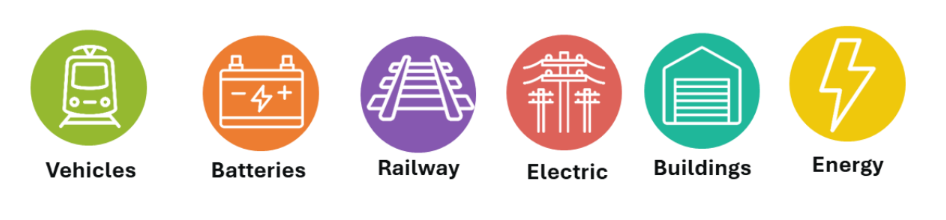
Circularity Compass topics by Rupprecht Consult Gmbh, copyright: trolley:motion, Interreg CE4CE project